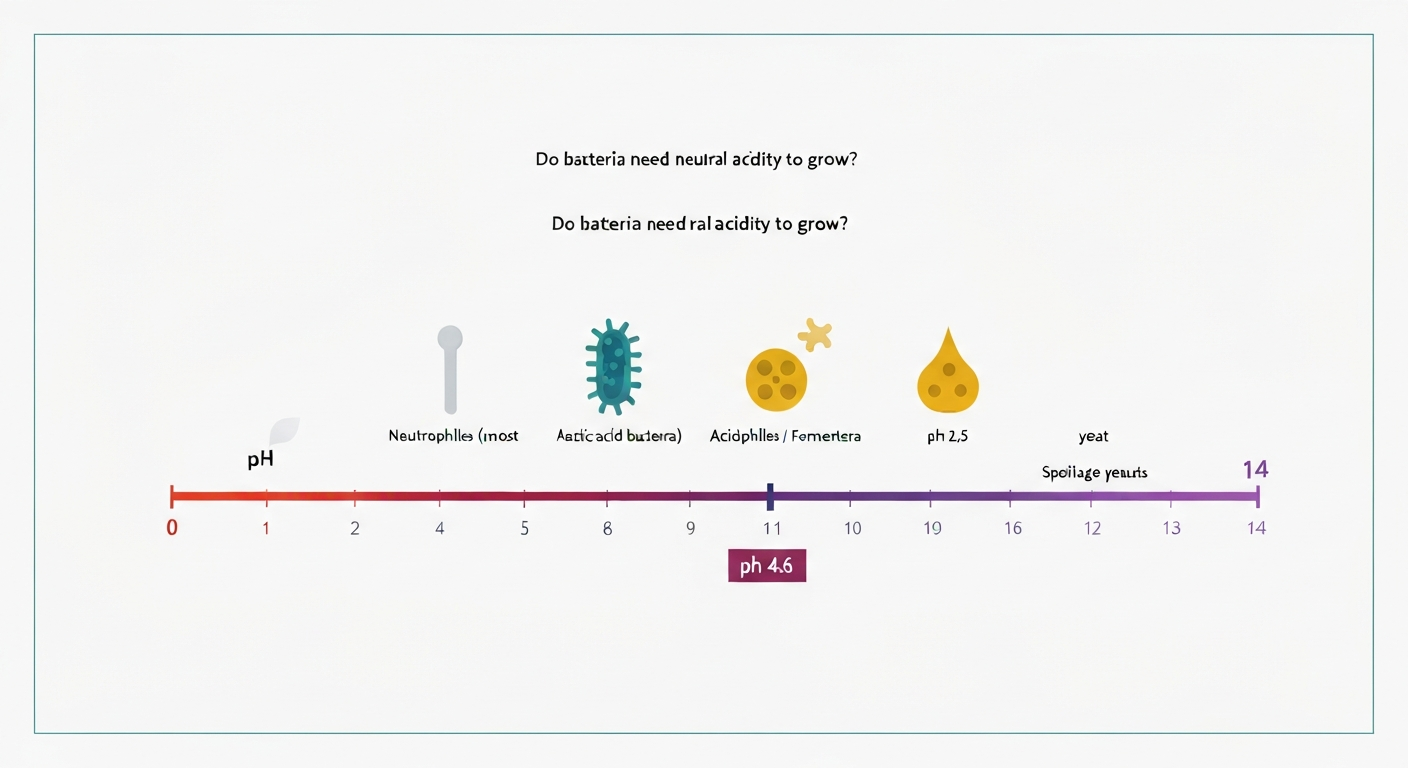
Most bacteria do not strictly need neutral pH to grow, but the majority of foodborne pathogens and spoilage bacteria do grow best close to neutral, roughly between pH 6 and 8. A few are capable of growing in surprisingly acidic conditions, but as a general rule, dropping pH below about 4.6 stops the most dangerous pathogens in their tracks, which is why that number appears so often in food safety regulations.
Does bacteria need neutral acidity to grow? pH and food safety

Marcus Reeves
8 Aug 2026
Short answer: do bacteria need neutral acidity to grow?
No, not all of them, but most do prefer it. For a concise overview, see does bacteria grow well in acidic environments. Bacteria that thrive near neutral pH (around 6 to 8) are called neutrophiles, and almost every major foodborne pathogen falls into that category. However, some organisms can grow significantly below pH 5, and a few spoilage yeasts push that boundary even further down to pH 2. See also does yeast grow in acidic or alkaline environments for details on yeast growth at low pH. 5. What the research consistently shows is that pH works as a dial, not a switch: the further you move from an organism's optimum, the slower it grows, until it cannot grow at all. Below the minimum growth pH it may still survive, just without multiplying.
Key terms: pH, acidophile, neutrophile, alkaliphile, and more
Understanding the vocabulary makes the rest of the science much easier to apply. These definitions are used consistently across microbiology literature and regulatory documents. For specifics on at which pH value an acidophile will grow best, consult the section on acidophiles and their optimal growth pH at which ph value will an acidophile grow best.
| Term | Definition | pH Range (approx.) |
|---|---|---|
| pH | A logarithmic scale measuring hydrogen ion concentration; lower numbers are more acidic, higher numbers more alkaline. pH 7 is neutral. | 0–14 |
| Acidophile | An organism whose optimum growth pH is acidic, typically below 5. Hyperacidophiles have optima below 3. | Optimum <5 |
| Neutrophile | An organism that grows best near neutral pH. Most human pathogens are neutrophiles. | Optimum ~5–9, peak ~6–8 |
| Alkaliphile | An organism that grows best in alkaline conditions, above pH 8. | Optimum >8 |
| Minimum growth pH | The lowest pH at which an organism can still multiply, below which it can survive but not grow. | Organism-specific |
| Acid tolerance response (ATR) | An inducible stress response triggered by mild acidity that allows some bacteria to survive and sometimes grow at lower pH than they otherwise could. | Triggered ~pH 5–6 |
| Equilibrium pH | The uniform pH throughout a food product after all acids and buffers have fully equilibrated, the value regulators measure for safety decisions. | Measured at product level |
How pH actually controls whether bacteria grow
Bacteria maintain a near-neutral internal pH regardless of their environment. This process, called pH homeostasis, requires energy. When the external pH drops far enough, the concentration gradient across the cell membrane becomes too steep to maintain, protons flood in, enzyme systems stop working, and growth halts. Different organisms differ in how efficiently they pump protons out and how well they buffer their internal environment, which explains why the growth limit varies so much from species to species.
The type of acid matters as much as the pH number itself. Organic acids like acetic acid (vinegar) and lactic acid are lipophilic, meaning they can cross the cell membrane in their undissociated form and disrupt the internal pH directly. This makes them more inhibitory than the pH reading alone would suggest. A food at pH 4.0 acidified with acetic acid is genuinely more hostile to bacteria than the same pH achieved with a mineral acid like hydrochloric acid. This is why vinegar-based pickles and fermented products with lactic acid are particularly effective preservation systems.
pH growth ranges for common foodborne pathogens, spoilage bacteria, and yeasts
The table below compiles minimum, optimum, and maximum growth pH values for organisms that matter most in food safety and spoilage. These values come from controlled experimental studies and authoritative food safety references. They represent the best available estimates, and actual limits can shift depending on temperature, water activity, acidulant type, and strain differences.
| Organism | Min. Growth pH | Optimum pH | Max. Growth pH | Notes |
|---|---|---|---|---|
| Clostridium botulinum | ~4.6 | 6.0–7.0 | ~8.5 | Toxin production halted at pH ≤4.6; basis of the regulatory cutoff |
| Listeria monocytogenes | ~4.4 | 6.0–8.0 | ~9.6 | Unusually wide range; a concern in mildly acidic products |
| Salmonella spp. | ~3.94–4.05 (experimental) | 6.5–7.5 | ~9.5 | Minimum varies with acidulant, temperature, and strain |
| Escherichia coli (incl. STEC) | ~4.4 | 6.0–7.0 | ~9.4 | STEC strains can be more acid tolerant due to ATR |
| Staphylococcus aureus (growth) | ~4.0 | 6.0–7.0 | ~9.0 | Enterotoxin production requires higher pH, typically >5.0–5.1 |
| Bacillus cereus | ~4.3–4.9 | 6.0–7.0 | ~8.8 | Minimum varies by strain and acidulant |
| Clostridium perfringens | ~5.0–5.8 | 6.5–7.5 | ~8.5 | More sensitive to acid than many pathogens |
| Yersinia enterocolitica | ~4.2 | 7.0–8.0 | ~9.0 | Grows at refrigeration temperatures; psychrotrophic risk |
| Lactic acid bacteria (e.g., L. plantarum) | ~3.0–3.5 | 5.5–6.5 | ~8.0 | Deliberately used in fermentation; acidophilic tendencies |
| Zygosaccharomyces bailii (spoilage yeast) | ~2.5 | 4.0–5.0 | ~7.5 | Exceptionally acid tolerant; spoils acidic sauces and beverages |
A few patterns stand out from this data. First, Clostridium perfringens is genuinely more pH-sensitive than the others, which means moderate acidification is enough to suppress it. Second, Listeria monocytogenes has one of the widest growth ranges of any pathogen, which explains why it remains a concern even in refrigerated, mildly acidic foods. Third, spoilage yeasts like Zygosaccharomyces bailii operate well below the pH 4. For more on yeast behavior and specifically whether Candida prefers acidic or alkaline conditions, see does candida grow in acidic or alkaline. 6 threshold that stops bacterial pathogens, which means a product safe from botulism can still spoil from yeast activity.
Survival versus growth: a critical distinction
Growth and survival are not the same thing. When pH drops below an organism's minimum growth threshold, cells stop dividing, but they do not necessarily die immediately. They can persist in a non-growing state for days, weeks, or even longer depending on the organism, the acid type, temperature, and food matrix. This is measured using time-kill experiments that calculate D-values, the time required at a given condition to reduce the population by 90 percent (one log unit). In acidic matrices, D-values can vary by orders of magnitude depending on those same variables.
The practical implication is that acidified food is not sterile food. A product with a final pH below 4.6 will not allow Clostridium botulinum to grow or produce toxin, but viable cells of other organisms may still be present. If that product is later diluted, mixed with a higher-pH ingredient, or improperly processed, conditions can shift enough for growth to resume. This is why regulatory frameworks require equilibrium pH to be maintained throughout a product's shelf life, not just at the moment of production.
Regulatory and practical pH thresholds for food safety
The most widely used pH threshold in food safety is 4.6. The U.S. FDA defines acidified foods as low-acid foods brought to a finished equilibrium pH of 4.6 or below, and 21 CFR Part 114 requires that this pH be achieved and maintained as a process control. 21 CFR 114.80 requires acidified foods to be manufactured so the finished equilibrium pH is 4.6 or lower and maintained; the Code of Federal Regulations uses the pH 4.6 cutoff in process controls for acidified foods Specifically, 21 CFR §114.80 requires acidified foods to be manufactured so the finished equilibrium pH is 4.6 or lower and maintained.. The specific driver for this number is Clostridium botulinum: at pH 4.6 and below, under normal food water-activity conditions, this organism cannot grow or produce its neurotoxin.
It is worth understanding what the 4.6 threshold does and does not cover. It is designed to prevent botulinum toxin production in shelf-stable acidified and low-acid canned foods. It is not a universal kill-all barrier for every pathogen. Listeria, E. coli, and Salmonella all have minimum growth pH values at or below 4.4 in some conditions, which means they can technically still grow in products just at the legal threshold under favorable circumstances. Regulatory decisions also account for the fact that most products acidified to 4.6 will have other controlling factors alongside pH.
Common exceptions and context-specific considerations
- Staphylococcus aureus can grow down to pH 4.0, but preformed enterotoxin production generally requires pH above 5.0 to 5.1, so the hazard from toxin in products below pH 5 is significantly reduced even if some cell growth is theoretically possible.
- Fermented meats and cheeses routinely drop to pH 4.6 to 5.0 through lactic acid fermentation; safety depends on the combined effect of pH, low water activity, salt, and cold storage, not pH alone.
- Mayonnaise and similar egg-based products often have pH values in the range of 3.6 to 4.1, which is inhibitory to most pathogens; however, dilution with higher-pH ingredients (as in potato salad) can raise the effective pH enough to support Salmonella growth.
- Fruit juices can have pH values below 3.5, which suppresses bacterial growth, but spore-forming acidophiles and yeasts like Z. bailii can still spoil them.
- Fresh produce with mildly acidic pH (4.5 to 6.5) sits in a zone where Listeria monocytogenes and other pathogens can grow, especially when combined with ambient or slightly chilled temperatures.
Acid-tolerant and acid-adapted organisms: the exceptions worth knowing
Several pathogens have developed specific mechanisms to survive and, in some cases, grow in acidic environments that would be lethal to less adapted strains. The best-documented of these is the acid tolerance response (ATR), an inducible mechanism found in Salmonella, E. coli O157:H7, and Listeria, among others. When these organisms are briefly exposed to mildly acidic conditions (around pH 5 to 6), they upregulate acid shock proteins and other protective mechanisms that allow them to withstand much lower pH than non-adapted cells. Prior exposure to a food with mild acidity can actually prepare a pathogen to survive the more acidic environment it encounters next.
E. coli O157:H7 in particular became notorious after outbreaks linked to apple cider with pH values below 4.0, a level once thought safe from bacterial pathogens. The pathogen's ATR and low infectious dose combine to make it a genuine concern in acidic products that were previously considered low-risk. This is one reason why juice HACCP regulations now require a 5-log reduction in the relevant pathogen regardless of pH.
Lactic acid bacteria represent a different kind of acid tolerance, one that is actively exploited in food production. Strains like Lactiplantibacillus plantarum thrive at pH values down to 3.0 to 3.5, generating lactic acid that both preserves the food and competes with other organisms. This is the ecological foundation of yogurt, sauerkraut, kimchi, and most other fermented foods. Their acid tolerance is a feature, not a risk.
How pH interacts with temperature, water activity, oxygen, and food composition
pH never works in isolation. Microbial growth is the product of multiple environmental factors acting together, and understanding how they interact is essential for accurate risk assessment. A food at pH 4.8 that is also stored at 4 degrees Celsius with a water activity of 0.93 presents a very different risk profile from the same pH at room temperature with a water activity of 0.99.
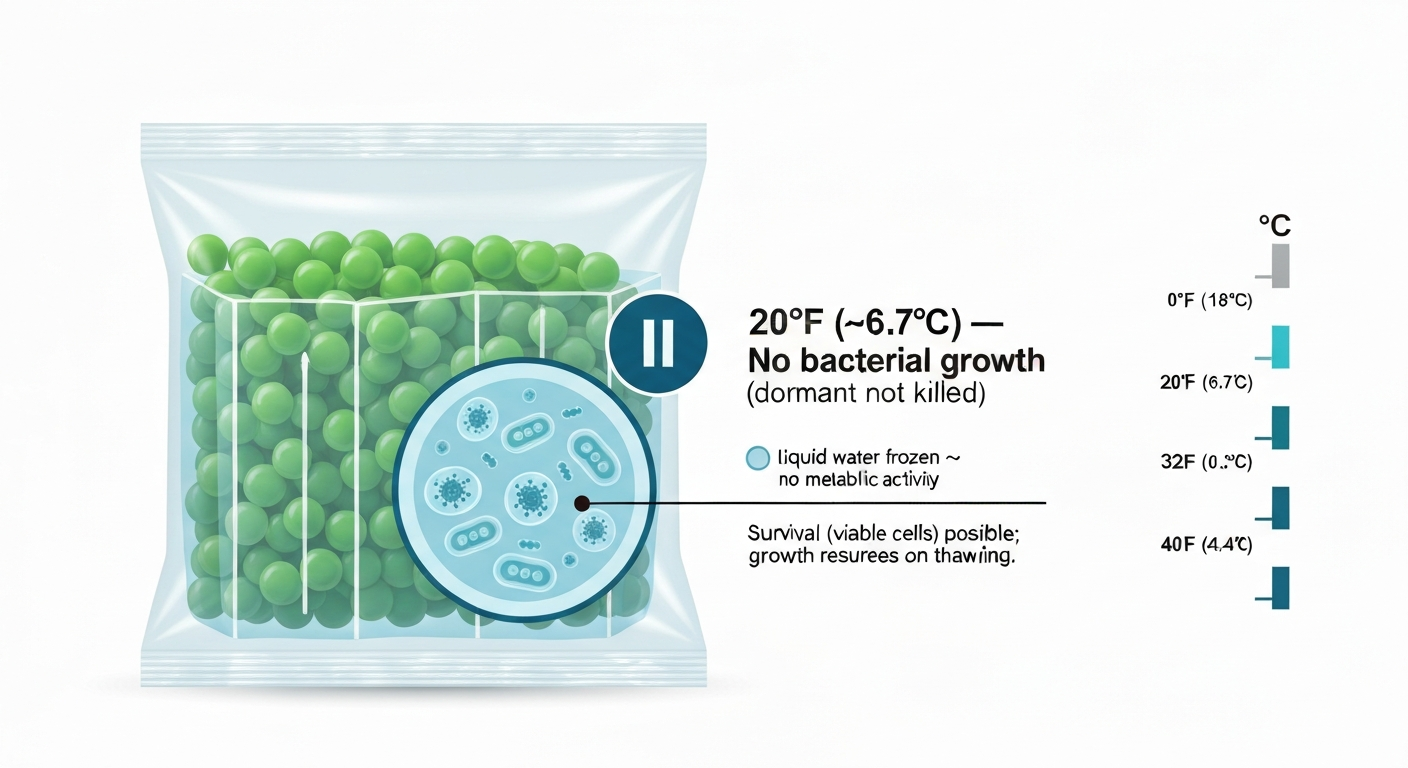
Temperature and pH interact in a predictable way: as temperature drops toward refrigeration range, the minimum growth pH for most organisms increases slightly, meaning acid becomes more effective at cold temperatures for suppressing growth. For related guidance on temperature thresholds (for example the misconception that food-poisoning bacteria cannot grow below 20 °F), see food poisoning bacteria can not grow below 20 f. However, organisms like Yersinia enterocolitica are psychrotrophic and can still grow at refrigeration temperatures at pH values as low as 4. FAO, Assessment and Management of Seafood Safety and Quality (pathogen growth factors table) lists Yersinia enterocolitica minimum growth pH around 4.2 and documents psychrotrophic growth at refrigeration temperatures blank" rel="noopener noreferrer">FAO — Assessment and Management of Seafood Safety and Quality (pathogen growth factors table). 2, which makes them a specific concern in chilled, mildly acidic foods.
Water activity (aw) compounds the effect of pH. When both are reduced simultaneously, the combined stress is greater than either alone. This is the principle behind shelf-stable acidified pickles: vinegar drops the pH while salt reduces water activity, and together they create conditions that no relevant pathogen can tolerate. Regulatory guidance on acidified foods considers water activity alongside pH precisely because the interaction matters.
Oxygen availability adds another layer. Clostridium botulinum is an anaerobe, meaning it only grows and produces toxin in the absence of oxygen. The pH 4.6 cutoff is most critical for low-acid canned foods and vacuum-packed products where oxygen is excluded. In high-oxygen environments, other spoilage organisms become the primary concern, and the botulinum risk is lower regardless of pH. Similarly, aerobic spoilage molds and yeasts can grow at low pH values where bacteria cannot, which is why high-acid products like jams, pickles, and fruit preserves still require proper heat treatment or airtight sealing to prevent mold and yeast spoilage.
Food composition also modifies pH effectiveness. High buffering capacity (common in protein-rich foods like meat and dairy) means that more acid must be added to achieve a given pH than in low-buffering substrates. Additionally, fat content, salt, sugar, and naturally occurring antimicrobials like phenolic compounds all interact with pH to either enhance or reduce its inhibitory effect. Predictive microbiology tools, including the USDA ARS Pathogen Modeling Program and ComBase Predictor, allow food safety professionals to model these multi-factor interactions quantitatively rather than relying on single-variable rules of thumb.
Measuring and controlling pH in food production
Accurate pH measurement is a prerequisite for applying any of this knowledge in practice. The standard method for food products is a calibrated pH meter with a glass electrode, measured after the product has reached equilibrium (meaning after all ingredients are fully mixed and the pH has stabilized). Strip indicators and colorimetric tests are useful for screening but are not accurate enough for regulatory compliance decisions, especially near the critical 4.6 boundary.
There are four main strategies for reducing and controlling pH in foods:
- Direct acidification: Adding food-grade acids such as acetic acid (vinegar), citric acid, or lactic acid directly to the product. This is fast, consistent, and measurable. FDA regulations for acidified foods require verification that equilibrium pH is achieved and maintained.
- Fermentation: Using starter cultures of lactic acid bacteria or other organisms that generate acid as a metabolic byproduct. pH drops gradually and must be monitored to confirm it reaches the target level. This method also produces flavor compounds that direct acidification does not.
- Pickling: Submerging or brining foods in acidified solutions, typically vinegar-based. The acid must penetrate to the center of the food to ensure equilibrium pH throughout, which is why pickle processing times are standardized.
- Formulation adjustment: Selecting or modifying ingredients to reduce buffering capacity or naturally increase acidity, for example using tomato-based ingredients or fruit juices as partial replacements for low-acid components.
Monitoring pH over a product's shelf life is equally important. Some products can see pH drift due to ongoing fermentation, ingredient interactions, or contamination. Acidified food regulations under 21 CFR Part 114 require producers to control and document the process that achieves and maintains the target pH, not just verify it once at production.
Putting it together: practical guidance for storage, preservation, and risk assessment
For food safety professionals and home preservers alike, the actionable takeaways from this science come down to a few consistent principles. First, pH below 4.6 is a meaningful safety boundary for preventing botulinum growth and toxin production in shelf-stable products, but it does not eliminate all risk from all organisms. For example, food poisoning bacteria are unlikely to grow in acidic foods with pH below 4.6. For a quick answer to the question "do bacteria grow well in food that is highly acidic", see the dedicated explanation of how acidity limits bacterial growth. Second, the type of acid used matters: organic acids like acetic and lactic acid are more inhibitory than their pH alone suggests. Third, pH should always be considered alongside temperature, water activity, and oxygen availability, because the combination of hurdles creates safer products than any single factor can achieve alone.
For practical risk assessment, a product with a pH of 4.0 to 4.3 stored under refrigeration with moderate salt content is very well protected against the major bacterial pathogens. A product at pH 4.8 stored at room temperature with no other controlling factors is not. The difference between those two scenarios is not just academic: it is the difference between a shelf-stable product and one that requires refrigeration and a defined shelf life.
When designing or evaluating a preservation system, the safest approach is to model the specific pathogen of concern against the full combination of conditions using validated tools like the USDA ARS Pathogen Modeling Program, and then confirm predictions with challenge studies using the actual product formulation. No single rule applies across all products and organisms, but understanding what pH does and does not control is the foundation for getting the analysis right.
FAQ
Direct answer: Do bacteria need neutral pH to grow?
No. Many bacteria prefer near‑neutral pH (roughly pH 6–8), but bacteria as a group have wide pH tolerances. Some species (neutrophiles) grow best near neutral, acidophiles grow best at low pH, and alkaliphiles at high pH. Whether a specific bacterium can grow at a given pH depends on species/strain, temperature, water activity, acid type, prior exposure (acid tolerance), and the food matrix.
Key definitions (pH, acidophile, neutrophile, alkaliphile)
pH: a logarithmic scale of hydrogen ion activity; lower values are more acidic. Acidophile: organism with optimum growth at low pH (often <5). Neutrophile: optimum around neutral (commonly pH ≈5–9; many human pathogens ≈6–8). Alkaliphile: organism with optimum growth at high pH (optima >8). These are broad categories; individual strains vary.
Typical pH growth ranges and concrete examples for common foodborne pathogens
Ranges (approximate minima; growth depends on other conditions): Clostridium botulinum: growth/toxin prevented at pH ≤4.6 under normal aw (>0.85) in foods (regulatory cutoff) [FDA/USDA]. Listeria monocytogenes: can grow roughly down to pH ≈4.4 under favorable conditions (strain, temp, buffering) [review]. Salmonella spp.: generally neutrophiles but some strains/conditions allow growth near pH 3.9–4.1 (acid type and temp dependent) [review]. Escherichia coli (including STEC): commonly cited minimum ≈4.4 (strain/acid dependent) [FAO]. Staphylococcus aureus: can grow down to ≈4.0; enterotoxin production often requires higher pH (commonly >~5.0) [NCBI]. Bacillus cereus: minima often in mid‑4s (~4.3–4.9) [FDA/US EPA]. Clostridium perfringens: higher minima (≈5.0–5.8) [FAO]. Yersinia enterocolitica: can grow to ≈4.2 and is notable for growth at chilled temperatures [FAO].
Typical pH ranges for spoilage microbes, yeasts and Candida
Many spoilage bacteria are neutrophilic and limited by acid. Lactic acid bacteria (food starters) grow well at low pH and commonly tolerate pH ~3.0–3.5 (strain dependent) and are used to acidify/preserve foods. Some yeasts (e.g., Zygosaccharomyces bailii) and molds tolerate very low pH and preservatives; Z. bailii strains can initiate growth near pH 2.5 in high sugar/osmotic matrices and spoil acidic products that bacteria cannot [IJFM]. Candida species vary but many yeasts grow at lower pH than typical bacteria.
Survival versus growth: what's the difference and why it matters
Growth: cells reproduce and increase in number (risk of toxin formation or spoilage). Survival (non‑growth): cells remain viable but do not multiply; they can persist and sometimes recover when conditions improve. Many pathogens can survive below their growth pH for extended periods; survival times depend on acid type, concentration, temperature, and food buffering and are quantified by D‑values/time‑kill curves. For food safety, preventing growth/toxin production is primary, but survival matters for later outgrowth if conditions change.
Regulatory and practical pH thresholds for food safety (including pH 4.6)
Regulatory cutoff pH 4.6: U.S. FDA and 21 CFR 114.80 use pH 4.6 as the boundary for preventing growth and toxin formation by proteolytic Clostridium botulinum in acidified and low‑acid canned foods. Acidified foods are those adjusted to finished equilibrium pH ≤4.6 with aw >0.85 [FDA]. This is a conservative regulatory threshold for botulism control; other pathogens have different minima and require additional controls (temperature, a_w, preservatives).
Next Article
Food poisoning bacteria: can they grow below 20°F?
Do food-poisoning bacteria grow below 20°F? Evidence-based guide on which pathogens, survival vs growth, controls.