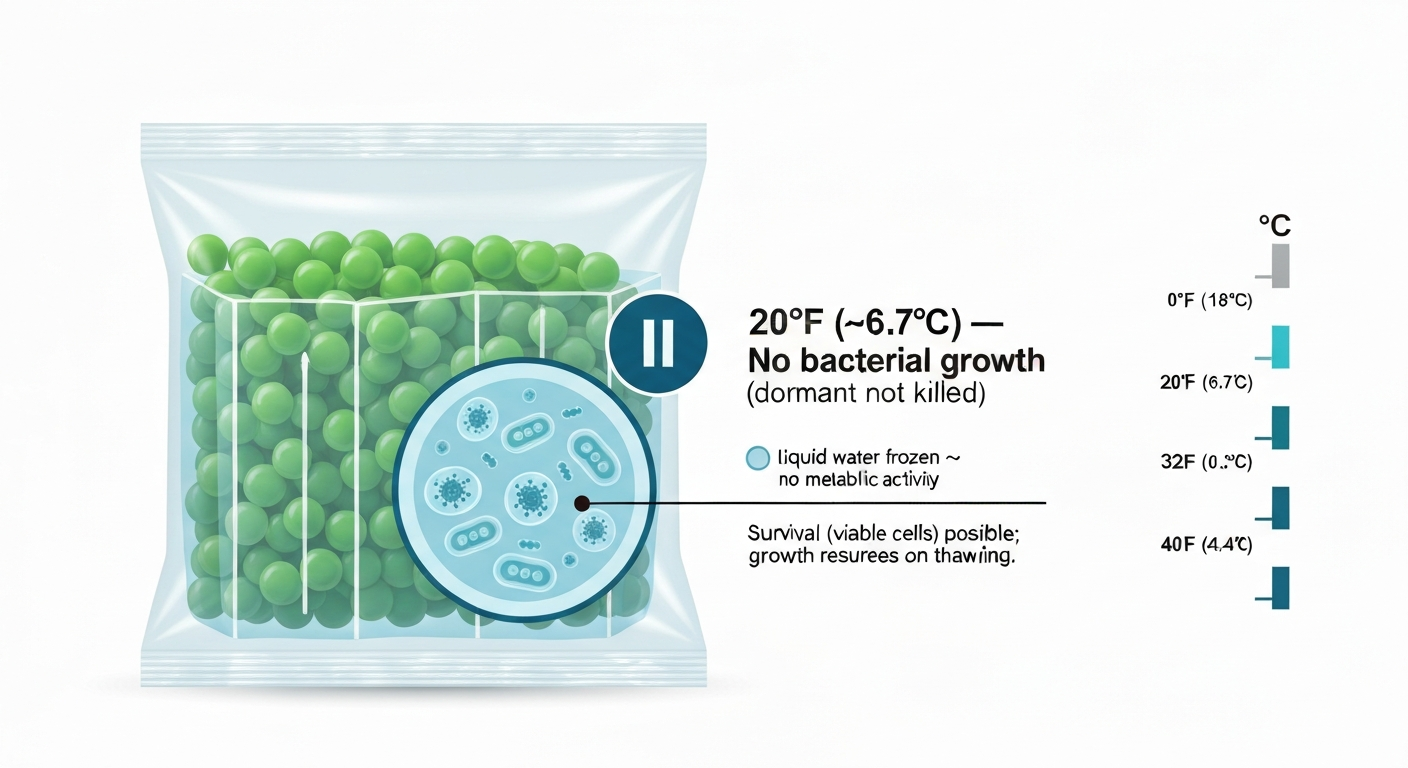
Food poisoning bacteria cannot grow below 20°F (−6.7°C). At that temperature, any food held in a functioning freezer is below the growth threshold for every known foodborne pathogen. Freezing removes the liquid water bacteria need for biochemical activity, so replication stops completely. The important caveat is that 'cannot grow' is not the same as 'cannot survive': many pathogens remain viable in frozen food and can resume growth once the food thaws back into the temperature danger zone.
Food poisoning bacteria: can they grow below 20°F?

Marcus Reeves
4 Aug 2026
What 20°F actually means in food safety terms
Water freezes at 32°F (0°C) under standard conditions. A food held at 20°F (−6.7°C) is well below that threshold, meaning virtually all free water in the food matrix has converted to ice. Without liquid water, bacterial enzymes cannot catalyze reactions, nutrient transport across cell membranes stops, and DNA replication cannot proceed. Growth, defined as net cellular multiplication and population increase, requires all of those things simultaneously.
The 20°F figure sits between two practical reference points that food safety professionals use constantly. Refrigeration is typically held at 35–41°F (1.7–5°C): cold enough to slow most pathogens dramatically, but still above freezing. Standard freezer storage runs at 0°F (−18°C), which is the FDA and USDA recommended frozen storage temperature. At 20°F, a food is frozen but warmer than the recommended frozen storage setpoint, which matters during temperature abuse, malfunctioning equipment, or improperly set chest freezers.
| Temperature | °F | °C | Food Safety Status |
|---|---|---|---|
| Recommended frozen storage | 0°F | −18°C | No bacterial growth; minimal survival loss over time |
| The threshold in question | 20°F | −6.7°C | No growth for any known foodborne pathogen; survival possible |
| Freezing point of water | 32°F | 0°C | Growth ceases as ice forms; transition zone for some psychrotrophs |
| Refrigeration (typical) | 35–41°F | 1.7–5°C | Slow growth possible for psychrotrophic pathogens |
| Lower danger zone boundary | 40°F | 4.4°C | FDA/USDA upper refrigeration limit; rapid growth starts above this |
Growth versus survival: why the distinction matters
When microbiologists say bacteria 'cannot grow' below a certain temperature, they mean the population does not increase in size. Individual cells may still be metabolically dormant but structurally intact, and they can remain that way for weeks, months, or even years in frozen food. Listeria monocytogenes, Salmonella, and E. coli O157:H7 have all been recovered from commercially frozen products after extended storage.
Freeze-thaw cycling introduces an additional complication. Each freezing and thawing event causes some cell death through ice crystal damage, but it also promotes a subpopulation of sublethal injury: cells that are membrane-damaged, partially inactivated, and difficult to detect on standard culture-based tests. These 'viable but non-culturable' (VBNC) cells can sometimes resuscitate when returned to favorable temperatures and nutrient conditions, posing a risk that purely cell-count-based monitoring may underestimate.
The practical takeaway is straightforward: frozen food is not sterile food. If it was contaminated before freezing, that contamination largely persists. The frozen state is a pause button, not a delete button.
How low temperatures actually shut bacteria down
Several mechanisms work simultaneously as temperature drops toward and below freezing, each one compounding the effect of the others.
Metabolic slowdown
Enzyme-catalyzed reactions roughly halve in rate for every 10°C drop in temperature (the Q10 effect). At near-freezing temperatures, metabolic throughput slows so dramatically that growth rates approach zero even before ice forms. This is why refrigeration at 1–4°C does not fully stop psychrotrophic bacteria but does slow them enough to extend safe shelf life.
Membrane fluidity loss
Bacterial cell membranes are phospholipid bilayers that must remain fluid enough for proteins and nutrients to move through them. Cold temperatures stiffen the membrane. Most mesophilic pathogens (Salmonella, E. coli, S. Staphylococcus aureus generally cannot grow at temperatures below about 7 °C, though enterotoxin production and exact growth kinetics depend on strain and food matrix (see Staphylococcus aureus and its food poisoning toxins: characterization and outbreak investigation (FEMS Microbiology Reviews)). aureus) cannot adjust their membrane fatty acid composition fast enough to compensate, so transport and energy production collapse. Psychrotrophic species partly overcome this by incorporating unsaturated fatty acids that remain fluid at lower temperatures.
Ice crystal formation and osmotic stress
As extracellular water freezes first, solutes concentrate in any remaining liquid. This drives water out of bacterial cells by osmosis, causing severe dehydration stress. Intracellular ice formation at lower temperatures directly punctures membranes and denatures proteins. Together these effects are lethal for most mesophiles, though the rate of killing depends on how fast freezing occurs: very rapid freezing can be less damaging than slow freezing because smaller ice crystals form.
Enzyme and DNA function
At subfreezing temperatures, DNA polymerases and ribosomal machinery required for replication essentially stop functioning in mesophilic bacteria. RNA transcription, protein folding, and ATP synthesis all have cold-sensitive steps. Even if a cell survives structurally, coordinated growth cannot occur without all of these processes running in parallel.
Why temperature alone is not the whole story
Temperature is the dominant controlling variable at subfreezing conditions, but in near-freezing and refrigeration ranges it interacts with other environmental factors. Food safety professionals use the concept of 'hurdle technology': combining multiple suboptimal conditions that together prevent growth even when no single factor would be sufficient alone.
Water activity (aw) is particularly important at near-freezing temperatures. Water activity measures how much free, available water exists in a food on a scale from 0 to 1.0. Most foodborne pathogens require aw above 0.92–0.95 to grow. Foods like dry-cured meats, hard cheeses, or concentrated brines have reduced aw, which compounds the effect of cold storage. Freezing itself lowers effective aw dramatically by converting free water to ice, which is one reason why frozen storage is so effective at halting growth even slightly above −18°C.
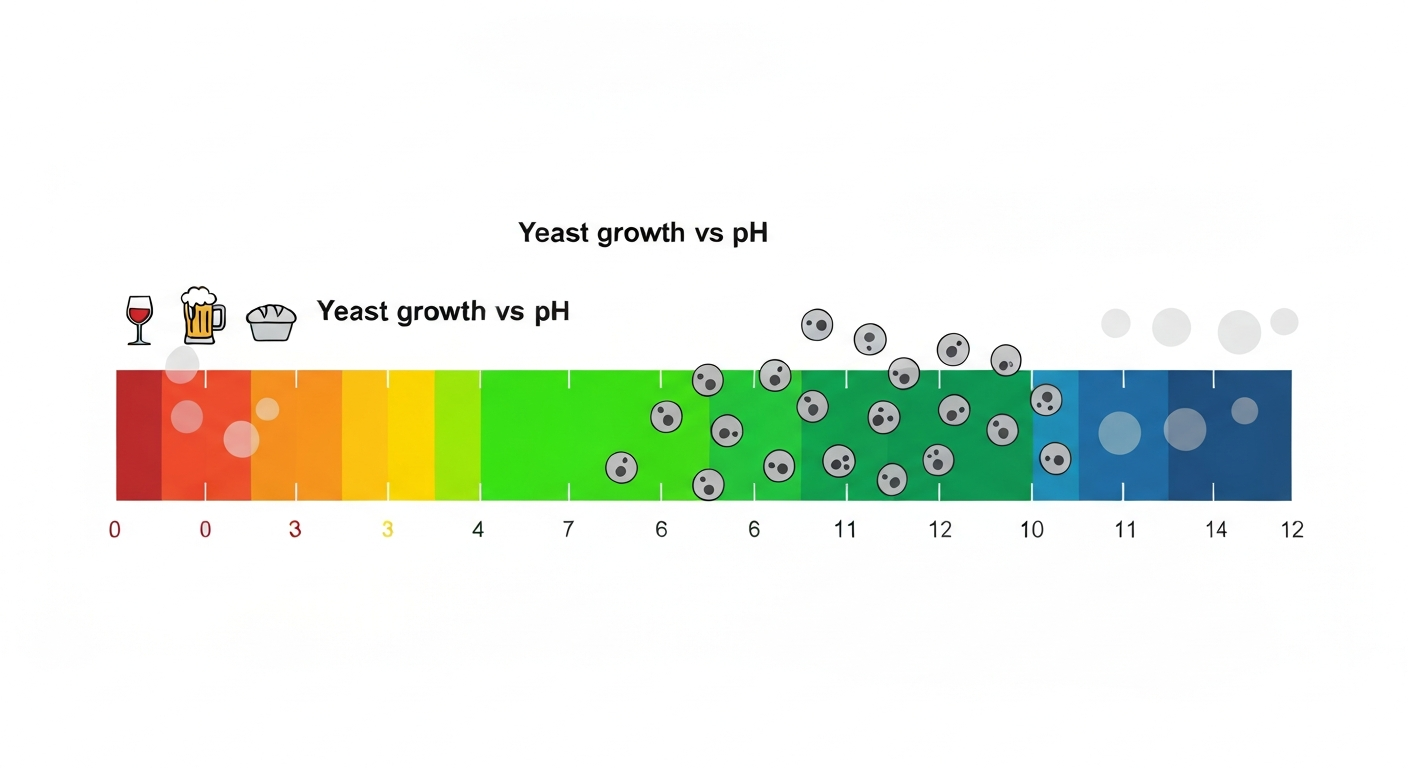
pH and acidity interact with temperature in a comparable way. At any given temperature, a more acidic environment (lower pH) narrows the window of growth further. For more on how pH affects fungal growth, see does yeast grow in acidic or alkaline environments. The interplay between acidity and bacterial growth is relevant in acidified or fermented refrigerated foods, where the combination of cold temperatures and low pH provides stronger protection than either factor alone. For example, information about whether Candida grows better in acidic or alkaline environments provides useful context for understanding how pH limits microbial growth. Highly acidic foods are generally inhospitable to foodborne bacteria regardless of temperature, and that protective effect stacks with cold storage. In line with this, food poisoning bacteria are unlikely to grow in acidic foods, which further reduces the risk when combined with cold storage. For more detail on how acidity limits microbial growth, see does bacteria grow well in acidic environments. For more detail on how acidity affects microbial growth and the preferred pH ranges of acid-loving organisms, see at which ph value will an acidophile grow best. Do bacteria grow well in food that is highly acidic? Generally no, low pH inhibits most foodborne pathogens, though some acid-tolerant organisms or improperly acidified products can still pose risks.
Oxygen availability matters too, particularly for anaerobes. Non-proteolytic Clostridium botulinum (Group II) is a refrigeration-temperature risk specifically under anaerobic, low-acid, moist conditions, such as in vacuum-packed or modified-atmosphere chilled seafood and meats. Removing oxygen does not automatically make cold storage safer; for this particular organism, anaerobic packaging at refrigeration temperatures is actually one of the more dangerous combinations.
Food composition variables, including fat content, protein levels, and the presence of natural antimicrobials (nitrites in cured meats, organic acids in fermented products, lysozyme in egg white), further modulate how effectively temperature controls microbial growth. Predictive microbiology models such as ComBase incorporate temperature, pH, and aw together because none of these factors operates in isolation.
Organisms that cannot grow at subfreezing or near-freezing temperatures
The majority of foodborne pathogens are mesophiles: organisms with optimal growth somewhere between 25°C and 40°C. Their minimum growth temperatures fall well above the freezing point of water, meaning refrigeration alone is sufficient to halt their replication, and subfreezing conditions stop them entirely.
| Organism | Category | Approx. Min. Growth Temp. | Notes |
|---|---|---|---|
| Salmonella spp. | Mesophile | ~5–7°C (41–45°F) | No growth at refrigeration temperatures below ~5°C; freezing fully halts growth |
| E. coli O157:H7 / STEC | Mesophile | ~7–9°C (45–48°F) | Strain-dependent; no growth under typical refrigeration or frozen conditions |
| Staphylococcus aureus | Mesophile | ~7°C (45°F) | Growth and toxin production cease below ~7°C; refrigeration effective |
| Campylobacter jejuni | Thermophile | ~30°C (86°F) | Cannot grow at refrigeration; requires warmth and microaerophilic conditions |
| Bacillus cereus (vegetative) | Mesophile | ~4–5°C (39–41°F) | Refrigeration limits growth; spores survive both refrigeration and freezing |
| Clostridium perfringens | Mesophile | ~12–15°C (54–59°F) | Growth ceases well above freezing; spores persist through frozen storage |
Campylobacter is worth highlighting because its minimum growth temperature of around 30°C means it is uniquely vulnerable to both refrigeration and freezing as growth-prevention tools. This also means its survival in frozen poultry is a real issue: the organism can persist for days to weeks in frozen meat even though it is incapable of multiplying there.
Psychrotrophic and psychrophilic species: the exceptions
Psychrotrophic bacteria are defined as organisms capable of growth at refrigeration temperatures (0–7°C) even though their optimal growth temperature is higher. Psychrophilic bacteria are true cold-loving organisms with optima below 15°C and the ability to grow at or below 0°C. True psychrophiles found in sea ice and polar environments (genera like Psychromonas and Colwellia) can replicate at temperatures as low as −12°C in liquid brine micro-niches, but these are environmental taxa, not foodborne pathogens. Liquid micro-niches such as cryoconcentrated brines preserve microscopic liquid water, enabling documented microbial activity in sea-ice at −5 to −20 °C.
Among organisms that are genuinely relevant to food safety, the psychrotrophs are the critical group. These species can grow in the refrigerator, making them hazards in chilled ready-to-eat foods even when cold storage is maintained correctly. At subfreezing temperatures (below 0°C), even psychrotrophic pathogens do not grow under normal food storage conditions. The 20°F threshold is therefore safe for all of them, but refrigeration temperatures above 32°F are not adequate to stop them.
High-risk exceptions: pathogens with low minimum growth temperatures
These are the species that food safety professionals need to keep in mind during refrigerated storage, modified-atmosphere packaging, cold-chain management, and thawing operations. None grow at 20°F, but several can grow in a refrigerator that is slightly too warm or during slow thawing.
| Organism | Approx. Min. Growth Temp. | Key Foods at Risk | Additional Risk Factors |
|---|---|---|---|
| Listeria monocytogenes | ~0–1°C (32–34°F); model Tmin values as low as ~−2.8°C | RTE deli meats, soft cheeses, smoked fish, cold-stored produce | Grows slowly but steadily at typical refrigeration; survives well in frozen storage |
| Yersinia enterocolitica | ~0–1°C (32–34°F) | Pork products, chilled dairy, cold-stored vegetables | Growth at 0°C documented for some strains; a refrigeration-temperature hazard |
| Non-proteolytic C. botulinum (Group II) | ~2.5–3.3°C (37–38°F) | Vacuum-packed and MAP fish, chilled meats, sous-vide products | Anaerobic conditions required; toxin risk without obvious spoilage signs |
| Aeromonas hydrophila / spp. | ~0–2°C (32–36°F) | Seafood, RTE chilled products, fresh produce | Psychrotrophic spoilage and opportunistic pathogen; grows during cold storage |
| Brochothrix thermosphacta | ~0°C (32°F) | Refrigerated meat and seafood | Primarily a spoilage organism but indicates cold-chain inadequacy |
| Pseudomonas spp. (spoilage) | ~0°C (32°F) | Meat, poultry, dairy | Spoilage organisms; not foodborne pathogens but important cold-chain indicators |
Listeria monocytogenes is the organism that receives the most regulatory attention at low temperatures. EFSA risk assessments and models like ComBase assign it a Tmin in the range of approximately −2.8°C to 0°C depending on the dataset and modeling approach. In practical terms, this means some Listeria strains can grow, extremely slowly, at the coldest end of normal refrigeration. At 20°F (−6.7°C), even Listeria does not grow. But because its minimum growth temperature is so close to 0°C, any temperature abuse during thawing, cold-chain gaps, or malfunctioning refrigeration equipment creates a genuine hazard in RTE products.
Non-proteolytic Clostridium botulinum (Group II) is unusual because it combines a very low minimum growth temperature (around 3°C) with the ability to produce botulinum neurotoxin without producing obvious spoilage. This makes it a priority concern in vacuum-packed or modified-atmosphere chilled fish and meats where anaerobic conditions persist throughout refrigerated shelf life. Its minimum growth temperature is still well above 20°F, but the narrow gap between its Tmin (~3°C / 37°F) and normal refrigeration temperatures (~4°C / 39°F) means that even modest temperature abuse creates risk.
Practical controls: what this means for storage, thawing, and monitoring
For anyone managing food safety, the conclusions from this temperature science translate into a small set of actionable rules.
- Maintain freezer storage at 0°F (−18°C) or colder. At this temperature, all known foodborne pathogens are fully arrested. The 20°F threshold is safer than refrigeration but warmer than the recommended frozen storage setpoint.
- Do not rely on freezing to decontaminate food. If a product was contaminated before freezing, the pathogens survive frozen storage and revive on thawing. Freezing is a preservation step, not a kill step.
- Thaw food safely. Thawing at room temperature moves product through the danger zone (40–140°F / 4–60°C) for hours. Thaw under refrigeration, under cold running water (at 70°F or below), or as part of an immediate cooking process.
- For psychrotrophic-pathogen-relevant products (deli meats, smoked fish, vacuum-packed chilled seafood), strict refrigeration at or below 40°F (4.4°C) is critical. Listeria and non-proteolytic C. botulinum will grow slowly but consistently if temperatures creep above their minimums.
- Monitor refrigerator and freezer temperatures with calibrated thermometers, not just indicator lights. Equipment failure, overpacking, and door cycling can allow temperatures to rise without triggering obvious alarms.
- Apply multiple hurdles in high-risk products. For chilled RTE foods where Listeria or Group II C. botulinum are concerns, pH control, reduced water activity, and proper use-by dating complement temperature control rather than replacing it.
- Use predictive microbiology tools (ComBase, USDA Pathogen Modeling Program) to model growth potential during realistic temperature fluctuations, particularly during distribution, retail display, and consumer handling.
Testing and monitoring strategies also need to account for VBNC cells and freeze-thaw injury. Culture-based plate counts may underestimate viable pathogen loads in frozen or freeze-thaw-cycled products. PCR-based and other molecular detection methods can identify pathogen DNA even in injured or VBNC cells, which is why regulatory and quality assurance programs increasingly pair culture methods with molecular confirmation.
Temperature is the single most powerful lever available for controlling food poisoning bacteria, and 20°F sits firmly in the 'no growth' zone for all known foodborne pathogens. The nuance lies in everything that happens on either side of the freezer: the cold chain, the thaw, the refrigerator temperature, and the specific organisms present. Understanding where each pathogen's growth boundary sits, and how it interacts with the acidity, water activity, and composition of specific foods, is what makes the difference between food that stays safe and food that doesn't.
FAQ
Short, evidence‑based answer: Can foodborne bacteria grow below 20°F (≈−6.7°C)?
No — in general, common foodborne pathogens cannot grow at 20°F (≈−6.7°C). Growth requires liquid water and active metabolism; most foods are frozen at subzero temperatures so free liquid is unavailable and biochemical reactions are effectively arrested. However, exceptions exist: specialized psychrophilic/environmental bacteria and certain psychrotrophic foodborne species can grow at or near 0°C and, in rare micro‑niches (brines/cryoconcentrated pockets), some microbes have been documented to replicate at subzero temperatures. Freezing typically stops replication (no growth) but does not guarantee inactivation — many pathogens survive frozen storage and can regrow after thawing.
Which foodborne pathogens can grow at refrigeration or near‑freezing temperatures, and are any able to grow at ≈−6.7°C?
Psychrotrophic foodborne species that grow at refrigeration/near‑freezing include Listeria monocytogenes (can grow at ~0°C; some models use Tmin near 0 or slightly negative for extreme strains), Yersinia enterocolitica (can grow at ≈0–4°C), non‑proteolytic (Group II) Clostridium botulinum (minimum growth ≈2.5–3.3°C), and some Aeromonas spp. Mesophilic pathogens such as Salmonella, pathogenic E. coli (STEC), and Staphylococcus aureus generally do not grow below about 5–8°C (S. aureus often ≈7°C). True growth at −6.7°C is not a property of typical foodborne pathogens; subzero growth has been reported for environmental psychrophiles (e.g., Psychromonas, Colwellia) in brine/sea‑ice niches but these are not common foodborne agents.
What is the difference between growth (replication) and survival during freezing?
Growth means active cell division and population increase; survival means cells remain viable (capable of causing illness) without dividing. Freezing usually halts replication because liquid water is removed and metabolic rates fall, but many pathogens survive frozen conditions for weeks, months or years with little log reduction. Freeze–thaw cycles and freezing stress can cause sublethal injury, membrane damage, or induce a VBNC (viable but non‑culturable) state; injured or VBNC cells may be missed by some culture tests yet resuscitate and grow when conditions become favorable (e.g., during thawing or in rich foods). Thus “no growth” during freezing ≠ “no risk” if the organism survives.
How can microbes grow at subzero temperatures? What are the mechanisms and niches that permit this?
Subzero growth requires microscopic liquid water and biochemical activity. Mechanisms and enabling niches include: 1) Freezing‑point depression in solute‑rich matrices creates brine pockets that remain liquid below 0°C. 2) Cryoprotectants (sugars, proteins, salts) and extracellular polysaccharides stabilize membranes and proteins. 3) Specialized cold‑adapted enzymes and membrane lipids maintain fluidity in psychrophiles. 4) Micro‑niches in porous or high‑salt foods (localized unfrozen water channels, concentrated solute pockets) can sustain metabolic activity. In nature, microbes in sea ice and brines have been observed active down to roughly −12°C in ideal microenvironments; such conditions are atypical in most prepared foods.
How do pH and water activity (a_w) interact with low temperature to influence growth risk?
Temperature, pH and a_w act together to determine whether growth is possible. Low temperature slows metabolism and raises the minimum requirements for pH and a_w to support growth. Acidic foods (low pH) greatly reduce the ability of psychrotrophs and mesophiles to grow at cold temperatures — many pathogens that might tolerate refrigeration cannot grow in low‑pH foods. Low water activity (high solute or dried foods) also prevents growth even if liquid pockets exist. Predictive models (ComBase, USDA PMP) use combined limits (temperature, pH, a_w, preservatives) to predict growth/no‑growth boundaries; applicability must be validated for each food matrix and strain.
What role does oxygen/atmosphere and food composition play at low temperatures?
Oxygen availability is critical for aerobes vs anaerobes: anaerobic pathogens like Clostridium botulinum (Group II) can grow under refrigeration if other conditions (a_w, pH, nutrients) permit and oxygen is excluded. Modified atmospheres and vacuum packaging can suppress aerobes but may favor anaerobic or facultative anaerobic psychrotrophs. Food composition (nutrients, fat content, buffering capacity, natural antimicrobials) affects cryoprotection and the ability of cells to survive and recover after freezing. High solutes (salt/sugar) depress freezing point and create brines that can either permit activity (if microbes tolerate the solute) or inhibit growth by osmotic stress.
Next Article
Does Yeast Grow in Acidic or Alkaline Environments? pH Guide
Does yeast grow in acidic or alkaline environments? pH ranges, species differences, and food-safety guidance.