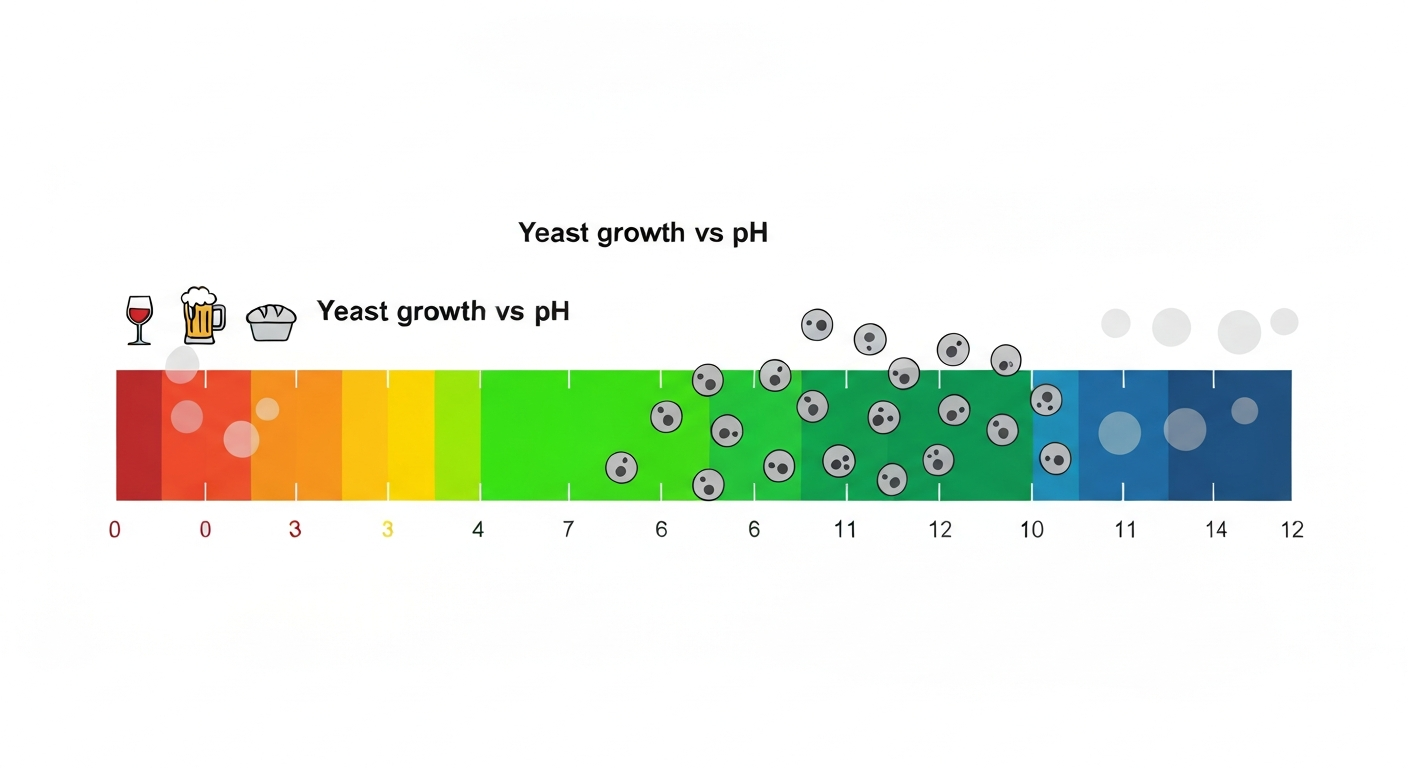
Yeast grows best in acidic environments. Most species prefer a pH somewhere between 4.0 and 6.5, with many common yeasts hitting their stride right around pH 4.0 to 5.0. Alkaline conditions generally suppress yeast growth, and a strongly alkaline environment (pH above 8 or 9) will inhibit or kill most species outright. This acidic preference is the reason yeast thrives in fermented foods like wine, beer, bread dough, and yogurt, and it is also why yeast spoilage can still occur in acidified foods that are too acidic for most bacteria.
Does Yeast Grow in Acidic or Alkaline Environments? pH Guide

Marcus Reeves
23 Jul 2026
pH basics: acid, neutral, and alkaline defined
The pH scale runs from 0 to 14. A pH of 7.0 is neutral, meaning the concentration of hydrogen ions and hydroxide ions is balanced. Values below 7.0 are acidic (the lower the number, the more acidic), and values above 7.0 are alkaline (also called basic). Each full step on the scale represents a tenfold change in hydrogen ion concentration, so pH 4 is ten times more acidic than pH 5, and one hundred times more acidic than pH 6.
Microorganisms are broadly categorized by their pH preferences. Acidophiles are organisms that grow optimally at low pH, typically below pH 5.0, and many can tolerate values as low as pH 1 or 2. Alkaliphiles do the opposite: they prefer or require pH values above 9.0 and often cannot grow near neutral. Most bacteria, fungi, and yeasts fall into neither extreme category. They are neutrophiles, preferring a pH range close to neutral, somewhere between pH 5.5 and 8.0. Yeast is an interesting case because, while not a strict acidophile, its preferred range sits clearly on the acidic side of neutral.
Why yeast prefers an acidic pH
Yeast cells maintain their internal (cytoplasmic) pH within a narrow range, typically around pH 6.5 to 7.5, regardless of what the external environment looks like. To do this, the cell membrane is studded with proton pumps, particularly the plasma membrane H+-ATPase, that actively expel hydrogen ions from the cell interior. In a moderately acidic environment, the proton gradient across the membrane is favorable for energy generation and nutrient transport. In a highly alkaline environment, that gradient is reversed, the pumps work against their natural direction, and cellular energy budgets suffer. This is why yeast is metabolically more efficient in acidic conditions: the external environment complements the cell's natural proton-management machinery rather than fighting it.
Acidity also affects competing organisms. Many bacteria that would otherwise outcompete yeast for nutrients are inhibited at pH values below 4.5 to 5.0. A moderately acidic environment therefore gives yeast a competitive edge, which is one reason fermentation processes like winemaking and sourdough production naturally select for yeast over bacterial competitors.
General pH growth range for yeasts
As a group, yeasts are generally capable of growing across a wide pH window, approximately pH 2.5 to 8.5, though growth rates drop off sharply near the extremes. The broad consensus from culture collections, brewing practice, and fermentation research places the optimal range for most common yeasts between pH 4.0 and 6.0. Below pH 3.0, only the most acid-tolerant species continue to grow at meaningful rates. Above pH 7.0, yeast growth slows noticeably, and above pH 8.5, most species are significantly inhibited. For practical food safety and fermentation work, the action zone is roughly pH 3.5 to 7.0.
These are population-level generalities. Strain-to-strain variation is real and matters in applied settings. A wine strain of Saccharomyces cerevisiae and a spoilage strain of Zygosaccharomyces bailii may both be called yeasts, but their pH tolerances can differ substantially, which has direct consequences for food preservation and fermentation control.
Optimal pH ranges by species: Saccharomyces, Candida, and common spoilage yeasts
Saccharomyces cerevisiae
Saccharomyces cerevisiae is the most studied yeast species and the workhorse of baking, brewing, and winemaking. Standard culture conditions in reference collections such as the DSMZ typically use media adjusted to around pH 5 to 6. In wine fermentation settings, experimental studies have placed the maximum specific growth rate for many strains near pH 4.0, with a workable growth range from about pH 2.5 up to pH 8.0. In practice, wine fermentation proceeds at must pH values of 3.0 to 4.0, and beer fermentation begins at wort pH 5.4 to 5.6 before dropping to a final pH of roughly 4.0 to 4.5 as fermentation completes. S. cerevisiae performs well across this range without requiring any intervention.
Candida species
The Candida genus contains a wide variety of species with different ecological niches. Candida albicans, the most clinically significant species, grows across a broad pH range (roughly pH 2. Does Candida grow in acidic or alkaline environments? Candida species can grow across a wide pH range, but C. albicans tends to become more hyphal, and potentially more invasive, under alkaline conditions. 0 to 10.0) and has the unusual ability to adapt its morphology, switching between yeast and hyphal (filamentous) forms depending on pH. Alkaline pH, around 7.0 to 8.0, actually promotes hyphal growth in C. albicans, which is associated with tissue invasion. This pH-driven morphological switch is a key virulence mechanism. For comparison, most environmental Candida spoilage species behave more like typical acidophilic yeasts, growing best in the pH 3.5 to 6.5 range.
Zygosaccharomyces rouxii and Z. bailii
Zygosaccharomyces species are among the most stress-tolerant spoilage yeasts in the food industry. Z. rouxii has a documented growth range from approximately pH 1.5 to 10.5, with some isolates showing an optimum around pH 3.5 to 5.5. This makes it exceptionally capable of spoiling high-sugar, high-acid products such as fruit concentrates, jams, and miso. Z. bailii is arguably the more notorious spoilage organism in acidified foods and beverages. It can grow from roughly pH 2.0 to 7.0 under favorable nutrient conditions and is particularly resistant to weak organic acid preservatives like acetic, sorbic, and benzoic acid. Its ability to spoil mayonnaise, salad dressings, soft drinks, and fruit concentrates at pH values where other yeasts would be inhibited makes it a significant quality and safety concern.
Other spoilage genera
Dekkera (Brettanomyces) species are common wine and beer spoilage yeasts that grow well across pH 3.0 to 6.0 and are tolerant of high ethanol and low pH. Pichia and Debaryomyces species are frequently isolated from dairy and meat products, with typical growth ranges of pH 3.0 to 7.5. Rhodotorula species, common environmental contaminants, tend to prefer slightly higher pH values, growing best around pH 5.0 to 7.0 but tolerating a range of 3.0 to 8.5.
pH ranges at a glance: common yeasts compared
| Species / Genus | Minimum pH | Optimum pH | Maximum pH | Notable Context |
|---|---|---|---|---|
| Saccharomyces cerevisiae | 2.5 | 4.0–5.5 | 8.0 | Wine, beer, baking; widely studied |
| Candida albicans | 2.0 | 4.0–7.0 (morphology-dependent) | 10.0 | Alkaline pH promotes hyphal form; clinical pathogen |
| Candida (environmental/spoilage spp.) | 3.0 | 3.5–6.5 | 8.0 | Food and environmental isolates |
| Zygosaccharomyces rouxii | 1.5 | 3.5–5.5 | 10.5 | Osmotolerant; high-sugar food spoilage |
| Zygosaccharomyces bailii | 2.0 | 3.5–5.5 | 7.0 | Highly acid- and preservative-tolerant; acidified food spoilage |
| Dekkera / Brettanomyces | 3.0 | 4.0–5.5 | 6.5 | Wine and beer spoilage; off-flavor production |
| Pichia / Debaryomyces | 3.0 | 4.5–6.5 | 7.5 | Dairy, meat, fermented foods |
| Rhodotorula spp. | 3.0 | 5.0–7.0 | 8.5 | Environmental contaminant; slightly higher optimum |
Acid-tolerance mechanisms and notable exceptions
Most yeasts manage external acidity through active proton export using the plasma membrane H+-ATPase. When the external environment becomes more acidic, protons tend to leak back into the cell across the membrane, and the pump works harder to eject them. This process consumes ATP, and there is a metabolic cost. Moderately acidic conditions are manageable; very low pH eventually overwhelms the system.
Weak organic acids, the kind used as food preservatives (sorbic, benzoic, and acetic acid), create a more targeted problem. In their undissociated form at low pH, these acids are membrane-permeable. They diffuse into the cell, dissociate in the near-neutral cytoplasm, and release protons internally. This acidifies the cell interior and forces the H+-ATPase into continuous, energy-draining operation. Most yeasts and bacteria are eventually overcome by this mechanism, which is why weak acid preservatives work best at low pH.
Z. bailii has developed several countermeasures. Its cells can upregulate proton pump expression and activity, tolerate intracellular acidification better than most yeasts, and show what researchers call heteroresistance: within a population, a small subpopulation of cells survives preservative concentrations that kill the majority. This subpopulation can then re-establish growth once preservative concentrations decline. Studies have shown that Z. bailii and similar spoilage yeasts can tolerate sorbic and benzoic acid concentrations in the low millimolar range that would completely inhibit common fermentation yeasts. The mechanistic basis includes reduced sensitivity in respiratory metabolism: sorbic acid targets respiration specifically, and highly fermentative organisms like some Zygosaccharomyces strains are less affected because they rely on fermentation rather than oxidative pathways for energy.
For Candida albicans, the relevant exception is pH-responsive morphogenesis rather than extreme acid tolerance. Alkaline pH, along with other signals such as serum and elevated temperature, triggers a yeast-to-hypha transition. This is relevant in clinical microbiology because the hyphal form is more invasive and harder for the immune system to clear. In acidic environments, C. albicans reverts to the less invasive yeast form. This pH sensitivity makes environmental pH a genuine virulence modulator in host-pathogen interactions.
How pH interacts with temperature, water activity, oxygen, and nutrients
pH does not act alone. Its effect on yeast growth is always modified by the surrounding environmental conditions, and food safety risk assessments must account for all of these factors together rather than treating pH as a standalone hurdle.
Temperature
Temperature is the most powerful single modifier of pH effects. At optimal growth temperatures (roughly 25 to 30°C for most common yeasts), organisms are metabolically equipped to manage pH stress most effectively. As temperature drops toward refrigeration range (4 to 8°C), both growth rates and stress-response capacity decline. Most food-poisoning bacteria cannot grow below about 20°F (approximately -6°C), so keeping foods at sufficiently low temperatures is an effective control against bacterial growth food poisoning bacteria can not grow below 20 F. A yeast that can tolerate pH 3.0 at 25°C may have a higher effective minimum pH at 5°C simply because the cell machinery operates more slowly. In predictive microbiology frameworks such as the ComBase Predictor and USDA Pathogen Modeling Program, pH and temperature are modeled jointly precisely because their combined effect is not simply additive. The review Predictive Modeling of Microbial Behavior in Food (PMC) describes the utility of the ComBase database and Predictor tools and the USDA‑ARS Pathogen Modeling Program (PMP) for modeling microbial growth/inactivation, noting that ComBase also provides downloadable growth datasets for re‑plotting The review Predictive Modeling of Microbial Behavior in Food (PMC) describes the utility of the ComBase database and Predictor tools and the USDA‑ARS Pathogen Modeling Program (PMP) for modeling microbial growth/inactivation, noting that ComBase also provides downloadable growth datasets for re‑plotting..
Water activity (aw)
Water activity measures the availability of free water in a food matrix. Most yeasts require an aw above about 0.88 to 0.90 for growth, although osmotolerant and xerophilic species like Z. rouxii can grow at aw values as low as 0.62. The US FDA's regulatory threshold for acidified and low-acid canned foods is set at a finished equilibrium pH of 4.6 or below, combined with an aw above 0.85. This combination is used because both parameters must be controlled simultaneously. A food with pH 3.5 but very high aw (close to 1.0) still presents a yeast spoilage risk, while a low aw combined with low pH provides stronger multi-hurdle protection. ISO standard 21527 separates yeast and mold enumeration methods by aw (above and below 0.95), recognizing water activity as a primary variable in which organisms are likely to be present.
Oxygen availability
Yeasts are facultative anaerobes, meaning they can grow with or without oxygen, but the pathway they use differs. In the presence of oxygen, yeast respires aerobically and grows more efficiently. In the absence of oxygen, it ferments, producing ethanol and carbon dioxide. Oxygen availability can affect how well a yeast tolerates pH stress because aerobic respiration generates more ATP, giving the cell more energy to run proton pumps. Modified atmosphere packaging and vacuum sealing reduce oxygen and can shift yeast behavior, but do not reliably prevent growth in acidic products on their own. In acidified foods, oxygen control is a useful supplementary hurdle but not a primary control.
Nutrient availability
Even under adverse pH conditions, nutrient-rich environments allow yeast to sustain the energy-intensive work of pH homeostasis. A yeast cell encountering pH 2.5 in a sugar-rich fruit concentrate has more metabolic resources to withstand that stress than the same organism in a dilute, nutrient-poor environment. This is one reason Z. bailii thrives in mayonnaise and soft drinks: high sugar or fat content provides the energy substrate that fuels its acid-resistance machinery.
Yeast vs. bacteria in acidic foods: a practical comparison
The pH tolerance difference between yeast and common foodborne bacterial pathogens is practically significant. For more detail on bacterial pH requirements, see the related discussion titled "does bacteria need neutral acidity to grow.". Salmonella spp. grow optimally at pH 6.5 to 7.5 and generally cannot grow below pH 3.8 to 4.5 (depending on acid type and temperature). Escherichia coli O157:H7 has a minimum growth pH typically reported around pH 4.0 to 4.4. Most other foodborne pathogens are similarly constrained. EFSA guidance suggests that foods with pH below approximately 3.9 generally do not support growth or toxin production by common foodborne bacterial pathogens.
Yeast and mold, by contrast, can still grow at pH values well below that threshold. A salad dressing at pH 3.2 is considered safe from bacterial pathogen growth, but it remains susceptible to spoilage by acid-tolerant yeasts like Z. bailii or molds. This is the core food safety implication: pH below 4. For more on bacterial survival and growth limits in very acidic foods, see do bacteria grow well in food that is highly acidic. 6 is a recognized control point for bacterial pathogens (it is the basis of the FDA's acidified food classification), but it does not eliminate yeast spoilage risk. For more on whether bacteria grow well in acidic environments, see does bacteria grow well in acidic environments. Understanding this distinction matters when designing preservation strategies and interpreting spoilage events in acidified products.
| Organism Type | Minimum Growth pH (approx.) | Optimum pH | Grows below pH 4.6? | Primary pH Concern |
|---|---|---|---|---|
| Most yeast species | 2.5–3.5 | 4.0–6.0 | Yes, many species | Spoilage in acidified foods |
| Z. bailii (extreme case) | ~2.0 | 3.5–5.5 | Yes | Spoilage + preservative resistance |
| Salmonella spp. | ~3.8–4.5 | 6.5–7.5 | No (in most conditions) | Pathogenic risk at near-neutral pH |
| E. coli O157:H7 | ~4.0–4.4 | 6.0–7.0 | No (in most conditions) | Pathogenic risk at near-neutral pH |
| Lactic acid bacteria | ~3.2–3.5 | 5.5–6.5 | Some strains yes | Spoilage; also used beneficially in fermentation |
| Molds (most genera) | ~2.0–3.0 | 4.0–6.5 | Yes | Spoilage and mycotoxin risk at low pH |
Practical implications for food safety and fermentation
For food safety professionals, the key insight is that acidification to below pH 4. In practical terms, food poisoning bacteria are unlikely to grow in acidic foods, so acidification is a reliable control for many pathogens when combined with other hurdles. 6 reliably controls bacterial pathogens but does not eliminate the need to monitor for yeast and mold spoilage. Products like fruit concentrates, vinaigrettes, pickled vegetables, and acidic beverages require yeast-specific control strategies even when they meet the pH threshold that regulators use to classify them as microbiologically safe from pathogen growth.
Practical control options for yeast in acidic foods include:
- Reducing water activity through added sugar, salt, or drying to below 0.88, which synergizes with low pH as a combined hurdle
- Using organic acid preservatives (sorbic, benzoic, or acetic acid) at permitted concentrations and verifying that the product pH is low enough to keep the acid in its undissociated, active form (most effective below pH 4.5)
- Heat treatment calibrated to yeast thermal inactivation (most vegetative yeast cells are killed at 60°C for a few minutes, though thermal tolerance varies by species and substrate)
- Modified atmosphere or hermetic packaging to reduce available oxygen, slowing aerobic growth
- Regular microbiological monitoring using ISO 21527 colony-count methods, with media and incubation conditions appropriate to the expected aw range of the product
- Strain-level awareness in fermentation contexts: switching to Z. bailii-resistant formulations or validating that preservative concentrations are sufficient against the most tolerant expected spoilage organisms
In fermentation settings, pH management is an active tool rather than just a passive safety threshold. Brewers target specific wort pH values (typically 5.2 to 5.6 at pitching) to optimize enzyme activity and yeast health. Winemakers may acidify or de-acidify musts to keep pH within a range that supports the chosen yeast strain while also managing bacterial competitors. Bread bakers rely on the natural acidification from sourdough fermentation to progressively drop pH and select for yeast over undesirable bacteria. In all of these cases, controlling pH is inseparable from controlling the microbial community.
Testing and measuring pH for yeast control
Accurate pH measurement is straightforward but requires attention to calibration and matrix effects. Calibrated pH meters with temperature compensation are standard in food laboratory and production settings. pH strips give rough estimates but are not reliable for regulatory or quality-control decisions, particularly in colored or opaque matrices like sauces or fruit purees. For regulatory compliance under FDA acidified food regulations, equilibrium pH must be measured on the finished product, not just the added acidulant, because buffering capacity of the food matrix affects the actual equilibrium value.
For yeast enumeration, ISO 21527-1 covers products with aw above 0.95, and ISO 21527-2 addresses products at or below 0.95 aw. Both use dichloran rose bengal chloramphenicol (DRBC) agar or dichloran 18% glycerol (DG18) agar, incubated at 25°C for up to five days. Identifying spoilage yeasts to species level typically requires molecular methods (ITS sequencing) or MALDI-TOF mass spectrometry, which is now routine in larger food microbiology laboratories. Species identification matters in spoilage investigations because the control strategy appropriate for a Z. bailii contamination differs from what would be used against a Rhodotorula or Pichia contamination.
FAQ
Short answer: does yeast grow in acidic or alkaline environments?
Most yeasts are acid‑tolerant organisms that grow best in mildly acidic to near‑neutral pH; many species grow well from about pH 3–7 with optima commonly around pH 4–5. A minority of specialist yeasts tolerate very low pH (≈2) or extend into alkaline ranges, but true alkaliphilic yeasts are uncommon in foods.
What pH ranges do common yeast genera show (practical, species‑level ranges)?
Typical ranges (strain and medium dependent): Saccharomyces spp.: ~pH 3–6, optima often ≈4–5. Zygosaccharomyces (e.g., Z. bailii, Z. rouxii): very wide tolerance; reported growth from ≈pH 1.5–2 up to pH 10 for some isolates, with practical growth in foods often between pH 2–7 and optima ≈3.5–5.5. Candida spp. (human‑associated and food isolates): often grow ≈pH 2.5–8, variable by species. Other spoilage yeasts (Pichia, Kluyveromyces, Rhodotorula): generally pH 3–7. These are general windows — consult strain data for prediction.
How are acidophiles and alkaliphiles defined and are many yeasts in those groups?
Acidophiles are organisms with optimal growth at low pH (often ≤3); alkaliphiles prefer high pH (≥9). Most food‑associated yeasts are acid‑tolerant rather than true acidophiles; a few spoilage yeasts (notably some Zygosaccharomyces strains) behave like strong acid‑tolerant organisms. True alkaliphilic yeasts are rare in food contexts.
How does pH interact with temperature, water activity and oxygen to affect yeast growth?
pH is one factor among several that determine net growth. Lower temperatures, reduced water activity (a_w), oxygen limitation (affecting respiratory vs fermentative metabolism), or nutrient limitation all raise the pH‑dependent hurdle needed to permit growth. Predictive models (ComBase, PMP) and experimental data show pH × temperature × a_w interactions — e.g., a food at pH 4.0 may support growth at warm temperatures and high a_w but not at low temperature or low a_w.
How does yeast pH tolerance compare to bacterial foodborne pathogens?
Many bacterial pathogens prefer near‑neutral pH (optima ≈6–7) and are inhibited below pH ≈4–5 depending on species, strain, temperature and acid type. Yeasts generally tolerate lower pH than many pathogens: yeasts and molds commonly grow at pH values that inhibit pathogen growth (e.g., pH <4), which is why acidic foods (vinegar dressings, fruit preserves) are often microbiologically safe but can still suffer yeast spoilage.
What pH thresholds are used in food safety guidance?
Regulatory and guidance thresholds commonly cited include pH 4.6 (FDA/Codex) as the breakpoint for distinguishing low‑acid/acidified canned foods for thermal processing decisions. EFSA and other guidance note that foods with pH below ~3.9 (and/or low a_w) generally do not support growth/toxin production by common bacterial pathogens, though yeasts and molds may still grow.
Next Article
Does Candida Grow in Acidic or Alkaline Conditions?
Find out whether Candida prefers acidic or alkaline pH, how pH affects growth vs survival, and key real-world factors.