Some bacteria don't just survive in salty environments, they actively grow there, and a few actually require high salt to function. These organisms, broadly called halophiles, range from moderate salt-tolerant pathogens like Staphylococcus aureus (capable of growth at up to around 20% NaCl under some conditions) to extreme halophilic archaea that demand saturated brine to thrive. For food safety work, the most important takeaway is that salt alone is not a universal antimicrobial barrier: the concentration, water activity, temperature, and pH all determine whether a given organism grows, merely survives, or dies.
Bacteria That Can Grow in High Salt Concentration: Guide

Marcus Reeves
22 Jul 2026
Why salt and water activity matter in microbiology
Salt inhibits microbial growth primarily by reducing water activity (aw), a measure of how much free water is available for biochemical reactions. Pure water has an aw of 1.00; saturated NaCl solution sits around 0.75. Most bacterial pathogens need aw above 0.90 to grow, and the FDA uses 0.85 as a practical lower bound below which temperature control for pathogen growth is generally not required. FAO and WHO data put the broader bacterial range at aw 0.90 to 1.00, with specialized halophiles pushing that floor down to roughly 0.77.
For practitioners, aw is the single most useful predictor of microbial growth in foods and water systems, more reliable than a raw salt percentage, because different solutes (salt, sugar, glycerol) depress aw differently. That said, NaCl percentage is far easier to measure in the field, so both units appear throughout this article and in routine food-safety documentation.
What counts as 'high salt'
In practical microbiology, 'high salt' starts at concentrations well above seawater (roughly 3.5% NaCl, aw ~0.98). A useful conversion ladder: 1 M NaCl is approximately 6% w/v, 2.5 M is approximately 13%, and 4 M is approximately 20%. Saturated NaCl solution is close to 5 M, or about 26% w/v. These reference points are worth keeping handy when reading research that reports salt in molar terms.
| NaCl concentration (approx.) | % w/v (approx.) | Water activity (aw, approx.) | Practical context |
|---|---|---|---|
| Seawater (~0.6 M) | ~3.5% | ~0.98 | Marine environments, many seafood pathogens |
| 1 M | ~6% | ~0.96 | Lower boundary of moderate halophile optimum |
| 2.5 M | ~13% | ~0.90 | Upper growth boundary for most halotolerant pathogens |
| 3–5 M | ~17–30% | ~0.80–0.75 | Extreme halophile optimum; near-saturated brine |
| Saturated (~5.2 M) | ~26% | ~0.75 | Salt curing, solar salt ponds |
Halophile categories explained
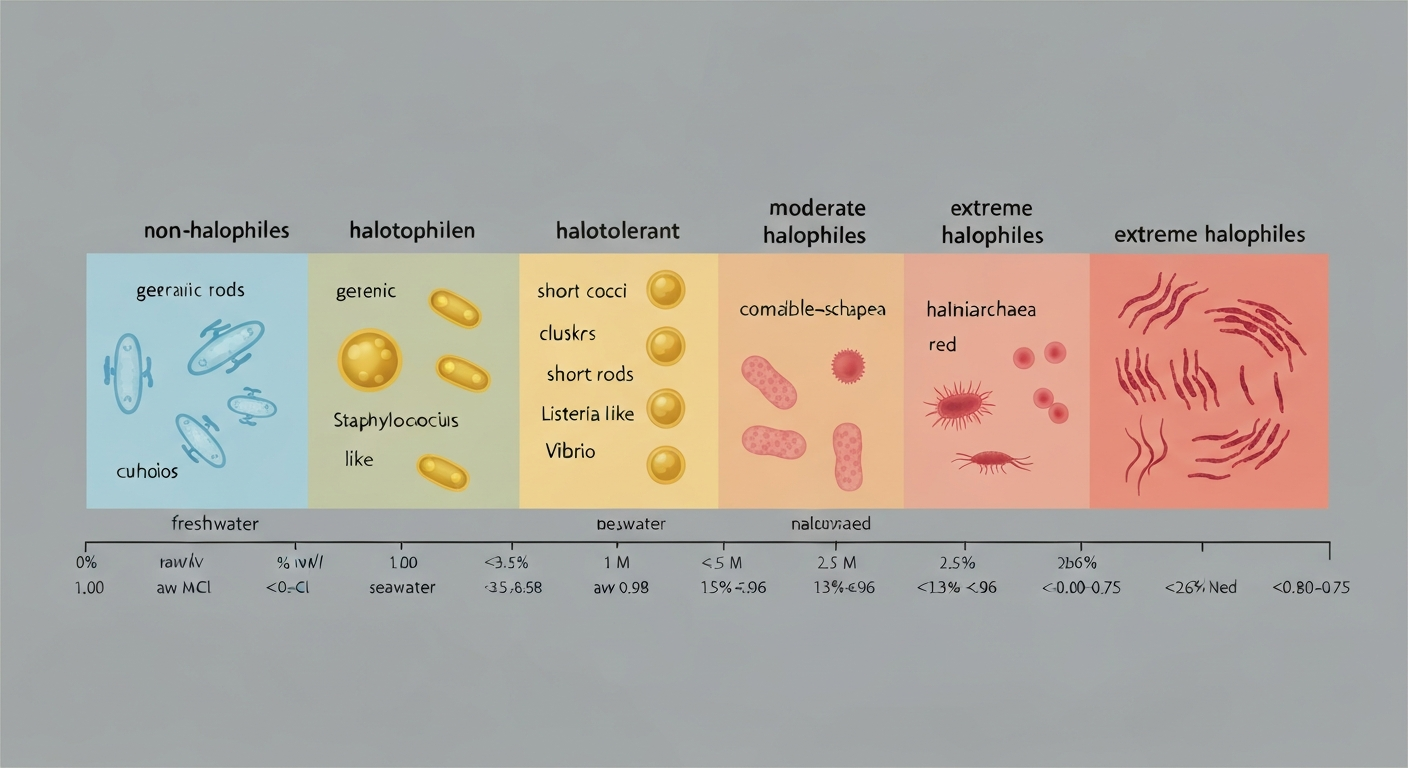
The terminology in the literature can be inconsistent, but a practical framework used by many microbiologists divides salt-associated organisms into four groups based on their growth optima.
- Non-halophiles: grow best in low-salt conditions (0–1% NaCl), inhibited at higher concentrations. Most common foodborne pathogens fall here at higher salt levels.
- Halotolerant organisms: do not require salt but can grow across a wide NaCl range, sometimes up to 10–15%. Staphylococcus aureus is the most clinically important example.
- Slight/moderate halophiles: optimal growth between approximately 0.5–2.5 M NaCl (roughly 3–15% w/v). Genera like Halomonas, Chromohalobacter, and Marinococcus belong here, as does the seafood pathogen Vibrio parahaemolyticus.
- Extreme halophiles: require very high salt, with optima above 2.5–4.0 M NaCl (15–25%+ w/v). Most are archaea (haloarchaea); the bacterium Salinibacter ruber is a notable exception.
A working rule from the Oren/Ventosa framework: an organism qualifies as halophilic if it grows optimally at or above 50 g/L NaCl (roughly 0.85 M, ~5% w/v) and tolerates at least 100 g/L (~1.7 M, ~10% w/v). Below those thresholds, 'halotolerant' is the more appropriate label.
Representative organisms: food, clinical, marine, and spoilage
Staphylococcus aureus
S. aureus is the most salt-tolerant common foodborne pathogen. It can grow at NaCl concentrations up to around 20% w/v under favorable conditions, and survives well in dry, salty environments. This explains why it is a persistent concern in cured meats and aged cheeses. One important nuance: enterotoxin production requires higher aw (typically above 0.90), so extremely salty conditions may permit growth while suppressing toxin output. This does not eliminate the risk, the cells themselves can become a toxin factory once conditions improve.
Listeria monocytogenes
Listeria can grow at aw down to roughly 0.92 in NaCl-adjusted laboratory media, which corresponds to several percent NaCl depending on the food matrix. Some experimental work documents survival or very slow growth at up to 10–12% NaCl when temperature and pH are favorable. This combination of cold tolerance and moderate salt tolerance makes it particularly problematic in ready-to-eat products that undergo refrigerated brining or curing.
Vibrio parahaemolyticus and other marine Vibrios
V. parahaemolyticus has an absolute sodium requirement for growth in some media and performs best at roughly 2–4% NaCl, matching marine conditions. It is the leading cause of seafood-associated gastroenteritis in many countries, particularly associated with raw oysters. Freshwater environments tend to inactivate it, making salinity a genuine ecological determinant rather than just a growth modifier.
Halomonas, Chromohalobacter, and moderate halophiles
Halomonas elongata is the textbook moderate halophile: it grows well above 5–7% NaCl and tolerates concentrations up to roughly 15%. It is common in salterns, brined vegetables, and marine sediments. It is not a recognized pathogen, but members of the broader Halomonadaceae family appear as spoilage organisms in heavily salted foods and marine processing environments.
Haloarchaea (extreme halophiles)
Genera such as Halobacterium, Haloferax, and Halorubrum are routinely cultured at 3–5 M NaCl (17–30% w/v), with optimum growth near 4.3 M (~25% w/v) for some strains. They cannot grow in low-salt conditions and are not foodborne pathogens, but they are responsible for the reddish 'salt burn' spoilage of heavily salted fish and hides. Salinibacter ruber is a halophilic bacterium (not archaeon) that shares similar extreme salt requirements and uses a comparable physiology.
Other notable organisms
- Salmonella spp.: less salt-tolerant than Listeria or S. aureus; growth is typically inhibited below aw ~0.94–0.95, making adequate curing effective against it.
- Escherichia coli: similarly sensitive, with growth generally inhibited at lower NaCl than S. aureus or Listeria.
- Enterococcus spp. and Cronobacter sakazakii: intermediate tolerance, positioned between the more tolerant S. aureus and the more sensitive Salmonella/E. coli.
- Debaryomyces hansenii: a halotolerant yeast commonly found in brined and cured foods; not a bacterium but worth noting in food safety contexts.
Growth limits and practical control thresholds
The table below summarizes approximate NaCl and aw growth boundaries for the organisms most relevant to food safety and spoilage. These are working estimates from the research literature; actual thresholds shift with temperature, pH, and other hurdles acting simultaneously.
| Organism | Max NaCl for growth (approx. % w/v) | Minimum aw for growth (approx.) | Notes |
|---|---|---|---|
| Staphylococcus aureus | ~20% | ~0.83–0.86 | Toxin production typically requires aw >0.90 |
| Listeria monocytogenes | ~10–12% | ~0.92 | Growth very slow near upper NaCl limit |
| Salmonella spp. | ~6–8% | ~0.94–0.95 | Inhibited by moderate salting |
| E. coli (incl. STEC) | ~6–8% | ~0.95 | Similar to Salmonella |
| Vibrio parahaemolyticus | ~8–10% (optimal 2–4%) | ~0.94 | Requires Na+; inactivated by freshwater |
| Halomonas elongata | ~15% | ~0.91 | Spoilage organism; not a pathogen |
| Haloarchaea | ~26% (saturated brine) | ~0.75 | Require very high salt; not pathogens |
For food safety control, the key practical threshold is aw 0.85. Below this level, the major bacterial pathogens cannot grow, though some can survive for extended periods. Salt brines at 20–26% NaCl achieve aw values in the 0.85–0.75 range, which is why saturated or near-saturated brines are used in traditional preservation of fish, olives, and some meats. High salt increases lag time and reduces the maximum growth rate even at concentrations that permit growth, which is why hurdle-technology approaches combining salt, refrigeration, and low pH are more effective than any single parameter alone.
How bacteria actually cope with high salt
When the external salt concentration rises, water moves out of the bacterial cell by osmosis, shrinking the cytoplasm and threatening protein function. Bacteria that survive this have evolved two main countermeasures.
Compatible solute accumulation (the 'salt-out' strategy)
Most halotolerant and moderately halophilic bacteria, including Halomonas and many common pathogens at sub-inhibitory salt levels, respond by accumulating small organic molecules called compatible solutes. These raise internal osmotic pressure without disrupting protein function. The most common compatible solutes are glycine-betaine (often taken up from the environment via high-affinity transporters), ectoine and hydroxyectoine (synthesized via the ectABC operon, well-characterized in H. Halomonas elongata synthesizes ectoine via the ectABC operon and tolerates growth from roughly 5–7% up to about 15% NaCl Halomonas elongata synthesizes ectoine via the ectABC operon and tolerates growth from roughly 5–7% up to about 15% NaCl.. elongata), proline, trehalose, and glycerol. This strategy is energetically costly and has limits, it works well across moderate salt ranges but cannot sustain growth in saturated brine.
The 'salt-in' strategy
Extreme halophiles like haloarchaea and Salinibacter ruber take a fundamentally different approach: they accumulate high concentrations of potassium (and sometimes sodium) ions inside the cell, matching the external ionic concentration. This distinction between the 'salt-in' strategy used by haloarchaea and Salinibacter ruber and the 'salt-out' compatible-solute strategy is reviewed in Strategies of adaptation of microorganisms of the three domains of life to high salt concentrations (FEMS Microbiology Reviews). This requires that every enzyme and structural protein in the cell be adapted to function in molar salt concentrations, which is why haloarchaea have characteristically acidic proteomes and cannot survive if salt is removed. The salt-in strategy is cheaper energetically than synthesizing compatible solutes, but it locks the organism into a high-salt lifestyle permanently.
Ion pumps, cell envelope adaptations, and biofilms
Beyond solute strategies, halophilic and halotolerant bacteria maintain ion homeostasis using Na+/H+ antiporters that actively export sodium from the cytoplasm. Cell envelope modifications, including changes in membrane lipid composition and surface-layer proteins, improve mechanical stability at high ionic strength. Some halotolerant organisms also form biofilms in salty environments, embedding cells in an exopolysaccharide matrix that buffers against osmotic fluctuation and reduces water loss, a factor relevant to persistence in food processing equipment and water systems.
Growing in saturated brine versus sitting on dry salt crystals
There is an important distinction between growth in a high-salt solution and contact with dry crystalline salt. In saturated brine (aw ~0.75), extreme halophiles have liquid water available, reduced, but present, so growth is physically possible. On the surface of a dry salt crystal, the local aw approaches zero; there is no free water for metabolism, and no bacterium can grow under these conditions. Bacteria can survive as dormant cells on or within salt crystals (some have been cultured from ancient halite inclusions), but survival is not growth. Dry salt curing kills or immobilizes pathogens primarily through this desiccation effect combined with the ionic stress once the salt dissolves into surface moisture.
Survival versus active growth across different water environments
Several closely related questions come up regularly in food safety and water-system management. Here are clear answers grounded in the same aw and osmotic framework.
Can bacteria grow on salt?
Not on dry crystalline salt, as discussed above. For more detail on this distinction, see can bacteria grow on salt. Where bacteria are found 'on' salt, they are typically surviving in microscopic films of saturated brine at the crystal surface, or in occluded brine inclusions within the crystal. Extreme halophiles can persist this way for a very long time, but active division requires liquid water at a permissive aw. The practical implication: dry salt does not support pathogen growth, but moist salt surfaces in food processing environments can harbor halotolerant organisms.
Can bacteria grow in ordinary tap or surface water?
Yes, readily. See can bacteria grow in water for detailed guidance on the risks, key control parameters, and common organisms involved. Ordinary freshwater has an aw of essentially 1.00 and no salt-based inhibition. Many bacteria grow freely in water when nutrients are available, including opportunistic pathogens like Pseudomonas aeruginosa and Legionella pneumophila. The absence of salt in water removes one barrier, making temperature, nutrient levels, and disinfectant residuals the primary control parameters.
Can bacteria grow in reverse osmosis (RO) water?
RO filtration removes dissolved solids and reduces total dissolved solids to near zero, but it does not sterilize water. Post-membrane, bacteria with very low nutrient requirements (oligotrophs such as Sphingomonas and Ralstonia spp.) can colonize RO membranes and storage tanks, sometimes forming biofilms. For more detail on whether bacteria can grow in RO water, see can bacteria grow in RO water. RO permeate actually lacks the mineral salts that would inhibit halotolerant organisms from the opposite direction, low mineral content simply means there is no osmotic barrier to growth at all, so any nutrient input supports colonization.
Can bacteria grow in a water softener?
Water softeners contain two potentially problematic zones: the resin bed and the brine tank. The resin bed operates at near-neutral ionic strength and, if not maintained, can support biofilm growth by heterotrophic bacteria. The brine tank holds saturated or near-saturated NaCl solution (aw ~0.75), which prevents growth by most organisms but can harbor extreme halophiles and some halotolerant bacteria over time. Stagnant brine, contaminated salt, and infrequent cleaning create conditions for microbial accumulation in the brine compartment. Routine cleaning and using food-grade salt are the standard control measures.
Can bacteria grow in dry conditions or without water?
No bacterium can actively grow without water. At aw below roughly 0.60, all known microbial growth ceases. Below aw 0.85, most bacterial pathogens cannot divide even if nutrients are available. In dry conditions (aw < 0.60), bacteria can survive as dormant or desiccation-resistant forms for extended periods, some Bacillus and Clostridium spores are exceptional examples, but survival is categorically different from growth. For a focused discussion, see can bacteria grow in dry conditions. This distinction is central to understanding why dry foods are shelf-stable yet can still carry bacterial contamination that activates when rehydrated.
Measurement and monitoring in practice
For food safety professionals, aw measurement using calibrated benchtop meters (chilled-mirror or capacitance-based) gives the most reliable picture of growth risk. NaCl percentage can be measured quickly with a refractometer or titration in brine solutions and is useful for rapid process checks. The two measurements complement each other: aw accounts for the combined effect of all solutes, while NaCl% tracks the primary preservative agent in salted products.
In water system management, total dissolved solids (TDS) meters, conductivity probes, and periodic microbiological plate counts (heterotrophic plate count) are the standard monitoring tools. For systems with high-salt contact zones such as softener brine tanks, swab sampling followed by culture on non-selective and halophile-specific media (e.g., media supplemented with 10–20% NaCl) gives a more complete picture of who is present.
Practical control and prevention
Salt works best as one component of a hurdle system. Combining reduced aw (through salting) with refrigeration (slowing growth rate), adjusted pH (acid inhibition), and where appropriate, heat treatment or antimicrobials, gives far more reliable control than salt alone. The key practical points:
- Target aw below 0.85 if you want to stop major bacterial pathogen growth in shelf-stable foods. For products that will be refrigerated, aw below 0.92–0.94 combined with cold chain significantly reduces Listeria and Salmonella risk.
- Do not assume that a visually salty product is microbiologically safe. A 3–5% brine (common in many cured products) does not approach inhibitory aw for S. aureus or Listeria.
- Monitor salt concentration throughout processing, not just at formulation. Dilution by surface moisture, rinsing steps, and uneven penetration in large cuts can create low-salt microenvironments within a nominally high-salt product.
- For water softeners, drain and clean the brine tank at least annually (more frequently in high-use systems), inspect resin beds for biofilm, and use food-grade salt to minimize contamination introduced with the salt itself.
- In RO systems, address post-membrane contamination separately from the membrane's filtration performance. Sanitize storage tanks and distribution lines on a scheduled basis and consider UV disinfection on the product side.
- When evaluating spoilage in heavily salted products (fish, hides, salterns), consider halophilic archaea and extreme halophilic bacteria as the likely agents, not the common foodborne pathogens used to design standard preservation protocols.
Comparing salt tolerance across the key organisms
If you need to decide whether a given salting level adequately controls a specific organism, the comparison below gives a ranked view. For most food-safety applications, S. aureus sets the hardest target: if your salt/aw combination inhibits S. aureus growth, it will generally inhibit Listeria, Salmonella, E. coli, and Vibrio as well.
| Organism | Category | Salt tolerance rank (higher = more tolerant) | Key food/environment context |
|---|---|---|---|
| Haloarchaea (e.g., Halobacterium) | Extreme halophile | 5 (highest) | Salt fish, hides, solar evaporation ponds |
| Salinibacter ruber | Extreme halophile (bacterium) | 5 | Salterns, evaporation ponds |
| Halomonas elongata | Moderate halophile | 4 | Marine/saltern spoilage, brined vegetables |
| Staphylococcus aureus | Halotolerant pathogen | 3 | Cured meats, aged cheese, skin/nasal carriage |
| Listeria monocytogenes | Halotolerant pathogen | 2 | RTE meats, soft cheese, cold-smoked fish |
| Vibrio parahaemolyticus | Slight halophile/pathogen | 2 | Raw shellfish, marine seafood |
| Salmonella spp. | Non-halophile | 1 | Poultry, eggs, produce |
| E. coli / STEC | Non-halophile | 1 | Ground beef, produce, water |
Understanding where an organism sits on this spectrum helps calibrate which preservation parameters matter most. For products where S. aureus is the key hazard, you need aw well below 0.90 to fully arrest growth. For Salmonella control, achieving aw around 0.94 with appropriate temperature management is generally sufficient. No salt-based approach replaces the need to verify the actual aw of the finished product, because food matrices interact with NaCl in ways that formulation calculations alone do not always predict accurately.
FAQ
What do we mean by “high salt” for microbial growth (NaCl % and water activity)?
High salt can be expressed as % NaCl (w/v) or water activity (a_w). Practical thresholds: most bacterial pathogens require a_w >0.90–0.95 to grow; FDA notes a_w >0.85 as a regulatory breakpoint for temperature control. In NaCl terms: seawater ≈3.5% NaCl; moderate halophiles grow optimally ≈3–15% NaCl (≈0.5–2.5 M); extreme halophiles/haloarchaea grow at several molar salt (≈15–30% NaCl). Water activity is the primary predictor of growth because solutes other than NaCl similarly depress a_w.
Which microbes can grow in high‑salt environments?
Three broad groups: 1) Halophilic archaea (Haloarchaea, e.g., Haloferax, Halobacterium) that require very high NaCl (typically ≈15–30% w/v). 2) Moderate halophilic bacteria (e.g., Halomonas, Chromohalobacter, Salinicoccus) growing well at ≈3–15% NaCl. 3) Halotolerant bacteria/foodborne organisms (e.g., Staphylococcus aureus, some Listeria, Enterococcus, Cronobacter) that tolerate elevated salt and may grow at intermediate salinities depending on a_w, temperature and matrix. Yeasts and molds often tolerate lower a_w than bacteria and can grow when many bacteria cannot.
Which common pathogens tolerate or grow at elevated salt levels?
Staphylococcus aureus is notably salt‑tolerant; growth has been reported at high NaCl (reports up to ≈20% in some lab conditions), though toxin production depends on a_w and other factors. Listeria monocytogenes can survive and sometimes grow at reduced a_w/NaCl (reports up to ≈10–12% NaCl under favorable conditions). Enterococci, some Cronobacter strains and certain Vibrio species (marine vibrios) are halotolerant/halophilic. Salmonella and E. coli are generally less salt‑tolerant and are inhibited at lower NaCl than S. aureus or Listeria.
Can bacteria grow directly on dry table salt or salt crystals?
No — growth requires available water (sufficient a_w) and nutrients. Dry salt crystals have extremely low water activity and are microbiologically inhibitory. Microbes may survive on dry salt surfaces (spores or dormant cells) but cannot metabolically grow on dry crystalline salt. Growth in saline systems requires an aqueous phase (solution, brine, or hydrated food matrix).
How do microbes tolerate high osmotic stress — what are the main mechanisms?
Two principal strategies: 1) Compatible‑solute strategy: many halotolerant/moderate halophiles synthesize or uptake organic osmolytes (glycine‑betaine, ectoine, proline, trehalose) to balance external osmotic pressure without disrupting proteins. 2) Salt‑in strategy: some extreme halophiles (e.g., haloarchaea, Salinibacter) accumulate high intracellular KCl/NaCl and have adapted proteomes to function at high ionic strength. These strategies determine how much salt a microbe can tolerate and whether it requires high salt to grow.
What environmental factors interact with salt to determine growth vs survival?
Temperature, pH, nutrient availability, and the nature of the solute all interact with salinity. Lower temperatures and unfavorable pH increase salt tolerance for some species but generally lengthen lag times and reduce growth rates. Solutes other than NaCl (e.g., sugars) depress a_w differently. Food matrix binding and microenvironments (e.g., pockets of moisture) can permit localized growth even when bulk measurements suggest inhibition.
Next Article
Can Bacteria Grow Without Water? Water Activity Explained
Bacteria need available water to multiply. Learn water activity limits, exceptions on dry foods, and safety storage tips