Salmonella does not grow reliably on mannitol salt agar (MSA). The medium's 7.5% sodium chloride concentration is the main reason: most Salmonella strains reach their upper NaCl tolerance somewhere between 3.9% and 6.0%, so the salt load in MSA is simply too high for them to establish visible growth. MSA is designed to select for salt-tolerant staphylococci, not Gram-negative Enterobacterales like Salmonella. If you are trying to isolate or detect Salmonella from a food, clinical, or environmental sample, MSA is the wrong medium and will give you a false negative in almost every practical scenario.
Does Salmonella Grow on Mannitol Salt Agar: Practical Guide

Marcus Reeves
21 Jul 2026
What mannitol salt agar actually is
MSA is a combined selective and differential medium. Its three defining components work together to do a specific job. The high sodium chloride content, formulated at approximately 75 g per liter (7. FDA BAM media specification M97 lists NaCl at 75 g per liter (7.5% w/v) in Mannitol Salt Agar FDA BAM media specification M97 lists NaCl at 75 g per liter (7.5% w/v) in Mannitol Salt Agar.. 5% w/v) per the FDA Bacteriological Analytical Manual media specification M97, creates an environment that most bacteria simply cannot tolerate. The medium also contains mannitol at roughly 10 g per liter, and a phenol red pH indicator at about 0.025 g per liter. The final pH is set at approximately 7.4.
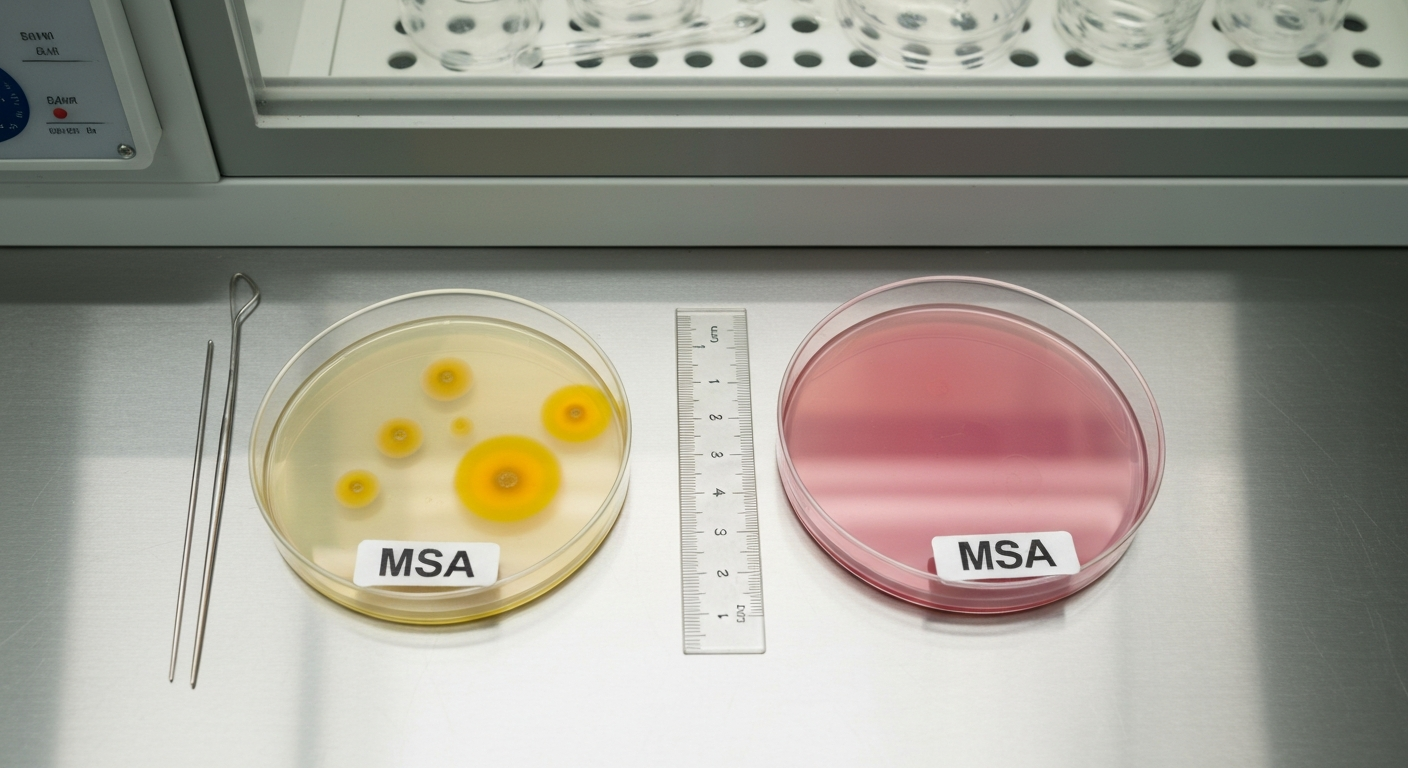
The selectivity is entirely built around salt tolerance. Organisms that cannot survive high NaCl concentrations are killed or suppressed before they ever get a chance to ferment mannitol. The organisms that do survive, principally Staphylococcus aureus and related staphylococci, are then differentiated by what they do to the mannitol. When mannitol is fermented, acid production lowers the pH and turns the phenol red indicator from its original red-pink color to yellow. Mannitol-fermenting colonies (like S. aureus) produce a yellow halo around them. Non-fermenting colonies leave the medium red or pink.
That differential readout is clinically meaningful for staphylococci: mannitol fermentation is a classic marker that helps distinguish S. aureus from coagulase-negative staphylococci. But this entire logic only applies to organisms that survived the NaCl barrier in the first place. For most Gram-negative bacteria, including Salmonella, that barrier is the end of the story.
Salmonella cell biology: why it matters for culture media
Salmonella enterica, the species responsible for the vast majority of human salmonellosis cases, is a Gram-negative, facultatively anaerobic bacillus belonging to the order Enterobacterales. Its Gram-negative status is directly relevant here. The Gram-negative cell envelope consists of an inner plasma membrane, a thin peptidoglycan layer, and an outer membrane containing lipopolysaccharide. This architecture gives Gram-negative bacteria different osmotic properties and different sensitivities to various selective agents compared to Gram-positive organisms like staphylococci.
Being a facultative anaerobe means Salmonella can grow with or without oxygen, which matters for enrichment broth strategies but is less relevant to MSA performance. Its metabolic versatility also means it can ferment a range of sugars, and many serovars do ferment mannitol. However, that fermentation capability is irrelevant on MSA if the organism is already inhibited at the NaCl stage. Some serovars are also mannitol-variable, meaning you cannot even rely on a yellow color change as a consistent marker for Salmonella if it somehow did grow.
Salmonella's environmental growth requirements
Understanding where Salmonella does and does not grow helps frame why the MSA conditions are so hostile to it. Temperature, pH, water activity, and salt concentration all set the boundaries for whether a population can expand. For a concise summary, see what conditions does salmonella need to grow.
Temperature
Salmonella grows optimally between roughly 35°C and 37°C. The maximum permissive temperature is around 45-47°C. At the cold end, the minimum growth temperature is approximately 5.2 to 5.3°C under favorable pH and water activity conditions, though practical food safety guidance generally treats 3°C or below as a threshold that reliably prevents multiplication. Around 7°C, growth is possible depending on strain and matrix. Standard refrigeration at 4°C or below does not kill Salmonella but does suppress growth for most strains. For more detail on growth at refrigeration temperatures, see can salmonella grow in a refrigerator. See can salmonella grow in cold temperatures for more detail on Salmonella's ability to survive and, in some cases, slowly multiply near refrigeration temperatures.
pH and water activity
Modeling work on Salmonella Typhimurium places the minimum pH for growth at approximately 3.94 and the minimum water activity at approximately 0.942 under favorable temperatures (25-35°C). Below either of those thresholds, growth stops, though the organism may survive for extended periods. The upper pH limit is around 9.0-9.5. These boundaries explain why acidic foods and dry low-aw environments are effective hurdles, even though they do not guarantee kill.
Oxygen requirements
As a facultative anaerobe, Salmonella grows in both aerobic and anaerobic conditions. This means oxygen availability is not a meaningful barrier to its growth in most food, clinical, or laboratory settings. It matters more for understanding which enrichment broths and incubation setups are appropriate.
Salt tolerance
This is the critical parameter for MSA. Experimental gradient-plate work has shown that maximum visible growth for tested Salmonella strains occurs at NaCl concentrations ranging from about 3. Testing multiple variables on the growth of a mixed inoculum of Salmonella strains using gradient plates | ScienceDirect reports maximum visible Salmonella growth across tested strains at NaCl concentrations from ≈3.9% to ≈6.0%. 9% to 6.0%, with considerable strain-to-strain variability. Multi-strain studies on 60 S. enterica isolates confirmed significant growth rate reductions as NaCl concentration increased through that range. At 7.5% NaCl, the concentration in MSA, most strains face severe growth inhibition or complete suppression.
What actually happens when Salmonella meets MSA
In routine practice, you should expect no visible growth, or at most extremely sparse, stressed colonies that cannot be relied on for identification. The 7.5% NaCl is above the tolerance ceiling for the overwhelming majority of Salmonella strains encountered in food, clinical, or environmental samples. This is not a subtle inhibition; it is a hard physiological barrier.
Even in the rare scenario where a salt-tolerant strain produced a few colonies, the differential readout would be unreliable. Salmonella mannitol fermentation is variable across serovars, so you might see yellow halos (suggesting S. aureus to an untrained eye) or no color change at all. Neither result would tell you anything useful about Salmonella, and the more dangerous outcome is interpreting the absence of growth as a confirmed negative for the pathogen. That conclusion would be wrong.
There is no validated scenario in standard methods where MSA serves as a useful screening tool for Salmonella. Any apparent growth that does appear should prompt re-plating onto appropriate Salmonella-selective media rather than interpretation directly from the MSA plate.
The right media and protocols for isolating Salmonella
Established methods from the FDA Bacteriological Analytical Manual (BAM), ISO 6579, and USDA-FSIS all follow the same basic workflow: pre-enrichment in a non-selective broth, selective enrichment in specialized broths, plating onto Salmonella-specific agars, and then biochemical or molecular confirmation. This multi-step approach dramatically increases sensitivity compared to any single direct-plating approach.
Pre-enrichment
The first step is to resuscitate stressed or low-level Salmonella cells without yet applying selective pressure. Buffered peptone water (BPW) is the standard pre-enrichment broth used in ISO 6579 and broadly recommended in food safety methods. The sample is incubated in BPW at 37°C for roughly 16-20 hours. This step is especially important for processed foods where the pathogen may be present at very low numbers or in a sub-lethally stressed state.
Selective enrichment
After pre-enrichment, a portion of the BPW culture is transferred into selective enrichment broths that suppress competing flora while allowing Salmonella to proliferate. Rappaport-Vassiliadis (RV) broth and modified RV soya (RVS) broth are the primary options in ISO 6579, typically incubated at 41.5-42°C. Tetrathionate broth and selenite cystine broth are used in FDA and USDA methods, usually at 35-37°C. Using two different enrichments in parallel increases the probability of recovery across different sample types and serovars.
Selective and differential plating agars
From the enrichment broths, samples are plated onto Salmonella-selective agars. Each has its own selectivity profile and colony morphology:
| Medium | Selective agents | Salmonella colony appearance | Notes |
|---|---|---|---|
| Xylose Lysine Deoxycholate (XLD) | Bile salts, sodium deoxycholate | Pink-red with black center (H2S) | Recommended in ISO 6579; good sensitivity |
| Hektoen Enteric (HE) | Bile salts, dyes | Blue-green with black center | Good for H2S-producing Salmonella |
| Salmonella-Shigella (SS) agar | Bile salts, brilliant green, neutral red | Colorless with black center | Can inhibit some stressed strains |
| Brilliant Green Agar (BGA) | Brilliant green dye | Pink-red, opaque | Useful for non-H2S producers |
| MacConkey agar | Bile salts, crystal violet | Colorless (non-lactose fermenter) | Less selective, useful for general screening |
| Chromogenic Salmonella media | Chromogenic substrates | Purple or pink colonies (product-specific) | High specificity, fewer false positives |
ISO 6579 currently recommends XLD as the primary plating medium. Using two different selective agars in parallel remains best practice in many food testing laboratories to catch strains that may be partially inhibited on one medium.
Confirming suspected Salmonella colonies
Suspicious colonies from selective agar plates always require confirmation. Visual appearance alone is not sufficient for a reportable Salmonella result. The confirmation workflow typically combines biochemical testing, serological testing, and increasingly, molecular methods.
Biochemical screening
Triple sugar iron (TSI) agar and lysine iron agar (LIA) are classical first-line confirmation tools. On TSI, typical Salmonella produces an alkaline slant with an acid butt, often with gas production and H2S blackening. On LIA, Salmonella typically gives an alkaline reaction throughout with H2S. Urease testing is also important: Salmonella is urease-negative, which helps distinguish it from Proteus and some other organisms that can mimic its appearance on selective agars.
Serotyping
Serological confirmation using polyvalent O and H antisera (Kauffmann-White scheme) establishes the serogroup and, ultimately, the serovar. Slide agglutination with group-specific antisera is a standard step in most food safety and clinical reference laboratories. Full serotyping to the serovar level requires a reference laboratory in most settings.
Automated and molecular confirmation
MALDI-TOF mass spectrometry has become a standard tool in clinical and food safety laboratories for rapid species-level identification of isolates in minutes rather than hours. PCR-based methods, including real-time PCR targeting invasion genes such as invA, are used both for confirming isolates and for direct detection from enrichment broths. Whole genome sequencing (WGS) is increasingly used in outbreak investigations and reference laboratories to provide serovar determination, antimicrobial resistance profiling, and epidemiological linkage from a single assay.
Practical implications for food safety testing and clinical labs
The core practical message is straightforward: MSA is not on any validated Salmonella detection method, and using it for that purpose will produce false negatives. In a food safety testing context, a false negative for Salmonella is not an acceptable outcome. If a product is cleared based on a culture result from MSA, that result provides no meaningful assurance about Salmonella status.
In a clinical lab context, the same principle applies. Stool cultures for enteric pathogens including Salmonella rely on MacConkey, XLD, HE, or SS agar, not MSA. If a clinical sample is inadvertently plated only onto MSA (perhaps during a mixed or incomplete workup), Salmonella would almost certainly be missed.
MSA can also create confusion if a student or technician sees sparse or atypical growth and attempts to interpret it. A non-lactose-fermenting, urease-negative Gram-negative rod growing poorly on MSA should trigger immediate re-plating onto proper Salmonella-selective media and full confirmation workflow, not interpretation from the MSA plate alone.
One scenario where this question becomes especially relevant is when a lab is working with a mixed culture or an unknown sample and is screening for both staphylococci and Gram-negative enteric pathogens simultaneously. MSA handles the staphylococci side of that question. For the enteric pathogens, a parallel plate onto MacConkey or a Salmonella-selective agar is always required. The two investigations need different media; there is no single plate that does both jobs.
A note on biosafety and sample handling
Salmonella work in food testing and clinical settings is conducted at biosafety level 2 (BSL-2). Live cultures should be handled in a biosafety cabinet when aerosol generation is possible. Pre-enrichment and enrichment broths can contain high Salmonella concentrations even from samples with initially low contamination levels, which is part of why enrichment works but also means that enriched cultures require appropriate containment.
Choosing the right medium: MSA vs. Salmonella-targeted options
| Parameter | MSA | XLD / HE / Salmonella-selective agars |
|---|---|---|
| Target organism | Staphylococcus spp. | Salmonella spp. (and other enteric pathogens) |
| Selective agent | 7.5% NaCl | Bile salts, dyes, specific inhibitors |
| Salmonella recovery | Not expected (NaCl inhibitory) | Designed for reliable recovery |
| Differential indicator | Phenol red (mannitol fermentation) | H2S, lactose/xylose fermentation, chromogenic enzymes |
| Use in validated Salmonella methods | No | Yes (ISO 6579, FDA BAM, USDA-FSIS) |
| False-negative risk for Salmonella | Very high | Low when combined with enrichment steps |
If your goal is Salmonella detection, the choice is clear. Follow pre-enrichment in buffered peptone water, selective enrichment in RV or tetrathionate broth, and plating onto XLD or HE agar as your primary approach. MSA belongs in the staphylococci workflow, not the Salmonella one.
FAQ
Does Salmonella grow on mannitol salt agar (MSA)?
Generally no. Standard MSA contains ~7.5% NaCl which is inhibitory to most Salmonella enterica strains; routine recovery or isolation of Salmonella on standard MSA is not expected for most strains and therefore MSA is not appropriate for Salmonella detection.
What in MSA makes it selective and why does that inhibit Salmonella?
MSA combines high sodium chloride (~7.5% w/v) to select for salt‑tolerant organisms, mannitol as the fermentable carbohydrate, and phenol red as a pH indicator. The high NaCl selects for halotolerant Gram‑positive staphylococci and suppresses many Gram‑negative Enterobacterales (including most Salmonella). If Salmonella growth is suppressed by osmotic stress, it will not be recovered on MSA.
Could any Salmonella strain grow on MSA or give a misleading result?
Rarely. Salt tolerance varies by strain and environmental history; a highly salt‑adapted or unusually tolerant Salmonella strain might grow at lower levels of inhibition, but this is uncommon. If a salt‑tolerant Salmonella did grow, many Salmonella strains do not ferment mannitol, so colonies would typically not produce the yellow acid reaction; this makes interpretation unreliable and false negatives possible.
What would Salmonella colonies look like on MSA if they grew?
If a salt‑tolerant Salmonella grew, colonies would usually remain on the red/pink (non‑acidified) medium because most Salmonella do not ferment mannitol; colonies would lack the yellow halo typical of mannitol fermenting staphylococci. However, growth is generally weak or absent and atypical appearances can occur, so visual identification on MSA is not a reliable diagnostic indicator.
What Salmonella biological traits explain its poor growth on MSA?
Salmonella are Gram‑negative, facultative anaerobic Enterobacterales with limited tolerance for high NaCl concentrations. Salt at ~7.5% causes osmotic stress that inhibits most Salmonella cell growth. Mannitol fermentation is variable among serovars, so even if growth occurs the differential signal may not appear.
What temperature, pH, water activity (aw) and oxygen ranges affect Salmonella growth?
Temperature: Salmonella grows optimally 35–37°C; minimum growth temperatures can be near ~5–7°C depending on strain (growth at refrigeration temperatures is slow or absent for many strains). pH: growth generally occurs above ~4.0 (minimum ≈3.9–4.0 under favorable conditions). Water activity: minimum aw for growth is ≈0.94. Oxygen: Salmonella is a facultative anaerobe and can grow with or without oxygen, but plating is typically aerobic.
Next Article
What Conditions Does Salmonella Need to Grow?
Learn Salmonella growth needs: temperature, pH, water activity, nutrients, oxygen, salt and how to prevent proliferation