Salmonella grows actively between about 40°F and 140°F (4°C to 60°C). You can think of where Salmonella grows as the same temperature range that supports rapid bacterial multiplication in food. Within that range, it multiplies fastest around 98°F to 109°F (37°C to 43°C), which is close to human and animal body temperature. Keep food colder than 40°F or hotter than 140°F, and you either stop growth entirely or slow it to a crawl. Those two numbers are the ones worth memorizing.
What Temperature Does Salmonella Grow? Key Limits

Marcus Reeves
20 May 2026
Growth vs. survival: why this distinction matters
There is a real difference between Salmonella growing and Salmonella surviving, and mixing them up leads to bad decisions. Growth means the bacteria are actively dividing and numbers are increasing. Survival means the cells are still alive but not multiplying. At refrigerator temperatures, Salmonella largely survives without growing much. Frozen, it survives for months or even years without dividing at all. The risk from growth is that a food that started with a small, possibly harmless number of cells can reach an infectious dose within hours if it sits in the wrong temperature range.
This is why temperature control is the cornerstone of Salmonella prevention. You are not trying to kill it with cold, you are trying to stop it from multiplying to levels that cause illness. Killing is a different job, and that requires heat.
Minimum, optimal, and maximum temperatures for Salmonella growth
| Temperature Threshold | °F | °C | What Happens to Salmonella |
|---|---|---|---|
| Minimum growth temperature | ~40°F | ~4°C | Growth essentially stops; survival only |
| Lower edge of active growth | ~50°F | ~10°C | Very slow growth possible |
| Optimal growth range | 98–109°F | 37–43°C | Fastest doubling; most dangerous range |
| Upper edge of active growth | ~131°F | ~55°C | Growth slows sharply |
| Maximum growth temperature | ~140°F | ~60°C | Growth stops; survival still possible briefly |
| Pasteurization/kill zone | 145–165°F+ | 63–74°C+ | Cells begin to die; time and temp determine kill rate |
The minimum growth temperature is generally cited around 40°F (4°C), which is exactly why the FDA Food Code sets 41°F (5°C) as the cold holding limit for Time/Temperature Control for Safety (TCS) foods. At the other end, growth stops around 140°F (60°C), which aligns with the FDA and USDA hot holding standard of 135°F to 140°F. Between those two limits is what USDA FSIS calls the 'Danger Zone,' defined as 40°F to 140°F.
What refrigeration, freezing, and thawing actually do
Refrigeration
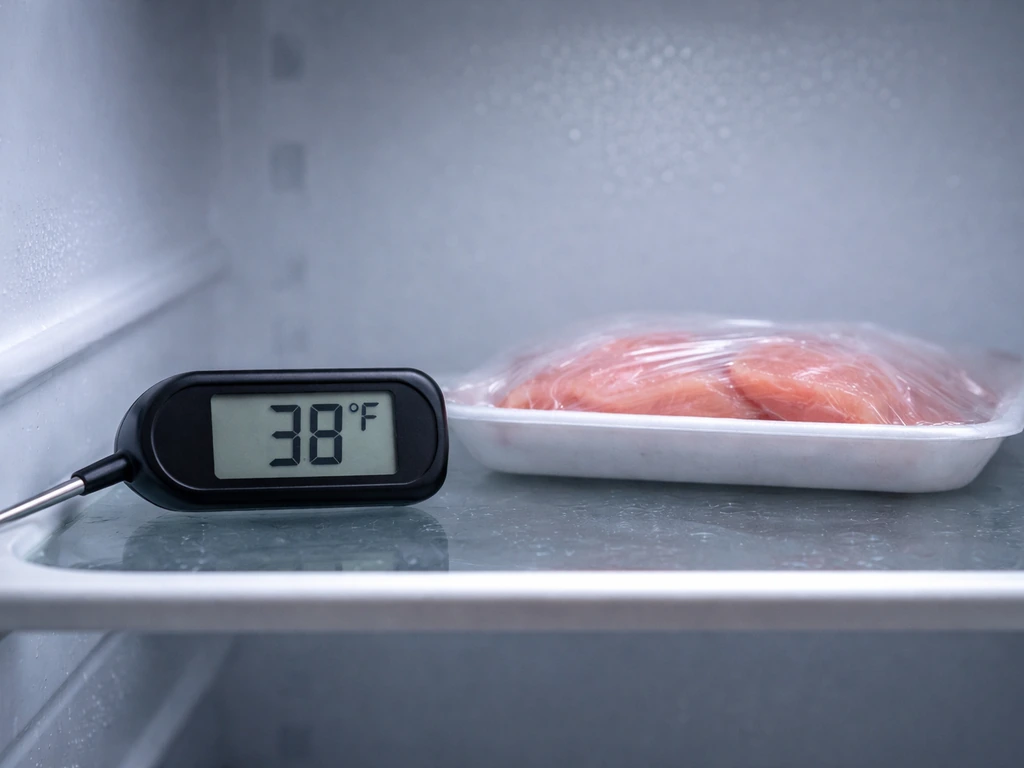
A refrigerator set at or below 40°F (4°C) keeps Salmonella in a state of suspended activity. It does not kill the bacteria, but it stops meaningful multiplication. USDA FSIS recommends keeping your refrigerator at 40°F or below throughout the unit, not just at the thermostat setting, since door-side shelves and overcrowded interiors can run warmer. If your fridge fluctuates above 40°F regularly, food that has been sitting in it for several days is at more risk than you might assume.
Freezing
Freezing puts Salmonella into dormancy. Cells survive but cannot grow, and some percentage die over time. The critical point people miss: freezing is not a decontamination step. If food was heavily contaminated before freezing, it will still be contaminated when thawed. USDA guidance notes that food can be safely refrozen if it has remained at 40°F or below, or still contains ice crystals, because that means it never warmed into the growth zone. USDA FSIS also notes that it is safe to refreeze food if it has remained at 40°F or below, or if it still contains ice crystals, since it never warmed into the Salmonella growth zone safe to refreeze if it has remained at 40°F or below or still contains ice crystals.
Thawing
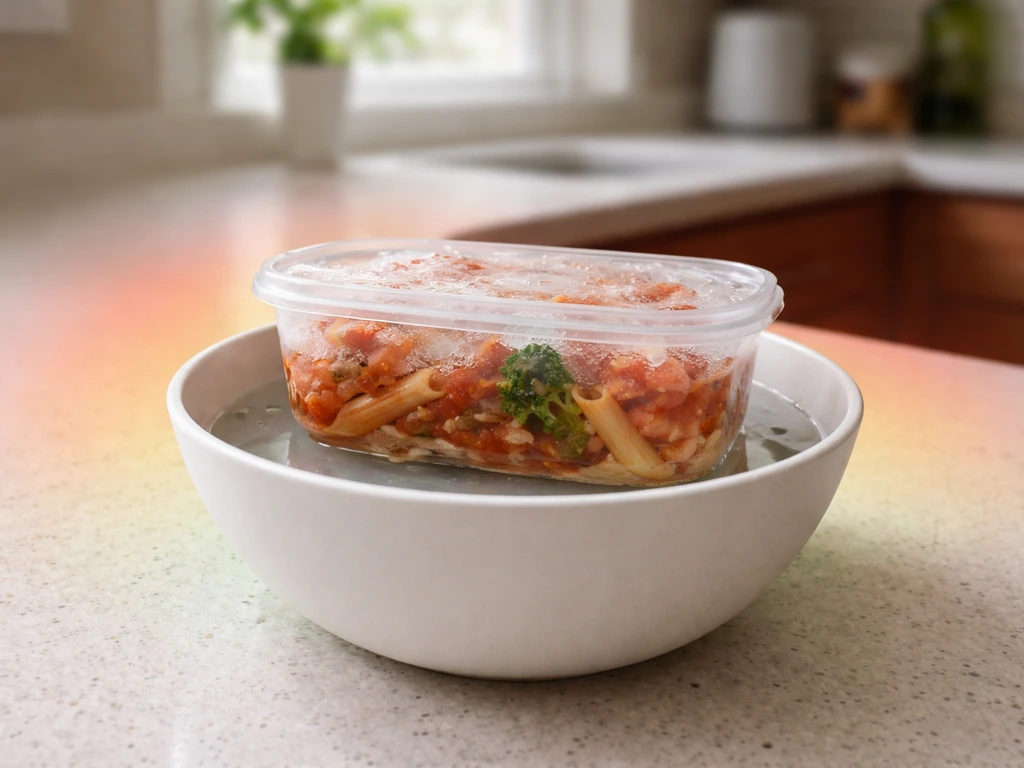
Thawing is where most temperature problems happen. Food thawing on a counter at room temperature will spend hours in the danger zone, giving any Salmonella present a chance to multiply. The FDA Food Code requires TCS foods to be thawed so the food temperature stays at 41°F (5°C) or below. USDA FSIS recommends thawing in the refrigerator as the safest method because the food stays at a constant safe temperature throughout. Cold running water (at 70°F or below) and microwave thawing followed by immediate cooking are the other acceptable methods.
Hot holding, warming, and the danger zone timing problem
The FDA Food Code sets 135°F (57°C) as the hot holding minimum for TCS foods. USDA FSIS sets it at 140°F. In practice, keeping hot food at or above 140°F is the widely applied rule for food service. Once food drops below that temperature and enters the danger zone, a clock starts. USDA FSIS advises that bacteria can grow to dangerous levels when food sits in the 40°F to 140°F range for more than two hours total (or one hour if the ambient temperature is above 90°F, like at an outdoor event).
Two hours is cumulative, not per exposure. If food sat out for 45 minutes at lunch and then another 90 minutes at dinner, it has exceeded the two-hour window even though neither single stretch felt long. This is the timing risk that gets people in trouble at buffets, holiday meals, and catered events.
The FDA Food Code also has specific cooling rules that address the same problem in reverse. When cooked food needs to be cooled and stored, it must drop from 135°F (57°C) to 70°F (21°C) within two hours, and then from 70°F to 41°F (5°C) or below within the next four hours, for a total cooling window of six hours. If cooling is too slow, food lingers in the Salmonella growth zone long enough for numbers to climb even in food that was just cooked.
Cooking and pasteurization: kill vs. growth
Heat above 140°F stops Salmonella from growing, but killing it reliably requires higher temperatures held for a specific time. Salmonella is destroyed by a combination of temperature and exposure duration. The standard safe internal cooking temperatures recommended by USDA FSIS are 145°F (63°C) for whole cuts of beef, pork, lamb, and fish (with a 3-minute rest), 160°F (71°C) for ground meats, and 165°F (74°C) for poultry and any previously cooked reheated food.
Pasteurization works on the same principle but at lower temperatures held for longer times. Milk pasteurized at 145°F for 30 minutes (vat pasteurization) achieves the same reduction in Salmonella as high-temperature short-time (HTST) processing at 161°F for 15 seconds. The higher the temperature, the shorter the time needed to reach the same kill. This is why sous vide cooking at 140°F for an extended hold time can be considered safe even though 140°F is just at the edge of the growth range.
One practical point: a surface temperature reading is not enough. Salmonella inside a thick piece of meat or a stuffed dish can still be at growth temperatures even when the outside looks cooked. Use a calibrated probe thermometer inserted into the thickest part.
Other conditions that change Salmonella's growth behavior
Temperature is the most important lever, but it does not work in isolation. Several other environmental factors interact with temperature to either speed up or slow down Salmonella growth, and understanding them helps explain why the same food can be riskier in one context than another. Salmonella can also grow under low-oxygen conditions. For example, the specific conditions that affect Salmonella growth include how warm the food is, how long it stays in that range, and whether it is refrigerated or held hot.
- pH: Salmonella grows best between pH 6.5 and 7.5 (near neutral). It can still grow down to about pH 3.8 under ideal conditions, but acidic foods like properly fermented pickles, vinegars, and citrus-based marinades inhibit growth significantly. However, acid alone is not a reliable kill step at room temperature.
- Water activity (moisture): Salmonella needs a water activity (aw) of at least 0.94 to grow. Dry foods like whole spices, flour, and chocolate have low water activity and do not support active growth, yet Salmonella can survive in them for months. This explains outbreaks linked to dry or low-moisture foods that were never 'wet' enough to seem risky.
- Oxygen: Salmonella is a facultative anaerobe, meaning it grows with or without oxygen. Vacuum packaging and modified atmosphere packaging do not stop Salmonella growth the way they stop some other pathogens. Temperature remains the critical control point in those situations.
- Food matrix and fat content: High-fat foods like peanut butter and chocolate can actually protect Salmonella from heat, raising the effective kill temperature needed. Foods with higher protein and fat content may require more conservative cooking temperatures or longer hold times.
These factors become especially relevant for food safety professionals and formulators designing products or kill steps. For most home and food service contexts, controlling temperature and time remains the primary and most practical tool.
Practical rules based on Salmonella's temperature limits
Here is how to translate the temperature science into daily handling decisions:
- Keep cold food cold: Refrigerate TCS foods at 40°F (4°C) or below. Check your fridge with a thermometer, not just the dial, especially if you have an older unit.
- Keep hot food hot: Hold hot foods at 140°F (60°C) or above. Use chafing dishes, slow cookers on warm, or steam tables to maintain temperature throughout service.
- Respect the two-hour rule: Any TCS food that has been in the 40°F to 140°F range for a combined total of two hours should be reheated to 165°F or discarded. At ambient temperatures above 90°F, the window drops to one hour.
- Thaw safely: Thaw in the refrigerator, under cold running water, or in the microwave with immediate cooking. Never thaw on the counter at room temperature.
- Cook to verified internal temperatures: Use a probe thermometer. Poultry to 165°F, ground meats to 160°F, whole cuts of beef, pork, lamb, and fish to 145°F with a 3-minute rest.
- Cool cooked food quickly: Get cooked food from 135°F to 70°F within two hours, then to 41°F within the next four hours. Use shallow pans, ice baths, or blast chillers to speed this up.
- Do not rely on freezing to make contaminated food safe: Freeze to stop growth and preserve, not to decontaminate. Proper cooking after thawing is still required.
- Remember that dry does not mean safe: Low-moisture foods can carry Salmonella without supporting active growth. Handle raw flour, spices, and nuts with the same hygiene you would apply to raw meat.
Temperature control is the single most reliable tool you have against Salmonella in most food handling situations. Mannitol salt agar is used to isolate staphylococci, so it is not the main medium people use to culture Salmonella does salmonella grow on mannitol salt agar. Get the numbers right, watch the clock, and use a thermometer instead of guessing, and you have addressed the biggest risk factor by a wide margin.
FAQ
Does Salmonella grow at refrigerator temperatures like 35°F to 38°F (2°C to 3°C)?
It may survive with little or no multiplication, but the key risk is slow growth during any time the food warms into the danger zone (above about 40°F). If your fridge regularly runs warm at door shelves or due to overcrowding, growth becomes more likely.
What happens if food sits at exactly 41°F or exactly 140°F?
Those are near-threshold temperatures. Growth can still occur if the food spends meaningful time just above the limit, so safety plans focus on keeping cold holding at or below 40°F and hot holding at or above about 140°F rather than aiming for the exact boundary.
Can Salmonella grow on dry foods like spices or bread crumbs?
Growth depends on water activity. Salmonella can persist and occasionally multiply on foods that retain enough moisture, but it generally does not grow well on very dry items compared with moist foods like meat, poultry, or cooked rice.
Is it safer to thaw frozen meat in the microwave, or does Salmonella risk increase?
Microwave thawing is acceptable when followed by immediate cooking because it can create warm spots that enter the danger zone during thawing. The goal is to minimize the time those hot spots sit before you cook through.
If I cooked food once, can Salmonella start growing again later in storage?
Yes. Cooking can kill existing Salmonella, but post-cooking contamination or insufficiently cooled storage can allow surviving cells to multiply later. After cooking, temperature control during cooling and holding is what determines the next risk.
How do I tell whether my fridge temperature is truly safe, not just my thermostat setting?
Measure actual food temperatures with a probe thermometer and account for warm zones like door compartments. If regularly loaded areas or door-side shelves exceed 40°F, food older than a few days is at greater risk.
What is the most common mistake people make when using the temperature limits?
They treat the limits as a one-time checklist rather than a time-and-temperature system. Even short warm-ups add up, so you must track cumulative time in the 40°F to 140°F range during holding, service, and transport.
Does Salmonella grow faster on thicker foods or larger portions?
Often, yes in practice because the center can take longer to cool or reheat. The outside may reach safe temperatures while the inside remains in the growth range, which is why using a calibrated probe thermometer in the thickest part matters.
If I freeze contaminated food, will it be safe after thawing?
Freezing does not remove contamination, it only stops growth. The thawed food can be unsafe if it spends time in the danger zone during thawing, so thawing methods that keep food cold are critical.
Can I prevent Salmonella risk without perfect temperature control if I cook it very well?
Cooking helps with the bacteria that are present at the time of cooking, but it does not protect against recontamination and unsafe holding. Temperature control during cooling, hot holding, and thawing remains essential even if you cook to safe internal temperatures.
Next Article
Where Does Salmonella Grow What It Grows On and Conditions
Learn where Salmonella grows, what it multiplies on, and key conditions like temperature, pH, moisture, and oxygen.