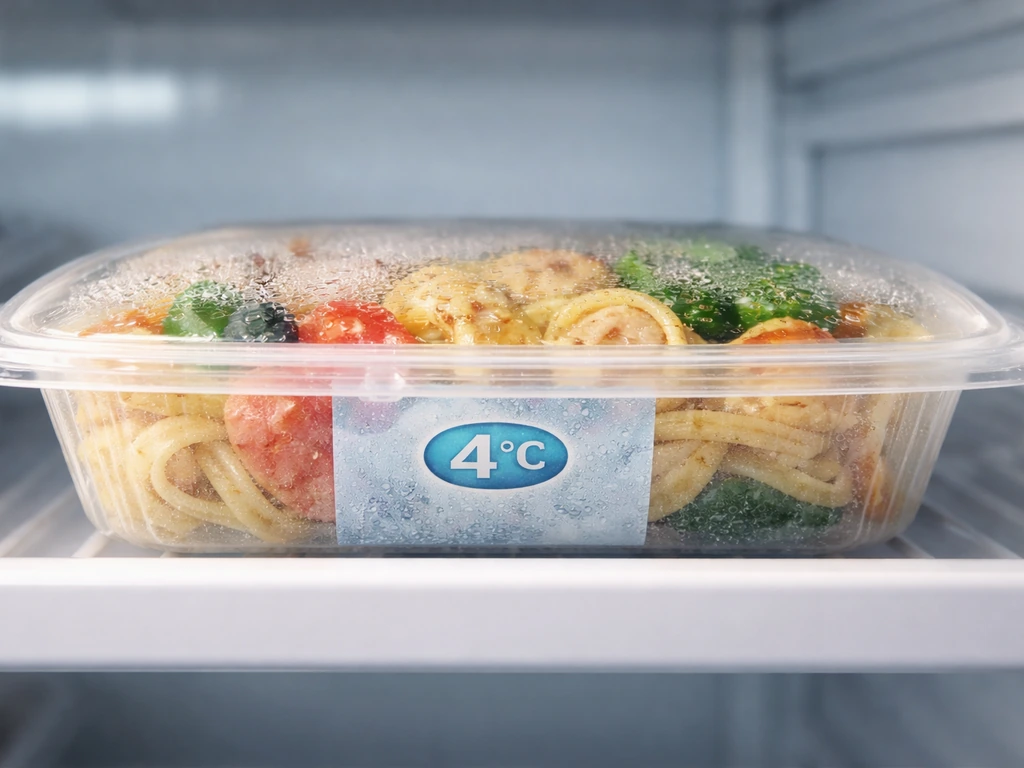
Legionella can survive in sealed commercial bottled water, but genuine replication is very unlikely under normal storage conditions. The bacterium needs temperatures between roughly 25°C and 42°C, biofilm surfaces, and often a protozoan host to multiply efficiently. A cold, sealed, single-use PET bottle sitting in a refrigerator or cool store does not provide those conditions. Where the risk picture changes is in refillable dispensers, water coolers with internal reservoirs, or any bottle stored in a warm environment for an extended period. Those scenarios introduce the temperature, stagnation, and surface area that turn a survival situation into a growth situation.
Can Legionella Grow in Bottled Water? Risk, Growth, Tests

Marcus Reeves
25 Jul 2026
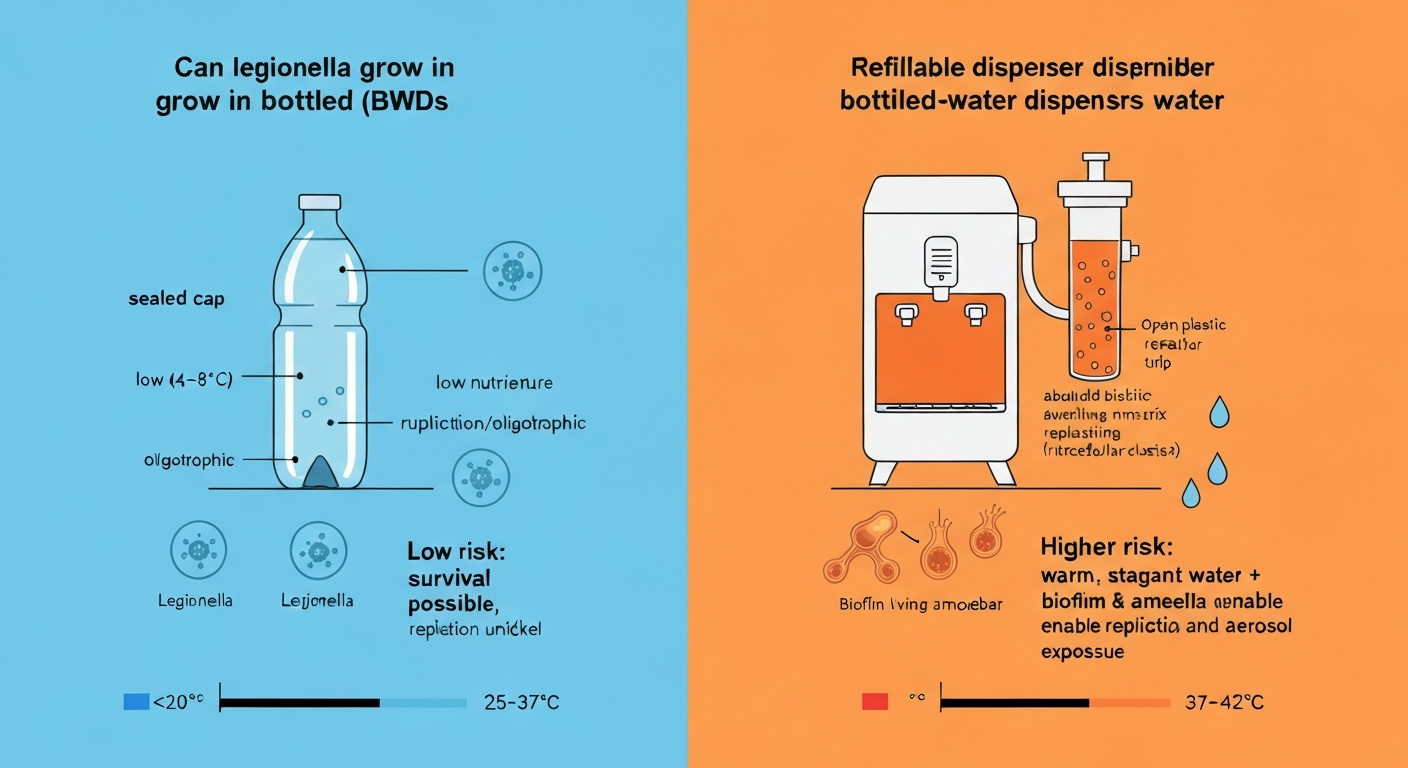
Can Legionella actually grow in bottled water? The key findings
The short distinction worth keeping in mind is that survival and replication are not the same event, and the conditions that allow one do not automatically allow the other. In sealed commercial bottled water, Legionella has occasionally been detected in surveys, but the evidence for active multiplication in that specific setting is weak. The bacteria are oligotrophic survivors in cold, closed systems rather than active colonizers. In contrast, multiple outbreak investigations and field surveys have linked water dispensers, water coolers, and devices with internal tanks to genuine Legionella amplification, including in healthcare settings.
- Sealed single-use commercial bottles: survival possible, active replication highly unlikely under normal storage conditions
- Refillable dispensers and water coolers with reservoirs: replication documented, especially when maintenance is inadequate or storage is warm
- Warm-stored bottles (above ~25°C for prolonged periods): conditions approach the permissive range for slow growth
- Refrigerated storage (below ~20°C): growth is effectively halted; survival in dormant or VBNC state is possible
Survival versus replication: why the distinction matters
When microbiologists talk about a bacterium 'growing' in a medium, they mean it is actively dividing and increasing in number. Legionella can persist in a non-replicating state for a surprisingly long time under hostile conditions, including low temperatures, starvation, and exposure to disinfectants. In that dormant state, it can enter what is called a viable but non-culturable (VBNC) form: the cells remain metabolically active and potentially infectious, but they will not form colonies on standard culture plates. This is important for understanding bottled water because standard culture methods can miss VBNC Legionella entirely, meaning a negative culture result from a sealed bottle does not guarantee the organism is absent.
Replication is a different matter. For Legionella to divide and increase its numbers to infectious concentrations, it needs a specific combination of temperature, nutrient supply, surface area or a cellular host, and time. When those conditions are absent, as they often are in a properly stored sealed bottle, the organism stays dormant rather than amplifying. The public health risk from a single dormant cell is fundamentally different from the risk posed by a biofilm-laden warm water cooler reservoir harboring millions of cells.
What Legionella actually needs to replicate
Temperature
Temperature is the single most important factor controlling whether Legionella replicates or simply persists. Multiplication occurs mainly in the range of approximately 25°C to 42°C, with the optimum often cited between 32°C and 42°C. See what temperature does legionella grow for a concise summary of the temperature ranges that support Legionella replication. Below about 25°C, growth slows progressively. Above roughly 45°C to 50°C, survival drops rapidly. These are ranges rather than hard cutoffs, as strain variation exists, but the practical takeaway is that water stored at or below typical refrigeration temperatures (around 4°C to 8°C) does not support replication. Warm stagnant water, such as the reservoir inside a room-temperature water cooler, sits squarely in the danger zone. The relationship between temperature and growth timeframes is covered in more detail further below.
pH
Legionella pneumophila can multiply across a broad pH range. Experimental potable-water studies have demonstrated multiplication at pH values from approximately 5.5 to 9.2, which covers virtually the entire pH spectrum of commercially available bottled water. pH alone is therefore not a reliable barrier to Legionella growth in water intended for drinking. Highly acidic or highly alkaline conditions outside that range can be inhibitory, but those conditions are not relevant to typical bottled products.
Nutrients and organic matter
Legionella is nutritionally fastidious compared to many environmental bacteria, meaning it cannot grow on simple nutrient media without specific amino acids (particularly L-cysteine) and iron. In the environment, it relies heavily on intracellular replication inside protozoa to obtain the nutrients it needs. Bottled water is oligotrophic, meaning it is low in dissolved organic matter, but it is not sterile. Studies using molecular profiling have shown that natural mineral and spring waters contain diverse dissolved organic matter and microbial communities that change after bottling. blank" rel="noopener noreferrer">Bottled aqua incognita: microbiota assembly and dissolved organic matter diversity in natural mineral waters (2017, PMC) documents that natural mineral and spring waters harbor diverse dissolved organic matter and shifting microbial communities after bottling. That background organic load is enough to sustain low-level heterotrophic bacteria, and by extension, potential protozoan hosts, over weeks inside a sealed bottle. It is not enough, on its own, to support direct free-living Legionella replication at high levels. For related information on substrates and surfaces that support Listeria growth, see what does listeria grow on.
Oxygen
Legionella is aerobic, meaning it requires oxygen to grow. Dissolved oxygen levels typical of drinking water, around 6 mg/L, are adequate for Legionella replication when temperature and other conditions are permissive. Oxygen is not a limiting factor in bottled water under normal circumstances.
Cold and refrigeration temperatures: halted growth, not guaranteed death
Refrigeration temperatures effectively shut down Legionella replication. Some studies report that certain Legionella strains or microenvironments can support growth even at refrigeration temperatures (see can grow at refrigeration temperatures). Below about 20°C, growth is extremely slow or undetectable, and below 10°C it is negligible for practical purposes. However, cold temperatures do not reliably kill Legionella. The organism can persist in a dormant or VBNC state through refrigerated storage and even survive freezing for extended periods under some conditions. This means a bottle that was contaminated before refrigeration can still harbor viable organisms when returned to room temperature, which is relevant for partially consumed bottles that are repeatedly refrigerated and then left out. The cold/refrigeration overlap with Legionella is relevant here because the same temperature-dependent principles that apply to cold water supply systems in buildings also govern bottled-water storage. The distinction between cold water survival and warm water growth is a recurring theme across Legionella risk assessment generally. For comparison, listeria monocytogenes does not grow in refrigerated foods. See can legionella grow in cold water for a focused review of Legionella survival and replication at refrigeration and lower temperatures. For related guidance on Listeria survival and the effects of refrigeration, see can listeria grow in the fridge.
Biofilms and amoebae: the two factors that change everything
Legionella is often called an 'accidental pathogen' because its primary ecological niche is not the human lung but the interior of free-living amoebae like Acanthamoeba castellanii. Intracellular replication inside amoebae and other protozoa provides Legionella with both nutrients and protection from environmental stressors, including disinfectants. Amoebae can also resuscitate VBNC Legionella back to a culturable, replication-competent state, which has direct implications for interpretation of culture-negative water samples.
Biofilms compound this problem. Legionella itself is not a strong primary biofilm former, but it readily colonizes biofilms established by other organisms, using the extracellular matrix and resident protozoa as shelter and a replication platform. Biofilm formation is strongly influenced by the material of the water-contact surface. Glass typically supports less biofilm than many plastics; polypropylene and polyethylene surfaces, common in water cooler reservoirs and tubing, tend to support higher biofilm densities. This is directly relevant when comparing sealed glass or PET bottles against plastic dispenser components.
The practical implication is that even a system with water temperatures in the cooler part of the permissive range can sustain Legionella if the biofilm and protozoan community are well established. Disinfection alone will not remove a mature biofilm, which is why periodic physical cleaning of dispenser reservoirs matters as much as disinfectant dosing.
How sealed commercial bottles hold up against Legionella risk
Several properties of commercially produced single-use bottled water work together to make Legionella amplification unlikely in the sealed product as it reaches a consumer.
| Factor | Sealed commercial bottle | Effect on Legionella risk |
|---|---|---|
| Packaging | Sealed PET or glass, no headspace contamination post-fill | Limits post-production introduction of organisms |
| Storage temperature (ideal) | Cool warehouse or refrigerated retail | Below growth range; replication halted |
| Disinfectant residual | Usually absent; some producers use permitted chlorine, chloramine, or ClO2 within regulatory limits | If present, suppresses organism counts; most products have none |
| Mineral content / TDS | Highly variable; generally oligotrophic | Low nutrient availability limits free-living bacterial growth |
| Biofilm surface area | Small interior surface of bottle only, no stagnant reservoir | Minimal surface for biofilm development compared to cooler systems |
| Protozoan presence | Background microbiota present but low biomass | Limited host for intracellular replication under cold storage |
Most bottled waters are not intentionally chlorinated at the point of bottling. Regulatory frameworks including Codex Alimentarius (Codex Stan 108) and the EU Bottled Water Directive set composition limits, and the U.S. FDA permits defined residual disinfectants under specific conditions, but the majority of natural mineral and spring waters reach consumers without a disinfectant residual. That means the absence of active multiplication in sealed bottles is due primarily to low temperature, low nutrients, and physical containment rather than a chemical kill step. Once any of those barriers is removed, the risk profile changes.
Scenarios where Legionella growth in bottled water becomes plausible
Refillable dispensers and water coolers
Bottled water dispensers (BWDs) and water coolers are the highest-risk category in the bottled water context. These devices typically have an internal reservoir or drip tray, plastic tubing and fittings, and often a tap or spout that is exposed to the environment. The water inside the reservoir is at or near room temperature in many installations, especially in spaces where the cooling unit is switched off overnight or during weekends. Field studies have found heterotrophic plate counts exceeding guideline values within days to weeks after cleaning, with rapid recolonization when maintenance is inadequate. Surveys of bottled‑water dispensers in healthcare facilities report frequent elevated heterotrophic plate counts, fungal contamination, and occasional opportunistic bacteria, with higher counts associated with longer time since last disinfection, sunlight during storage, warm storage temperatures, and expired bottles Mycological investigation of bottled water dispensers in healthcare facilities (Pathogens, 2021, PMC). Surveys of BWDs in healthcare facilities have detected opportunistic bacteria and fungi, and case investigations have linked devices with internal water reservoirs to Legionella-associated illness.
The spout and drip tray are particular concern areas. They accumulate biofilm and are exposed to ambient air, fingers, and splash-back, introducing organisms from outside the sealed bottle system. At room temperature, a warm drip tray with residual water and organic matter is a microbiologically active environment, and if Legionella enters via contaminated tap water backup or splash, conditions for slow multiplication are present.
Warm-stored and sun-exposed bottles
A bottle of water left in a car during summer, stored in a warm utility room, or left in direct sunlight on a windowsill can reach temperatures of 30°C to 40°C. This brings the water directly into Legionella's permissive growth range. Surveys indicate that expired or warm-stored bottles in dispensers are associated with higher microbial counts. If Legionella was present at any point before warm storage, the combination of warmth and time provides conditions for slow replication, particularly if the bottle has been opened and reused.
Partially consumed and refilled bottles
Reusing a single-use PET bottle by refilling it from a tap changes the contamination risk entirely. Tap water may introduce Legionella directly if the building water system is a source. The bottle interior, once used, has residual organic matter from the consumer's contact and is no longer sterile. Storing a refilled bottle at room temperature for hours creates a scenario that begins to resemble a small-scale dispenser reservoir.
Devices with internal water reservoirs
Beyond dispensers, devices that use bottled or tap water in internal reservoirs include humidifiers, water flossers, ice-and-water machines, and some medical nebulizers. Case reports have documented Legionella pneumophila linked to water flossers and ice/water machines, particularly in hospital environments. These devices share the same risk profile: warm or room-temperature stagnant water, internal plastic surfaces favorable for biofilm, no disinfectant residual, and often infrequent cleaning.
How fast Legionella grows: timeframes and influencing factors
Legionella growth rates are highly variable depending on temperature, the presence of protozoan hosts, nutrient availability, and strain. For more detail on how long does it take for Legionella to grow, see the section on timeframes and influencing factors for temperature- and host-dependent growth. Under optimal laboratory conditions at around 37°C, doubling times in mid-log phase are roughly 2 to 6 hours. In environmental potable water without protozoan hosts, growth is far slower. Studies have reported generation times on the order of 25 hours at 40°C for some environmental strains and around 210 hours at 18°C for others. These are strain-specific figures from experimental conditions, not universal constants, but they illustrate the temperature dependency clearly.
In practical terms, this means that at water cooler temperatures of around 30°C to 35°C, a Legionella population can reach significant numbers within days to weeks if nutrient and surface conditions are favorable. At 20°C to 25°C, the same process might take weeks to months. At typical refrigeration temperatures, meaningful growth within any practical storage window is not expected. The relationship between temperature and the time required to reach infectious concentrations is why temperature control is the primary intervention in Legionella risk management, not just in building water systems but also in bottled-water dispensing.
| Temperature range | Expected growth outcome | Typical scenario in bottled water context |
|---|---|---|
| Below ~20°C | No meaningful replication; survival and VBNC possible | Refrigerated sealed bottle; cold-room storage |
| ~20–25°C | Very slow growth if host/surface conditions are favorable | Room-temperature cool storage; marginal risk |
| ~25–37°C | Active replication possible; rate increases with temperature | Warm office dispenser; sun-exposed bottle; warm utility storage |
| ~37–42°C | Optimal growth range; fastest free-living and intracellular replication | Water cooler reservoir without active cooling; warm humid environment |
| Above ~45–50°C | Rapid die-off; thermal inactivation begins | Hot water dispensers; thermal disinfection scenarios |
The timeframes above also depend on whether protozoan hosts are present. Intracellular replication inside amoebae can be orders of magnitude faster than free-living growth in water at the same temperature, and amoebae are more resilient to disinfectants than free-living Legionella. A water cooler reservoir with an established protozoan community will support faster Legionella multiplication than the same volume of clean water at the same temperature.
Detection and testing: matching the method to the question
If you are investigating potential Legionella contamination in a bottled-water supply or dispenser system, the choice of detection method significantly affects what you will find. The reference standard is culture-based enumeration under ISO 11731 (EN ISO 11731:2017), which involves filtering the water sample, plating on selective media, and incubating for several days. This method is reliable for culturable Legionella and is required for regulatory compliance in most jurisdictions, but it will miss VBNC cells, which can be the dominant fraction in stressed or disinfectant-exposed populations.
Quantitative PCR (qPCR) under ISO/TS 12869:2019 detects Legionella DNA much faster, often within hours, and can identify L. pneumophila serogroup 1 specifically. The limitation is that qPCR detects DNA from dead or VBNC cells as well as live replicating ones, so a positive result needs careful interpretation and ideally confirmation by culture or viability assay. Flow cytometry combined with cell sorting and viability staining can distinguish live from dead cells, and viability PCR using propidium monoazide (PMA) suppresses signal from membrane-compromised dead cells.
Amoebal co-culture enrichment is a valuable complementary method. Co-culturing the water sample with Acanthamoeba castellanii or A. polyphaga before plating can resuscitate VBNC Legionella and recover organisms that would otherwise be missed by ISO 11731 alone. Multiple studies report statistically significant increases in detection rates when co-culture is added to the workflow, particularly in samples from chlorinated or otherwise stressed systems. For a bottled-water dispenser investigation, pairing ISO 11731 culture with qPCR and, where resources allow, amoebal enrichment gives the most complete picture.
| Method | What it detects | Speed | Key limitation | Best use case |
|---|---|---|---|---|
| ISO 11731 culture | Culturable, viable Legionella (CFU/L) | 5–14 days incubation | Misses VBNC; underestimates when disinfectant stress is present | Regulatory compliance; enumeration in non-stressed samples |
| qPCR (ISO/TS 12869) | Legionella DNA (genome units/L) | Hours | Cannot distinguish live from dead; may detect non-viable DNA | Rapid screening; outbreak investigation; alongside culture |
| Viability PCR / PMA-qPCR | DNA from membrane-intact (live/VBNC) cells | Hours plus PMA pre-treatment | Requires careful sample handling; not yet widely standardized | Assessing viability in disinfected or stressed samples |
| Flow cytometry + viability staining | Total cells; live/dead ratio | Hours | Requires specialist equipment; non-specific (all bacteria) | Research settings; high-throughput screening |
| Amoebal co-culture enrichment | VBNC and amoeba-associated Legionella | 10–14 days total | Labor-intensive; slower than PCR | Maximizing sensitivity in investigation samples; VBNC recovery |
Aerosolization versus ingestion: understanding the real exposure route
Legionellosis (including Legionnaires' disease and Pontiac fever) is caused overwhelmingly by inhaling aerosolized water droplets or droplet nuclei containing Legionella, not by drinking contaminated water. Ingestion of contaminated water does not typically lead to disease in immunocompetent individuals because the organism is not adapted to survive the gastrointestinal tract as a route of infection. This distinction is critical when evaluating bottled water risk.
For sealed bottled water consumed by drinking in the usual way, the aerosolization risk is negligible. The exposure changes when the same water is used in a device that generates aerosols: humidifiers, water flossers, dental unit waterlines, and some CPAP machines all create respirable droplets from their water supply. If those devices are filled with water from a cooler or dispenser that harbors Legionella, the risk profile becomes directly comparable to other recognized Legionella sources. Case reports confirm this, including documented illness linked to water flossers using contaminated tap or cooler water.
Practical controls for bottled water storage and dispensing
The controls that matter most follow directly from the environmental requirements outlined above. Managing temperature is the first priority, followed by eliminating stagnation and maintaining clean surfaces.
- Store sealed bottles at or below ~20°C and away from direct sunlight; avoid leaving bottles in warm vehicles or sunny rooms for extended periods
- Use water cooler dispensers with functioning active cooling and verify that the reservoir temperature stays reliably below 20°C or is maintained above 50°C if a hot-water function is in use
- Clean and disinfect water dispenser reservoirs, drip trays, spouts, and tubing on a regular schedule, at minimum every 3 to 6 months and immediately after any suspected contamination event; physical cleaning of biofilm is as important as chemical disinfection
- Replace water cooler bottles before they expire and do not leave bottles in dispensers for periods that allow the water to reach room temperature repeatedly
- Do not reuse single-use PET bottles for extended periods, especially if refilling from a tap connected to a building water system with unknown Legionella status
- For high-risk settings (healthcare facilities, immunocompromised populations), consider periodic microbiological testing of dispensers using a combination of culture and qPCR
- When filling aerosol-generating devices such as humidifiers or water flossers, use appropriately treated water rather than untreated cooler or dispenser water, particularly in clinical settings
- Document maintenance activities for dispensers; in healthcare environments, this should be part of a formal water safety plan aligned with CDC or WHO guidance on Legionella management
Regulatory context and what it covers
Regulatory frameworks for bottled water focus primarily on chemical composition, total dissolved solids, metals, and microbiological indicator organisms rather than on Legionella specifically. Codex Stan 108 (Codex Alimentarius), the EU Bottled Water Directive, and U.S. FDA standards do not set specific Legionella limits for bottled products, because sealed commercial bottled water is not recognized as a significant Legionella risk vector under normal conditions. The absence of a specific standard should not be interpreted as confirmation of safety in dispenser systems; it reflects the fact that the risk sits downstream of the bottle, in the dispensing hardware and storage conditions.
CDC and WHO guidance on Legionella exposure focuses on building water systems, cooling towers, and devices with water reservoirs rather than sealed bottled products. The factors those agencies identify as driving amplification risk are temperature, stagnation, absence of disinfectant residual, biofilm presence, protozoan hosts, and poor maintenance: exactly the conditions that distinguish a neglected water cooler from a freshly opened sealed bottle. For food safety professionals and facility managers, the practical implication is that bottled water dispensers in shared or healthcare spaces should be included in water safety plan scope, even though the sealed bottle product itself is not a regulated Legionella risk.
FAQ
Can Legionella grow in bottled water?
Yes — but uncommon in properly produced sealed commercial single‑use bottles. Legionella can survive in oligotrophic bottled waters and, under permissive conditions (warm temperatures, presence of biofilm and protozoa, stagnation, absence of disinfectant residual), can multiply. The highest risk is not sealed retail bottles but systems with internal reservoirs, refillable dispensers, or bottles stored/warmed for long periods.
What is the difference between survival and replication for Legionella in water?
Survival means cells remain viable (including VBNC state) without increasing in number; replication means active multiplication to higher concentrations. Legionella often survive long periods at cool temperatures in bottled water but need permissive temperatures (≈25–42°C), nutrients or intracellular growth in protozoa, and biofilm niches to replicate to high concentrations.
What temperature ranges favour Legionella growth and what about refrigeration?
Multiplication primarily occurs ≈25–42°C, with many references citing an optimum ~32–42°C. Growth slows below ~25°C and can be extremely slow near typical refrigeration temperatures (≤4–10°C) where replication is unlikely; refrigeration therefore largely prevents growth but not necessarily long‑term survival or VBNC state.
How fast can Legionella multiply if conditions are permissive?
Doubling times are highly temperature and strain dependent. In warm, nutrient‑rich or intracellular conditions (e.g., ~37°C), doubling can be hours (≈2–6 h). In environmental or low‑nutrient water at cooler temperatures doubling can be days to weeks (examples: ~25 h to ~210 h reported). Expect much slower growth in bottled‑water microenvironments than in lab cultures.
What role do biofilms and protozoa play in bottled‑water Legionella risk?
Biofilms provide surface niches, concentrate nutrients, and protect bacteria from stressors; protozoa (free‑living amoebae) can host intracellular replication and resuscitate VBNC cells. In bottles or dispensers where biofilm forms (plastic surfaces, taps, fittings, reservoirs), Legionella persistence and amplification are substantially more likely than in clean, sealed bottles.
How do sealed commercial single‑use bottles compare to refillable dispensers regarding risk?
Sealed single‑use commercial bottles are low‑risk because they are produced under controlled conditions, sealed, and usually stored cool. Refillable dispensers, devices with internal tanks, or water coolers where bottles are inverted into a reservoir are higher risk due to exposure to ambient air, potential biofilm on internal surfaces, warm storage, and repeated handling—conditions that permit stagnation, microbial regrowth and protozoal colonization.
Next Article
Listeria monocytogenes Can Grow in Refrigerated Foods
Why Listeria grows in refrigerated foods, realistic conditions, risk controls, and how to investigate suspected contamin