Listeria monocytogenes grows on foods that are moist, near-neutral in pH, and rich in nutrients, especially ready-to-eat items like deli meats, soft cheeses, smoked seafood, and pre-cut produce. What makes it unusual among foodborne pathogens is that it can keep multiplying even at refrigerator temperatures, which means your fridge does not make these foods safe to hold indefinitely. Understanding the conditions that allow growth, and the ones that stop it, is the fastest way to assess real risk.
What Does Listeria Grow On Foods and Conditions

Marcus Reeves
17 May 2026
What 'Listeria growth' actually means
There is an important distinction between Listeria growing on a food and Listeria simply surviving or persisting on it. Growth means the organism is actively multiplying, increasing in numbers over time. Survival or persistence means cells remain viable but are not necessarily multiplying rapidly, which happens in conditions that are close to but outside the organism's growth limits, for example on very dry surfaces or in highly acidic foods.
This matters practically because a food that merely carries a few persistent cells is a different risk profile than one where Listeria is doubling every several hours. Both situations are worth understanding, but risk is generally highest when conditions actively support growth over the storage period you are dealing with.
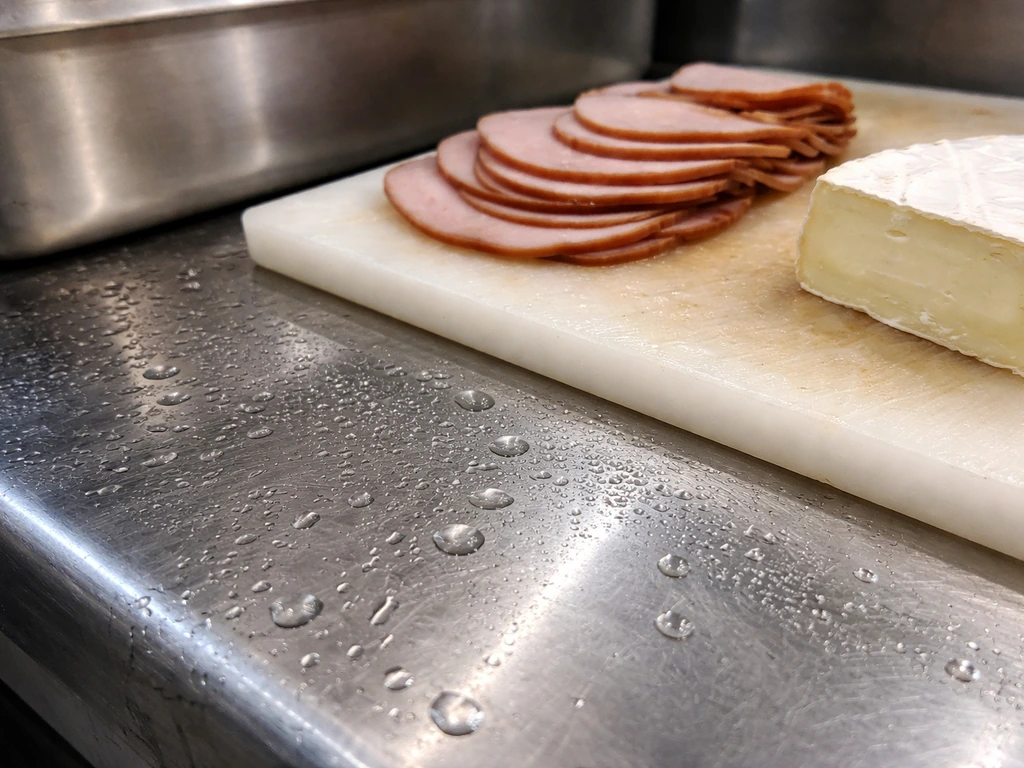
Surfaces in food-processing environments, cutting boards, and equipment are a major persistence niche. Listeria forms biofilms on stainless steel, plastic cutting boards, and other food-contact surfaces, allowing it to persist even after routine cleaning and sanitizing. Those biofilms can then transfer cells to foods that come into contact with the surface. So when someone asks 'what does Listeria grow on,' the honest answer covers both foods and environmental niches.
The conditions that determine whether Listeria can grow
Four parameters do most of the work in predicting whether Listeria will actively multiply on a given food or substrate. None of these work in isolation; they interact, and a food that is borderline on two or more parameters compounds the risk.
Temperature
Listeria monocytogenes has a growth range of roughly -0.4°C to 45°C (about 31°F to 113°F), with an optimum around 37°C. That minimum is the critical number because it means growth is technically possible even below typical refrigerator setpoints. At 4°C, doubling times measured in dairy products run roughly 30 to 46 hours. In fresh-cut fruit, one study found a doubling time of about 13.7 hours at 4°C. Slow, but over a 10-day refrigerator shelf life, that adds up to meaningful increases in cell count.
Water activity (aw)
Water activity measures how much free water is available for microbial use. Listeria needs a minimum aw of around 0.92 to grow; below that threshold, growth stops. Foods with aw at or below 0.92, such as dry-cured meats, hard cheeses, crackers, and dried goods, do not support active multiplication. Regulatory guidance (including FDA's CPG Sec. 555.320) uses aw ≤ 0.92 as a benchmark for classifying foods as 'not supporting growth,' though some guidelines put that threshold as low as 0.90 depending on the interaction with other factors.
pH
The pH growth minimum for Listeria is approximately 4.39 to 4.45, with optimum growth at neutral pH around 7.0. Foods acidified to pH ≤ 4.4 are generally classified as not supporting growth; FDA guidance references pH ≤ 4.4 as a no-growth criterion for deli-type salads that are deliberately acidified. Some international guidelines use pH ≤ 4.2 to be more conservative. Fermented and pickled foods that reach and hold these pH levels consistently fall outside the growth range, but fresh foods that are only mildly acidic (pH 5 to 6) are well within it.
Nutrient availability and food matrix
Listeria is not particularly demanding in terms of nutrients; it grows readily in protein-rich and lipid-rich environments. Ready-to-eat foods that combine high moisture, moderate-to-neutral pH, and plenty of protein or fat are essentially ideal growth substrates. The food matrix also affects how quickly the organism can colonize: soft, moist surfaces are easier for Listeria to penetrate and multiply through than dense, dry, or highly structured matrices.
Food categories where Listeria actively grows
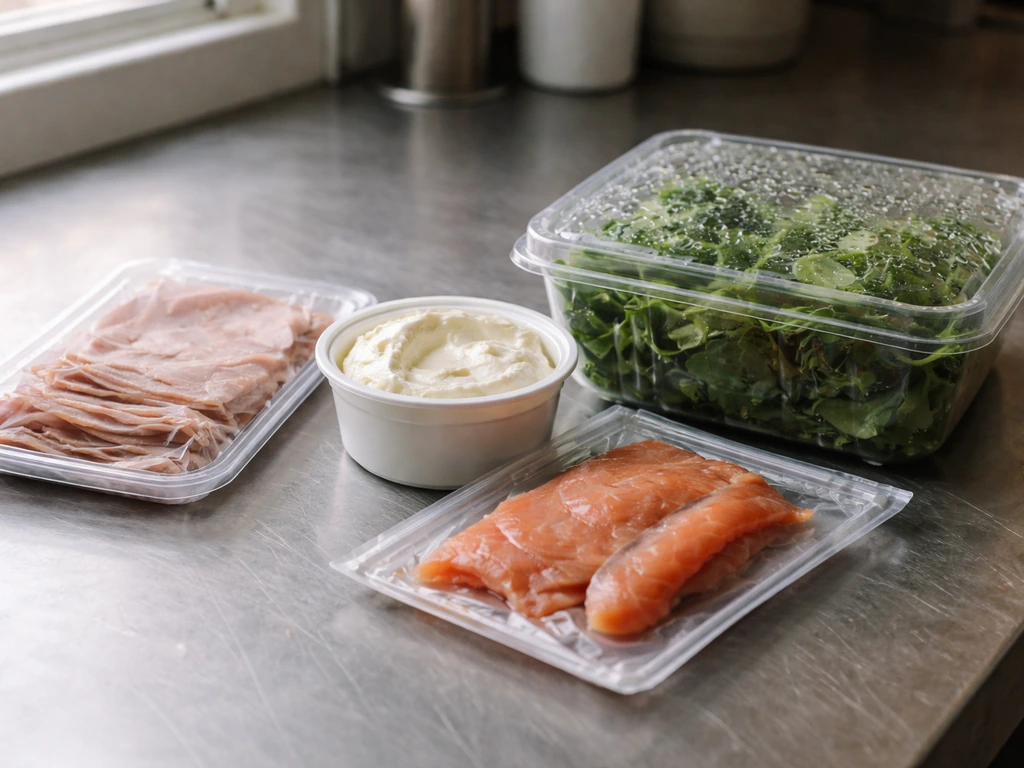
The following food categories combine the conditions, moisture, near-neutral pH, rich nutrients, and typical refrigerated storage, that make them genuine growth substrates rather than just survival surfaces.
| Food Category | Why It Supports Growth | Key Risk Factor |
|---|---|---|
| Deli meats and sliced luncheon meats | High aw, near-neutral pH, protein-rich; slicing exposes fresh surface area | Post-lethality recontamination; extended fridge storage |
| Soft and semi-soft cheeses (e.g., Brie, Camembert, queso fresco) | High moisture, near-neutral to mildly acidic pH, fat and protein substrate | Unpasteurized milk or post-process contamination |
| Smoked and cured seafood (e.g., cold-smoked salmon) | High aw, moderate salt that may not reach inhibitory levels, refrigerated RTE | Cold-smoking does not reach lethality temperatures |
| Hot dogs and cooked sausages | RTE, high moisture, near-neutral pH after cooking | Post-cook contamination before packaging or at deli counter |
| Pre-cut and fresh-cut produce | High aw, pH 5–6 range, cut surfaces expose nutrients | Minimal processing, no kill step, cold chain only slows growth |
| Deli salads (potato, pasta, coleslaw) | High aw, moderate pH unless deliberately acidified | Retail or home preparation introduces environmental contamination |
| Unpasteurized (raw) milk and products made from it | Ideal growth matrix, no heat treatment applied | No kill step; organism survives and grows at refrigerator temps |
Hard cheeses, dry-cured products (like dry salami at very low aw), fermented products at pH below 4.4, and commercially frozen foods do not support active growth. Listeria may survive in those matrices, but multiplication is effectively halted by the combination of low aw, low pH, or frozen temperatures.
Why cold storage alone is not enough
Refrigeration slows Listeria but does not stop it, and it certainly does not kill it. That means Listeria can indeed grow in the fridge under the right temperature, moisture, and pH conditions does not stop it. This is the property that separates Listeria from most other foodborne pathogens and makes time-in-fridge a real part of the risk equation. At 4°C, a deli meat or soft cheese stored for 10 to 14 days can accumulate substantially higher cell counts than the same product consumed within two or three days, even if it was barely contaminated at purchase.
FDA explicitly links risk to both temperature and duration: the longer a food sits in the refrigerator, the greater the opportunity for Listeria to grow. In general, the exact timing depends on storage temperature, pH, water activity, and how long the food sits in the danger zone where conditions support multiplication how long does it take for Legionella to grow. This is why use-by dates on refrigerated ready-to-eat products matter, not just as a quality marker but as a Listeria control measure. Manufacturers calculate those dates partly around limiting Listeria growth to safe levels under normal refrigerator conditions.
Freezing at 0°F (-18°C) stops growth entirely. It does not kill Listeria, so thawed food can resume growth, but while frozen the organism is not multiplying. This is meaningfully different from refrigeration, where growth continues at a slow but real rate. A food that is frozen promptly after purchase carries a lower Listeria risk from extended storage than the same food kept refrigerated for weeks.
There is a related topic worth being precise about: the claim that refrigerated foods do not support Listeria growth is incorrect as a blanket statement. The key idea is that some refrigerated foods can still be formulated so Listeria monocytogenes does not grow under refrigerator conditions refrigerated foods do not support Listeria growth. Whether a specific refrigerated food supports growth depends on its aw, pH, and how long it will be stored, not simply on the fact that it is refrigerated.
Where Listeria hides in processing environments
Beyond food itself, Listeria establishes persistent niches in food-processing environments that serve as ongoing contamination sources. This matters to food safety professionals managing facility hygiene, and it also translates to home kitchen surfaces in a practical way.
Floor drains, condensation on cold surfaces, standing water, and equipment harborage points (like conveyor belts, slicers, and hollow rollers) are classic Listeria reservoirs in commercial settings. The organism forms biofilms, structured communities of bacteria embedded in a protective matrix, on stainless steel and plastic surfaces. Biofilms are significantly harder to remove than planktonic (free-floating) bacteria. Research has shown that surface finish on stainless steel affects how readily biofilms form, and that biofilms on plastic cutting boards can act as direct cross-contamination sources to foods placed on them.
In a commercial deli or processing facility, a contaminated slicer blade or gasket can recontaminate every product that passes through it after cleaning, which is why post-lethality contamination control (governed by regulations like 9 CFR § 430.4 for meat and poultry) is a major regulatory focus. FSIS verification activities specifically check for Listeria biofilm formation on food-contact and non-food-contact surfaces because the organism's ability to persist despite routine sanitation is well documented.
At home, the practical equivalent is a cutting board or kitchen sink that has had raw or contaminated ready-to-eat foods on it. Listeria can establish on those surfaces and transfer to the next food placed there, especially if that food is moist and ready to eat without further cooking.
Practical steps that actually stop growth
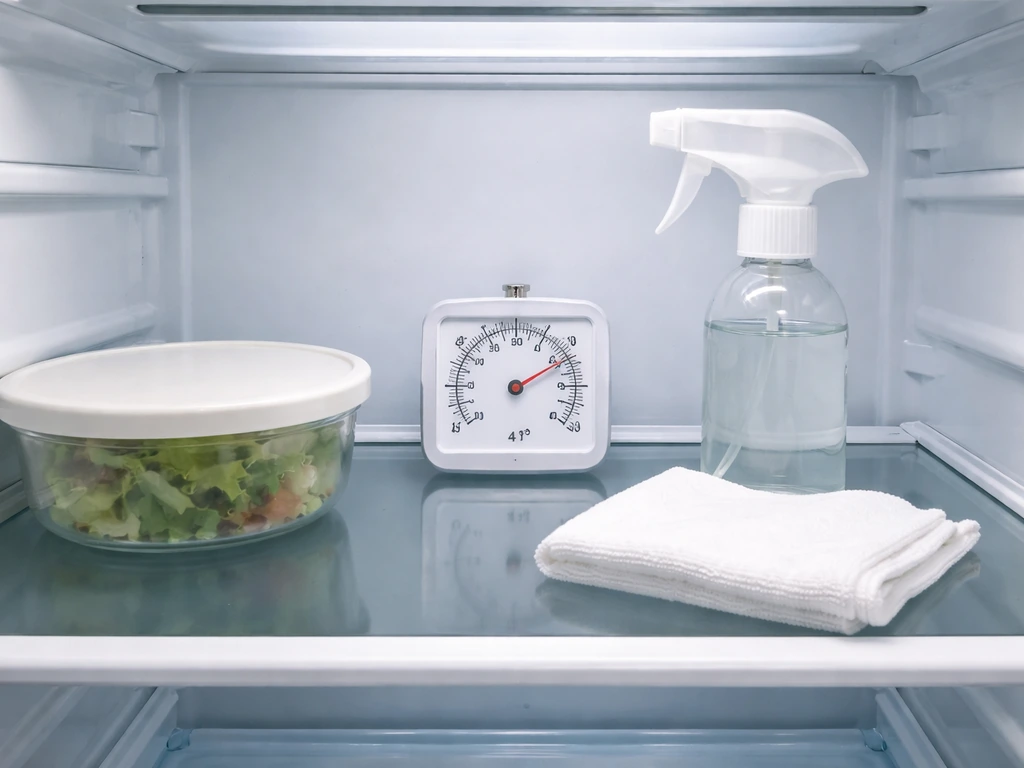
The good news is that the conditions Listeria needs to grow are the same ones that practical food-safety interventions target. Here is what actually works:
- Keep your refrigerator at or below 40°F (4°C) and verify this with a standalone thermometer, not just the appliance dial. Even a few degrees above this accelerates Listeria doubling times noticeably.
- Use ready-to-eat refrigerated foods promptly. Deli meats, soft cheeses, smoked fish, and pre-cut produce should be consumed within three to five days of opening or purchase. The longer they sit, the more any Listeria present can multiply.
- Freeze what you cannot use quickly. Freezing stops Listeria growth. If you bought deli meat for later in the week and the timeline is uncertain, freezing it and thawing only what you need is a reasonable control.
- Prevent cross-contamination. Keep raw meats separated from ready-to-eat items in the fridge, especially anything that might drip. Listeria in raw meat drippings can contaminate RTE foods stored below on fridge shelves.
- Clean cutting boards and food-contact surfaces thoroughly, especially after contact with raw meat, seafood, or soil-bearing produce. Biofilm formation begins with initial attachment, so removing organic matter promptly matters.
- Do not rely on salt or mild acidification alone as a growth stopper unless the product genuinely reaches pH ≤ 4.4 or aw ≤ 0.92. Light marinades or a small amount of vinegar in a salad typically do not drop pH far enough to inhibit Listeria.
- Reheat leftovers and cooked deli items to 165°F (74°C) internal temperature if you are concerned about contamination, since heat is one reliable kill step. This is especially relevant for hot dogs and deli meats consumed by high-risk individuals.
Preservation methods that genuinely inhibit growth include: freezing (stops growth, does not kill), true acidification to pH ≤ 4.4 (fermented products, vinegar-preserved goods at verified pH), drying to aw ≤ 0.92 (hard cheeses, dry-cured meats, dried goods), and thermal processing reaching lethal temperatures throughout the food. Refrigeration alone is a growth-slowing measure, not a growth-stopping or kill step.
How to assess your fridge right now
If you are trying to figure out whether something in your refrigerator is a Listeria concern today, ask yourself four quick questions about each ready-to-eat item.
- Is it a high-risk food type? Deli meats, soft cheeses, smoked seafood, pre-cut produce, deli salads, hot dogs, and foods made from unpasteurized milk sit in the high-risk category. Hard cheeses, fully dried meats, commercially heat-processed shelf-stable foods, and items at verified pH below 4.4 are substantially lower risk.
- How long has it been open and stored in the fridge? Items open for more than three to five days, particularly deli meats and soft cheeses, are higher risk than freshly opened products. Use-by dates on unopened products are a meaningful marker; once opened, the clock moves faster.
- Is your fridge temperature verified at or below 40°F (4°C)? If you have not checked with a thermometer recently, check now. A fridge running at 45°F turns a low-growth situation into a moderate-growth situation across the same storage time.
- Could cross-contamination have occurred? Raw meat or seafood stored above RTE foods, drips from thawing products, or use of the same cutting board without thorough cleaning between uses are all pathways that can introduce Listeria to otherwise lower-risk foods.
If something fails more than one of those checks, the safest call is to discard it. FDA guidance is direct on this: if you are unsure whether a perishable has been held safely, the risk of keeping it is not worth it. When in doubt, throw it out is not overcautious advice for Listeria; it reflects the genuine difficulty of knowing how much growth has occurred in a food you cannot test in real time.
Understanding these conditions, temperature range, water activity, pH, and food type, gives you a functional framework for assessing any new food or situation, not just a list of items to avoid. The FDA Bacteriological Analytical Manual provides an official method framework for detecting and enumerating Listeria monocytogenes in foods and environmental samples, supporting documentation of where the organism can be found and potentially persist blank" rel="noopener noreferrer">functional framework for assessing Listeria growth conditions. This same framework can help you judge whether bacteria like Legionella can grow in bottled water, including how storage conditions affect risk can legionella grow in bottled water. Listeria is predictable once you know what it needs to grow.
FAQ
Does Listeria always grow in the fridge if the food is refrigerated?
Yes. If a food is moist, has near-neutral pH (or at least not consistently below about pH 4.4), and has enough free water (aw above roughly 0.92), Listeria can actively increase in number at refrigerator temperatures, even though the process is slow. The determining factor is the product formulation plus how long it will sit cold, not just the fact that it is refrigerated.
What happens if I freeze a deli meat or soft cheese and then thaw it later?
Freezing prevents growth but does not reliably kill Listeria. If you thaw a previously frozen ready-to-eat product, and then keep it in the refrigerator for days, the conditions during thawing and refrigerated storage can allow resumed growth. Practically, minimize thaw time at refrigerator versus room temperature, and use thawed foods promptly.
Are pickled or fermented foods always safe from Listeria growth?
When foods are acidified to pH values that consistently stay at or below about 4.4, Listeria growth is generally not supported. However, if the food starts higher pH and only partially acidifies (or the pH is uneven), you can have pockets where growth is still possible, especially in moist, protein-rich sections. Also, if salt and acidification are borderline, other factors like aw and temperature can make outcomes less certain.
Can Listeria grow on foods that seem dry or shelf-stable?
Avoid assuming “no-growth” because a product is dry. If the product is not actually at or below the relevant aw threshold, or if moisture migration happens during storage (for example, a dry item stored near moist packaging), Listeria may survive and, in some cases, grow. For decisions, rely on product formulation and storage conditions rather than just texture (crisp versus soft).
If Listeria is on a cutting board, can it contaminate the next ready-to-eat food even when it is refrigerated?
Yes, contamination can transfer from persistent sources on surfaces to foods that are otherwise “fine.” Biofilms can protect Listeria on cutting boards, equipment parts, or drains, so cells may move onto the next ready-to-eat item that contacts the surface, particularly if the receiving food is moist and stored for multiple days.
How can I tell if Listeria grew on food that still smells and looks normal?
Do not rely on “smell” or “looks normal.” Listeria is not reliably detectable by sensory cues, and growth at 4°C can increase cell counts without making the food obviously spoiled. If you are uncertain about temperature abuse, time in fridge, or intact packaging, the safest action is to discard rather than taste-test.
What storage duration increases risk the most, temperature or days in the fridge?
The risk is highest when multiple growth parameters line up, especially longer refrigerated storage. A short exposure at purchase is less concerning than keeping the item for a week or more, even if initial contamination levels were low. Use-by dates matter, because manufacturers design them to limit growth under typical refrigerator conditions.
If my ready-to-eat food is hot-cooked later, does that eliminate Listeria risk?
Reheating does not always fix the problem. Listeria can be present in ready-to-eat foods, and while thorough cooking can kill cells, many products you are concerned about are meant to be eaten without cooking (deli meats, soft cheeses). If you choose to heat, ensure you reach lethal temperatures throughout, and remember post-heating contamination from surfaces can reintroduce Listeria.
Why do some refrigerated ready-to-eat products not support Listeria growth, while others do?
Some refrigerated foods can be formulated so they do not support growth at refrigerator temperatures, even though they are cold. That means you need product-specific formulation information like pH and aw, plus the expected maximum storage time. “Refrigerated” alone is not a guarantee either way.
Does using the same kitchen sink or cutting board for raw and ready-to-eat foods change the Listeria risk?
Yes. If you handle raw foods and then cut or prepare ready-to-eat foods on the same board, you can transfer Listeria from raw-associated contamination to foods where it can later grow. Separate tools for raw versus ready-to-eat, clean and sanitize after raw food handling, and avoid leaving ready-to-eat foods sitting on potentially contaminated wet surfaces.
Next Article
How Long Does It Take for Legionella to Grow in Water?
Legionella growth timing in water, including temperature-driven ranges and what to do to stop amplification fast.