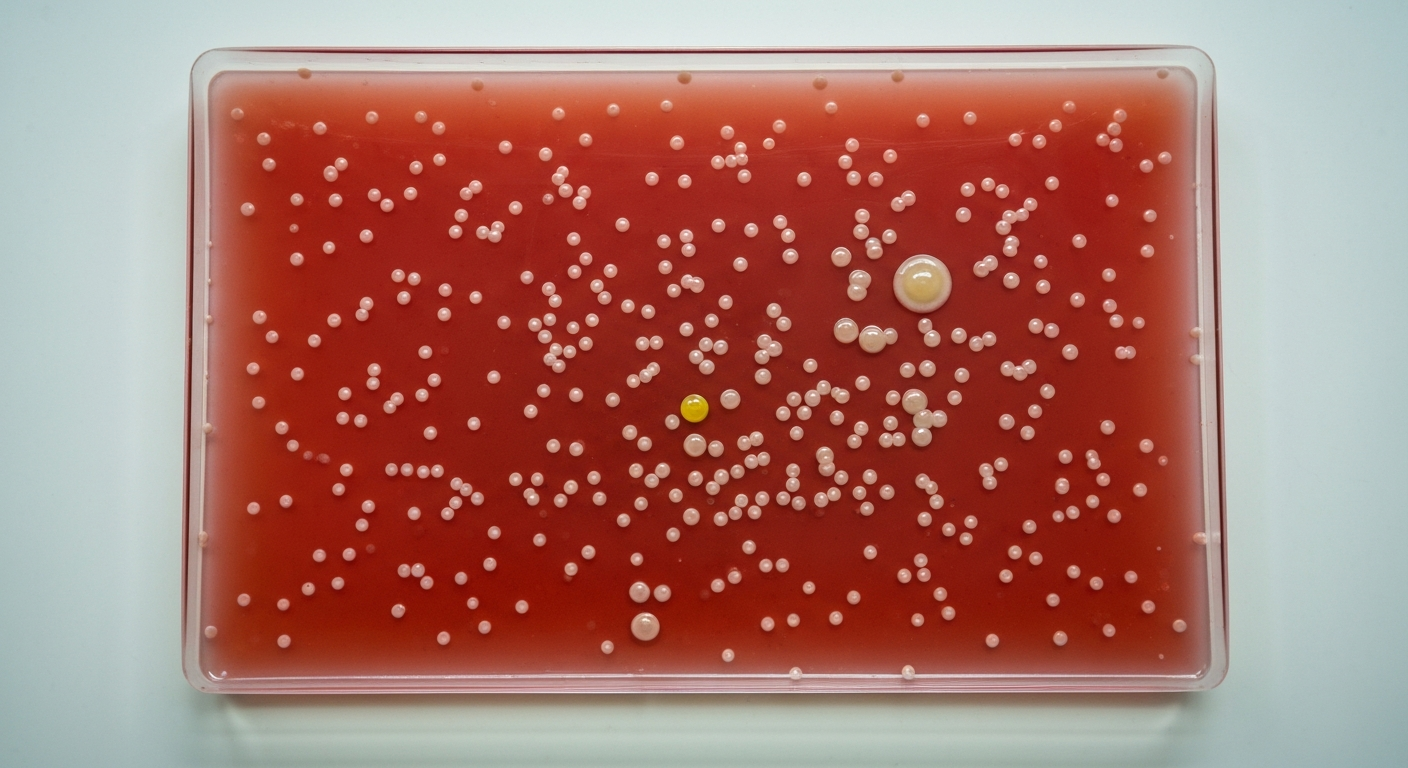
Yes, Burkholderia cepacia complex (BCC) does grow on MacConkey agar. Colonies typically appear colorless or pale because BCC does not ferment lactose, and they are often very small or pinpoint at 24 hours, becoming more reliably visible by 48 hours. Growth is possible but not guaranteed to be robust, and MacConkey alone is not enough to identify BCC to the species or even genus level with confidence. If you suspect BCC, especially in a clinical or cystic fibrosis (CF) setting, MacConkey is a starting point, not a finish line.
Does Burkholderia cepacia Grow on MacConkey Agar? Lab Guide

Marcus Reeves
20 Jul 2026
How MacConkey agar works
MacConkey agar is a selective and differential medium designed originally to isolate Gram-negative enteric bacteria. Its selectivity comes from two main inhibitors: bile salts (typically 0.15 to 1.5 g/L depending on formulation) and crystal violet (around 0.001 g/L). Both compounds disrupt the thick peptidoglycan cell wall of Gram-positive organisms, effectively preventing most Gram-positives from establishing colonies under routine conditions. This is why Gram-positive bacteria like staphylococci or streptococci are inhibited or killed on MacConkey while Gram-negatives pass through largely unaffected. For details, see can gram-positive bacteria grow on macconkey agar.
The differentiation side of the medium depends on lactose (10 g/L) and the pH indicator neutral red. Organisms that ferment lactose acidify the medium, which turns neutral red from pale yellow to pink or red. You end up with visibly pink or red colonies for lactose fermenters like Escherichia coli, and colorless or transparent colonies for non-fermenters like Pseudomonas, Salmonella, or BCC. Weak lactose fermenters may produce pale pink colonies or show a color change only after extended incubation, which is worth keeping in mind when reading plates at 24 hours.
What BCC actually does on MacConkey agar
BCC members grow on MacConkey agar as lactose-nonfermenting colonies, meaning they appear colorless or pale against the medium background. That part is fairly consistent across the complex. What is less consistent is how quickly and how robustly they grow. At 24 hours, many BCC isolates produce only pinpoint or very small colonies that are easy to miss. By 48 hours, colonies are more reliably visible and easier to characterize. Some genomovars within the complex grow more slowly or poorly than others on MacConkey, so a 24-hour read-out can produce false-negative results for the organism. Large clinical and cystic fibrosis laboratory studies report that most Bcc isolates will grow on MacConkey agar with recovery commonly observed at 24–48 hours, but growth rate and colony appearance vary between genomovars, and some genomovars grow more poorly Phenotypic Methods for Determining Genomovar Status of the Burkholderia cepacia Complex (PMC).
One important caveat: MacConkey was not designed for BCC, and bile salts plus crystal violet can depress growth of stressed or auxotrophic strains. Large clinical series comparing isolation media have shown that dedicated selective agars (discussed below) consistently outperform MacConkey for recovering BCC from mixed specimens, particularly respiratory secretions. MacConkey remains useful as a general screening plate, but it should not be the sole medium when BCC is the primary target.
Incubation conditions and timing
Most clinical laboratory protocols and manufacturer instructions recommend aerobic incubation at 35 to 37 degrees Celsius with an initial read at 18 to 24 hours and a second read at 48 hours if nothing is visible at 24 hours. For environmental or non-enteric isolates, some labs drop the temperature slightly, to around 30 to 33 degrees Celsius, which can improve recovery of certain non-fermenters including BCC. Burkholderia cepacia selective agar product inserts commonly recommend 33 to 37 degrees Celsius for the same reason.
If you are working with a specimen type where BCC is suspected and you only check MacConkey at 24 hours, you risk reporting a false negative. Extending incubation to 48 hours and flagging any colorless, slow-growing colonies for follow-up testing is a straightforward way to reduce that risk. Do not discard plates with only pinpoint growth at 24 hours without a second look.
Colony morphology on MacConkey: expect variability
BCC colonies on MacConkey agar at 48 hours are typically colorless to pale cream, small to medium in size, and can range from dry and slightly wrinkled to mucoid, depending on whether the strain produces a capsule. Mucoid colonies tend to appear glossy and slightly raised. Some strains within the complex produce pigments (yellow, cream, or even a faint purple) that can make colonies look slightly off-white or tinted, though this is strain and species dependent.
This variability is a real practical problem. A dry, pale, pinpoint colony at 24 hours looks nothing like a larger mucoid colony at 48 hours, and both can come from BCC. Morphology alone on MacConkey is not sufficient to identify BCC or to distinguish it from other colorless non-fermenters like Pseudomonas, Achromobacter, Ralstonia, or Stenotrophomonas. That is exactly why follow-up testing is essential.
How other Gram-negative non-fermenters compare on MacConkey
BCC is far from alone in appearing as colorless colonies on MacConkey. Several other clinically and environmentally important Gram-negatives share that non-fermenting appearance, which makes direct comparison useful when you are reading a plate.
| Organism | Lactose fermentation | Colony color on MacConkey | Growth speed | Notable feature |
|---|---|---|---|---|
| Burkholderia cepacia complex | Negative | Colorless to pale cream | Slow, often pinpoint at 24 h; better at 48 h | Variable morphology; can be mucoid; pigment possible |
| Pseudomonas aeruginosa | Negative | Colorless to pale; may show bluish-green tinge from pyocyanin | Moderate to good; usually visible at 24 h | Characteristic grape-like odor; flat spreading colonies |
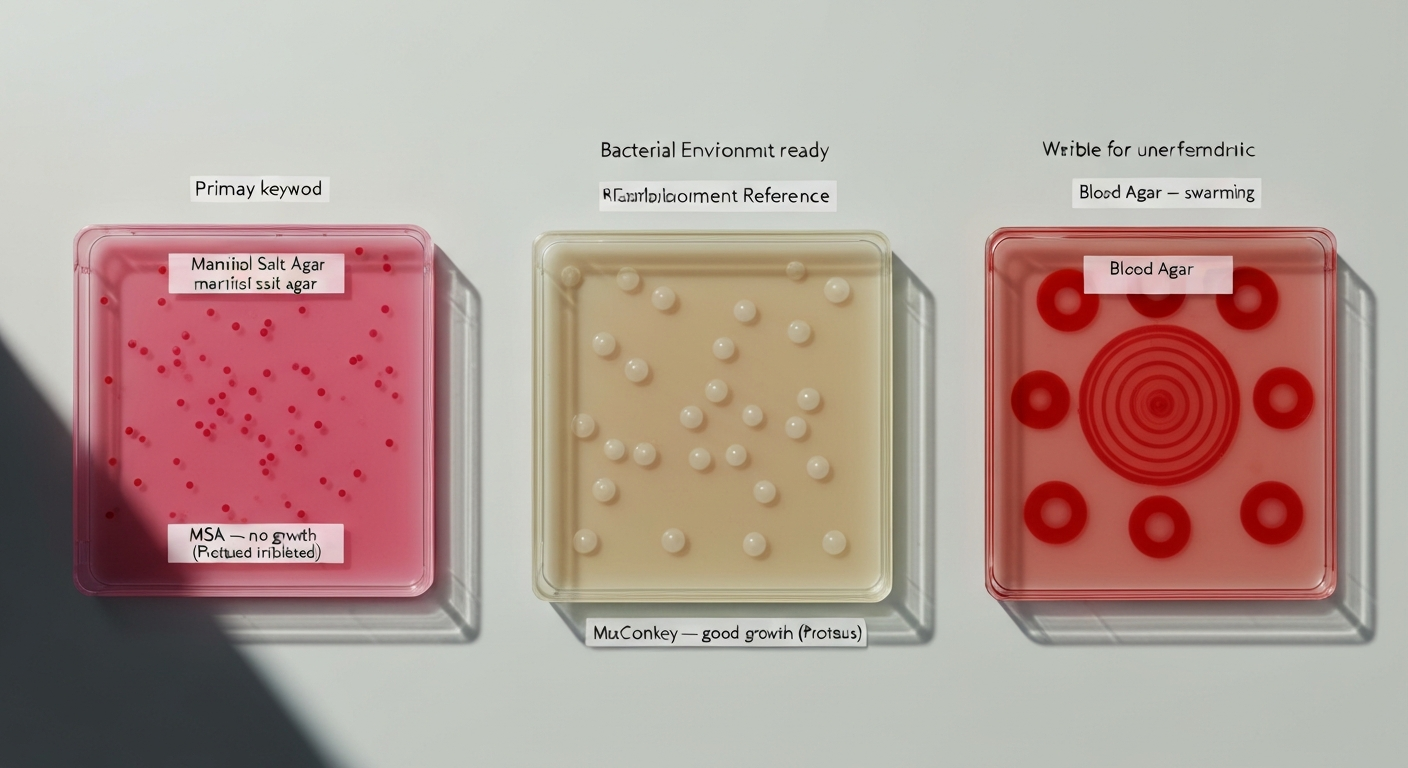
| Proteus vulgaris | Negative (or very weak) | Colorless; may show swarming on less inhibitory plates | Good; 24 h growth common | Swarming motility; urease positive; distinctive odor |
| Salmonella spp. | Negative | Colorless to translucent | Good; 24 h growth reliable | H2S production (black center) possible on some formulations |
Pseudomonas aeruginosa is probably the most clinically important organism to compare with BCC, particularly in a CF context. Both grow as colorless colonies on MacConkey, but Pseudomonas typically grows faster and more robustly at 24 hours, and mucoid Pseudomonas strains can overgrow the plate and physically obscure smaller BCC colonies. This is one of the main reasons dedicated BCC selective agar was developed for CF respiratory specimens in the first place.
Why the appearances differ: what actually drives the differences
The colorless appearance shared by BCC, Pseudomonas, Proteus, and Salmonella on MacConkey all traces back to the same root cause: none of them ferment lactose under the conditions the medium sets up, so no acid is produced, neutral red stays pale, and colonies remain colorless. For specifics on Proteus vulgaris growth on MacConkey agar, see the related article Does Proteus vulgaris grow on MacConkey agar. The differences in what you actually see come from other factors specific to each organism.
- Lactose fermentation: The primary driver of color on MacConkey. Fermenters go pink or red; non-fermenters stay colorless. BCC, Pseudomonas, and Salmonella are all non-fermenters in this context.
- Pigment production: Pseudomonas aeruginosa produces pyocyanin (blue-green) and pyoverdine, which can bleed into the agar or create a characteristic tinge not related to lactose. BCC can produce yellow or cream pigments, but this is inconsistent.
- Swarming motility: Proteus vulgaris is a classic swarmer but bile salts and crystal violet in MacConkey partially suppress this behavior. You may still see some spreading, but it is less dramatic than on blood agar.
- Growth rate: Salmonella and Proteus generally grow well at 24 hours on MacConkey. BCC often needs 48 hours. Pseudomonas is typically somewhere in between, growing well at 24 hours.
- Susceptibility to inhibitors: Crystal violet and bile salts primarily target Gram-positives, but they can also mildly suppress some Gram-negatives, particularly slow-growers or environmentally stressed strains. BCC may be more affected by this than robust enteric organisms.
Why Mannitol Salt Agar is a completely different story
Mannitol Salt Agar (MSA) selects through a completely different mechanism than MacConkey. Instead of bile salts and crystal violet targeting Gram-positives, MSA uses a very high sodium chloride concentration (typically around 75 g/L) to select for halotolerant organisms, primarily staphylococci. Most Gram-negative bacteria, including Proteus vulgaris and BCC, cannot tolerate that salt concentration and will not grow on MSA under routine conditions. Most Gram-positives other than staphylococci are also inhibited. For clarity, mannitol salt agar will only grow bacteria that are halotolerant (able to tolerate high salt concentrations), primarily staphylococci.
Differentiation on MSA is based on mannitol fermentation rather than lactose. Staphylococcus aureus ferments mannitol and produces yellow colonies (acid turns the phenol red indicator yellow), while coagulase-negative staphylococci like S. epidermidis generally do not ferment mannitol and produce pink or red colonies. BCC would not appear on MSA in a routine clinical or food-safety scenario precisely because it is not halotolerant. If you are choosing between MacConkey and MSA for a suspected Gram-negative non-fermenter, MacConkey is the appropriate choice.
Why MacConkey is not enough for a definitive BCC identification
Even when you recover colorless colonies on MacConkey that are consistent with BCC, the medium itself tells you very little beyond Gram-negative and non-lactose-fermenting. Multiple closely related organisms, including Pandoraea, Ralstonia, Achromobacter, and Stenotrophomonas, can produce nearly identical colonies on MacConkey and require entirely different clinical responses. Automated biochemical systems like VITEK 2 and API 20NE can misidentify BCC members or return low-confidence results. MALDI-TOF MS identifies BCC at the genus level reasonably well but species-level discrimination within the complex is limited unless you are using an enriched reference library.
Molecular methods remain the gold standard. The recA gene sequencing approach is widely used in reference labs to differentiate BCC species because 16S rRNA sequencing lacks sufficient discriminatory power within the complex. Accurate identification and epidemiological characterization of Burkholderia cepacia complex: an update (PMC review) recommends recA gene sequencing and multilocus sequence typing (MLST) for accurate Bcc species assignment because 16S rRNA lacks discriminatory power within the complex. Multilocus sequence typing (MLST) is used for epidemiological characterization. For routine clinical labs, the practical takeaway is that a colorless colony on MacConkey should trigger a structured follow-up workflow, not a direct report of BCC.
Follow-up steps after seeing a suspicious colony
When you pick up a colorless, slow-growing Gram-negative colony on MacConkey and BCC is on your differential, a practical follow-up sequence looks like this:
- Gram stain: Confirm the organism is a Gram-negative rod. BCC are small, slightly curved Gram-negative rods.
- Oxidase test: BCC is frequently oxidase-positive, though results can be weak or variable. A positive oxidase on a colorless MacConkey colony should immediately raise your index of suspicion for BCC or other non-fermenting Gram-negatives including Pseudomonas. A negative or ambiguous result does not rule out BCC.
- Subculture to non-selective media: Blood agar or chocolate agar will give you better colony morphology and confirm viability.
- Parallel plating to Burkholderia cepacia selective agar (BCSA): If BCC is clinically suspected, especially in a CF respiratory context, BCSA provides significantly better sensitivity and selectivity than MacConkey. BCSA suppresses competing flora like mucoid Pseudomonas aeruginosa that can mask BCC on routine media.
- Biochemical panel or MALDI-TOF: Use as a first-pass identification tool, but treat low-confidence results or misidentifications at the species level as expected. Flag for molecular confirmation if the identification matters clinically.
- Molecular confirmation: For definitive species-level identification within the complex, recA gene sequencing or MLST via a reference laboratory is recommended.
Biosafety and handling considerations
BCC is classified as a Biosafety Level 2 (BSL-2) organism in most jurisdictions. Routine microbiological safety practices, including standard precautions, a biosafety cabinet for aerosol-generating procedures, and disinfection with appropriate agents (chlorine-based or phenolic disinfectants are commonly used), are appropriate for handling suspected BCC cultures. BCC is particularly significant in the CF population because certain lineages can spread between patients and cause severe pulmonary decline. In a food-safety or environmental context, BCC is an opportunistic pathogen with relatively low risk to healthy immunocompetent individuals, but it is a recognized spoilage organism in pharmaceutical and cosmetic products and an environmental contaminant in water and soil.
If you are working in a CF center or a clinical lab that processes CF respiratory specimens regularly, following your institution's guidelines for patient cohorting and specimen handling is more important than the media choice. MacConkey is a reasonable triage tool in that workflow, but it should never be the only plate in a CF culture setup.
Common interpretation pitfalls to avoid
- Reading MacConkey at only 24 hours and reporting no growth: BCC colonies are frequently pinpoint or absent at 24 hours. Always extend to 48 hours when BCC is a possibility.
- Assuming any colorless colony on MacConkey is BCC: Pseudomonas, Proteus, Salmonella, and several other organisms share the same non-fermenting appearance. Run follow-up tests before drawing conclusions.
- Relying on oxidase alone to confirm or exclude BCC: Oxidase reactions in BCC can be weak or variable. A negative result does not rule it out.
- Using MacConkey as the sole selective medium for CF respiratory cultures: BCSA and equivalent selective agars have demonstrably better sensitivity and selectivity for BCC recovery. MacConkey alone is not sufficient for CF surveillance.
- Accepting low-confidence automated biochemical ID results without confirmatory testing: VITEK 2 and API 20NE misidentify BCC species more often than most lab staff realize. Molecular confirmation changes management decisions.
Environmental and food safety implications
In environmental monitoring programs, MacConkey agar is sometimes used as a general Gram-negative screening medium for water, surfaces, or process equipment. BCC can survive in water systems, moist surfaces, and even in some disinfectant solutions, which means it is not unusual to encounter it as an environmental isolate. Colorless non-fermenting colonies recovered from these settings warrant the same follow-up workup described above, particularly the oxidase test and subculture to selective media, before BCC can be implicated or excluded.
In food-safety contexts, BCC is primarily a concern in pharmaceutical-grade water, sterile products, and immunocompromised patient food service rather than in standard food manufacturing. Its recovery on MacConkey during environmental monitoring does not automatically indicate a food safety emergency, but it does require investigation and follow-up identification to determine whether the isolate is genuinely BCC or a different non-fermenter. The same media limitations apply: treat MacConkey as a screening tool, not a confirmatory one.
FAQ
Does Burkholderia cepacia complex (BCC) grow on MacConkey agar?
Yes. Most BCC isolates will grow on standard MacConkey agar, appearing as lactose‑nonfermenting (colourless) colonies. Growth can be slower or reduced compared with enteric Gram‑negatives, so colonies may be very small or faint at 18–24 h and are more reliably visible by 48 h.
Why does MacConkey agar allow growth of BCC and how does it select/differentiate organisms?
MacConkey contains bile salts and (in many formulations) crystal violet to inhibit most Gram‑positives, and lactose plus neutral red to differentiate lactose fermenters (pink/red) from non‑fermenters (colourless/transparent). BCC are Gram‑negative non‑enteric organisms that are typically lactose‑nonfermenting, so they are not inhibited by MacConkey's selective agents and do not produce the pink lactose reaction.
What incubation conditions should be used when screening for BCC on MacConkey?
Standard practice is aerobic incubation at 35–37°C and reading at 18–24 h with a routine extension to 48 h for slow growers. Some labs use 30–33°C or 33–37°C for non‑enteric non‑fermenters or when using Burkholderia‑selective agar; check media IFUs. Expect many BCC isolates to be clearer by 48 h.
What colony morphology of BCC should I expect on MacConkey and when?
Typical appearance: colourless (non‑lactose fermenting) colonies. At 24 h many isolates are pinpoint or small; by 48 h colonies enlarge. Morphology varies by species/strain — colonies may be dry/wrinkled, smooth, mucoid (capsulated strains) and sometimes pigmented (yellow/cream/purple depending on species). Morphology alone cannot reliably speciate BCC.
How does BCC appearance on MacConkey compare with other common Gram‑negative non‑fermenters (Pseudomonas, Proteus vulgaris, Salmonella)?
- Pseudomonas aeruginosa: usually grows well and produces characteristic large, often pigmented colonies (green/blue pyocyanin or yellow/pyoverdine) and is typically oxidase‑positive. - Proteus vulgaris: grows readily and may swarm on non‑inhibitory media (but MacConkey suppresses swarming); typically non‑lactose fermenting with distinctive biochemical traits (H2S variable). - Salmonella: enteric non‑lactose fermenter that grows robustly on MacConkey and often produces pale colonies; usually faster growing than BCC. BCC typically grows slower and colony texture/pigment patterns differ, so follow‑up tests are needed to discriminate.
Why is MacConkey limited for definitive identification of BCC?
MacConkey only selects/inhibits broadly (Gram‑positive vs Gram‑negative) and differentiates lactose fermentation; it does not identify genus/species. Some stressed or auxotrophic non‑enteric Gram‑negatives may be inhibited or grow poorly. Many non‑fermenters (Burkholderia, Pandoraea, Ralstonia, Stenotrophomonas, Achromobacter) can have similar MacConkey appearances, so species‑level identification requires further testing.
Next Article
Does Proteus vulgaris grow on Mannitol Salt Agar? Lab answer
Does Proteus vulgaris grow on Mannitol Salt Agar? Short answer: usually no, reasons, testing tips, and interpretation for