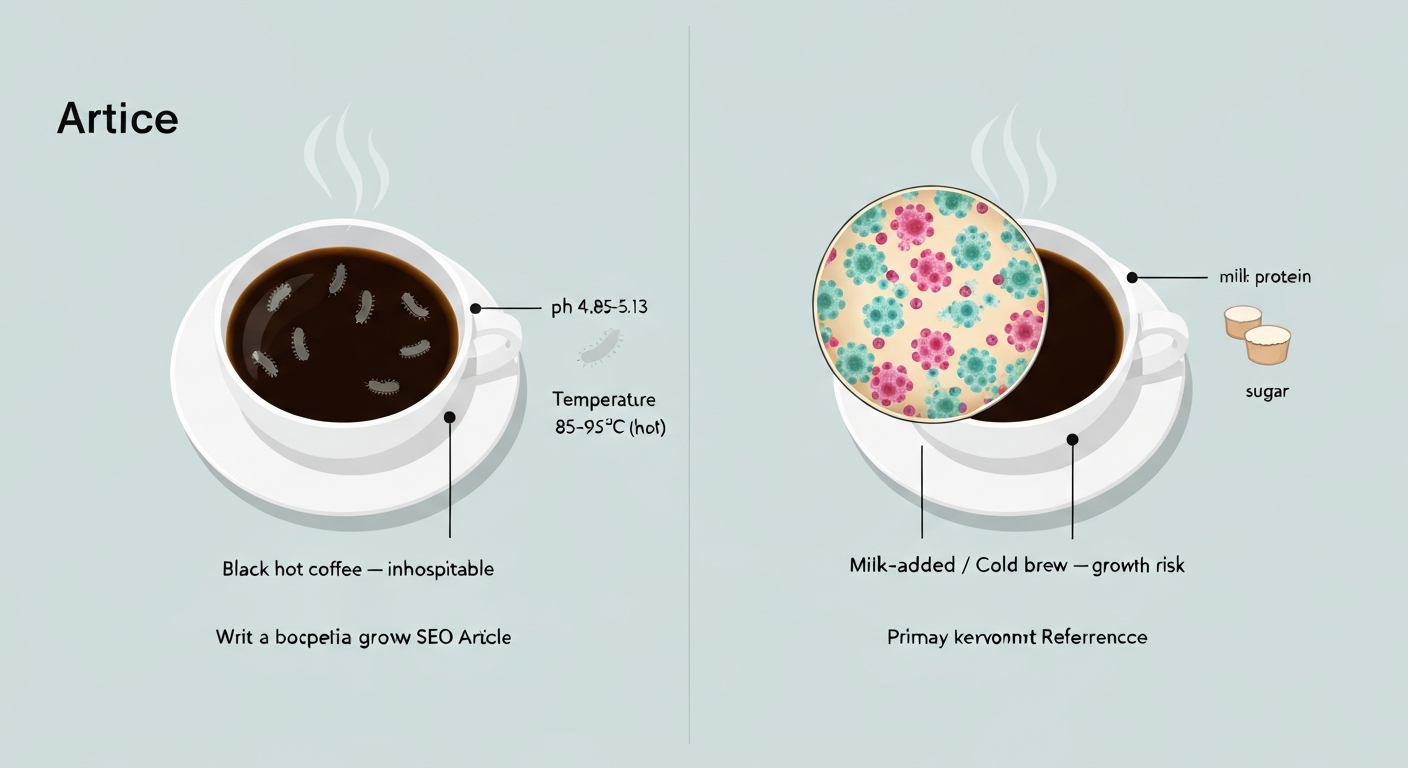
Yes, bacteria can grow in coffee, but whether they actually do depends heavily on the type of coffee, its temperature, what you have added to it, and how long it has been sitting out. Black hot-brewed coffee is a genuinely hostile environment for most bacteria: its pH sits around 4.85 to 5.13, it is served near boiling, and it provides almost no usable nutrients. Add milk, let it cool to room temperature, and you have changed the rules entirely. The short version is that black hot coffee rarely supports active bacterial growth, cooled and iced coffee creates growing risk windows, and cold brew without a pasteurization step can harbor pathogens for weeks to months.
Can Bacteria Grow in Coffee? Risks, Controls, and Guidance

Marcus Reeves
10 Aug 2026
What this article covers and who it is for
This article is written for food safety professionals, microbiologists, educators, and informed consumers who want a technically grounded answer to whether bacteria grow in coffee and under what conditions. I will walk through the environmental variables that control microbial growth in coffee, the specific types of microbes you are most likely to encounter, the contamination routes that matter in practice, and how additives and containers change the risk picture. I will not diagnose illness, prescribe medical treatment, or make claims about specific commercial products. Where I reference predictive microbiology data and published research, I will name the parameters precisely so you can apply them.
Key takeaways before you read further
- Freshly brewed hot coffee (black) is a poor growth environment due to low pH (around 4.85–5.13), high serving temperature, and low nutrient density.
- Black coffee falls just above the pH 4.6 threshold that regulators use to classify a food as potentially supporting bacterial growth, so it cannot be assumed fully self-preserving.
- Cold brew coffee skips the thermal kill step; pathogens including Salmonella, E. coli, and Listeria monocytogenes have been shown to survive in cold brew for over 60 days at 4°C and up to 90 days at 23°C.
- Adding milk or cream to coffee substantially raises nutrient availability and can shift a no-growth matrix into one that supports Bacillus cereus germination and growth.
- Roasting kills most vegetative bacteria and reduces mycotoxins on green beans, but heat-resistant Bacillus spores can survive and have been confirmed in commercial ground roasted coffee.
- Commercial ready-to-drink cold brew should be treated as a time/temperature control for safety (TCS) food and stabilized by pasteurization, high-pressure processing (HPP), or UV treatment.
- The highest practical contamination risks in foodservice are milk residues on steam wands and milk circuits, inadequately cleaned syrup pumps, and improper cooling after brewing.
Survival versus active growth: why the distinction matters
In food microbiology, survival and growth are not the same thing, and conflating them leads to both unnecessary alarm and genuine blind spots. Survival means a viable cell or spore is present and capable of causing harm if conditions later become permissive, but its numbers are not increasing. Active growth means the organism is multiplying, typically doubling at a rate determined by temperature, pH, water activity, and nutrient supply. A bacterium that merely survives in cold brew coffee at 4°C and stays at its original count is a different public health situation than one that doubles every few hours in a warm milk-coffee drink left on a counter.
For food safety professionals, the critical decision point is whether the matrix and storage conditions allow growth to reach an infectious or toxigenic dose. For consumers, the practical takeaway is that coffee can harbor organisms without actively growing them, but the moment you add a nutrient-rich additive or move into the temperature danger zone (4°C to 60°C), survival can rapidly convert to growth. This distinction also matters for lab testing: a culture method that shows low counts does not confirm safety if conditions have changed or if a toxin has already been produced.
Environmental controls on microbial growth in beverages
Temperature
Temperature is the most powerful lever available in coffee service. The FDA temperature danger zone, 4°C to 60°C (40°F to 140°F), defines the range where most foodborne pathogens can grow. Hot-held coffee above 60°C is effectively self-sanitizing over time for vegetative cells; refrigerated coffee at or below 4°C stops growth of most mesophilic pathogens but does not inactivate them. Psychrotrophic strains, including some Bacillus cereus variants and Listeria monocytogenes, can grow slowly at refrigeration temperatures, which is one reason cold brew held for extended periods at 4°C still poses a measurable risk even though total counts may be low.
pH
Coffee is mildly acidic. Controlled measurements of both hot-brewed and cold-brewed black coffee place pH in the range of approximately 4.85 to 5.13, and hot and cold brew are broadly comparable in acidity. The regulatory threshold below which most pathogens cannot grow is pH 4.6. At pH 4.85 to 5.13, black coffee is above that threshold, meaning acidity alone is not sufficient to prevent growth if temperature and nutrients are permissive. Lactic acid bacteria, some yeasts, and acid-tolerant spore-formers are particularly relevant here because they tolerate pH ranges well within the coffee window.
Water activity
Water activity (aw) measures how much free water is available for microbial use, on a scale from 0 to 1. Freshly brewed liquid coffee behaves as a high-aw food, with aw close to 1.0, meaning water is essentially unrestricted as a microbial resource. The USDA/FDA threshold for TCS classification is aw above approximately 0.86 combined with pH above 4.6. Brewed coffee clears both thresholds and is therefore classified as a TCS food when temperature control cannot be assured. By contrast, dried instant coffee or whole roasted beans have substantially lower aw and are correspondingly more stable microbiologically.
Oxygen availability
Most packaging and serving conditions for brewed coffee are aerobic or microaerophilic. This favors aerobic and facultatively anaerobic organisms. Sealed cold brew in nitrogen-flushed packaging shifts the environment toward anaerobic conditions, which suppresses aerobic spoilage but can theoretically favor anaerobic species. Tightly sealed containers without proper thermal processing could, in principle, create conditions relevant to Clostridium species, though this is more immediately applicable to canned and shelf-stable coffee products than to typical foodservice cold brew.
Nutrient availability
Black coffee is a genuinely poor nutrient medium. It contains minimal fermentable sugars, little protein, and a range of antimicrobial phenolic compounds including chlorogenic acids. When brewed coffee is supplemented with glucose or inactivated yeast, lactic acid bacteria and yeast can grow and ferment the beverage, which is the basis for deliberately fermented probiotic coffee products. This tells us plainly that nutrient limitation is a meaningful restraint in black coffee, and that any additive introducing sugars or protein erodes that restraint.
How different coffee matrices compare microbiologically
| Coffee type | pH (approx.) | Water activity (aw) | Thermal kill step? | Key risk factors |
|---|---|---|---|---|
| Hot-brewed black (>60°C) | 4.85–5.13 | ~1.0 | Yes (brewing temperature) | Spore survivors; cooling management |
| Cooled/room-temperature black | 4.85–5.13 | ~1.0 | Original only | Time in danger zone; nutrient-poor but permissive if held long |
| Iced/cold black coffee | 4.85–5.13 | ~1.0 | Original only | Dilution by ice; temperature fluctuations; pathogen survival |
| Cold brew (unprocessed) | 4.85–5.13 | ~1.0 | None | Pathogen survival for weeks to months; no kill step |
| Espresso (black) | ~5.0–5.5 | ~1.0 | Yes (high-pressure hot water) | Very small volume; rapid cooling; minimal held risk alone |
| Whole or ground beans (dry) | Variable | Low (<0.6 typical) | Partial (roasting) | Spore survival post-roast; mold/mycotoxin on green beans; post-roast recontamination |
Hot-brewed coffee is produced at temperatures well above 60°C, which inactivates most vegetative bacteria during the brew process. The risk window opens the moment brewing stops and temperature begins to fall. Espresso is brewed at approximately 90 to 96°C under pressure, further reducing vegetative cell survival, but the very small volume cools rapidly. Cold brew is the outlier: extraction occurs over 12 to 24 hours at room temperature or refrigerator temperature (4°C), providing no thermal kill step whatsoever. Whole and ground beans occupy a separate category with much lower aw, limiting active growth but not spore survival.
Which microbes are actually found in coffee
Environmental bacteria
Environmental bacteria including Pseudomonas, Acinetobacter, and various Gram-negative organisms are common transient contaminants from water, surfaces, and handling. They are typically poor competitors in acidic environments and are killed by brewing temperatures. Their main relevance is in post-brew contamination of cooled or cold-extracted coffee, particularly through contact surfaces and utensils.
Spore-forming bacteria
Bacillus cereus and related Bacillus group species are the most consistently documented bacterial presence in roasted and ground coffee. Molecular surveys have confirmed Bacillus cereus group strains, including B. thuringiensis, in commercial ground roasted coffee products. Spores survive roasting and can persist through standard brewing temperatures. In black coffee without milk, spore counts tend to decline over time. When milk is added, the dynamic changes: inoculation studies show that B. cereus and B. subtilis increase in number in milk-coffee drinks, while they decline in black coffee or tea, demonstrating that milk provides the nutrient substrate required for spore germination and vegetative growth.
Lactic acid bacteria and fermentative microbes
Lactic acid bacteria (Lactobacillus spp. and relatives) are associated with coffee at the fermentation stage during green bean processing, where wet fermentation of mucilage is standard practice. In brewed coffee, they are not typically active unless fermentable substrates are present. When glucose or yeast extract is added, Lactobacillus strains can grow, acidify the beverage, and alter flavor. This is exploited deliberately in fermented coffee beverages but is worth understanding as a contamination risk in sugar-enriched coffee products held at warm temperatures.
Yeasts and molds
Fungi are primarily a concern at the green bean stage. Toxigenic molds including Aspergillus and Fusarium species can colonize green coffee and produce mycotoxins such as ochratoxin A and fumonisins. Roasting substantially reduces viable fungal loads and lowers mycotoxin concentrations, but does not eliminate mycotoxins entirely since they are heat-stable molecules. In brewed and ready-to-drink coffee, yeast contamination is possible but generally considered a minor issue compared to bacteria, particularly at low pH.
Opportunistic pathogens
Salmonella, Escherichia coli O157:H7, Listeria monocytogenes, and Staphylococcus aureus have all been detected or experimentally inoculated into cold brew coffee, where they survive for extended periods. Salmonella on roasted beans shows only small count reductions during refrigerated storage over months. In brewed cold coffee at 4°C, pathogens can survive beyond 60 days; at 23°C, survival has been documented up to approximately 90 days. These organisms do not appear to actively multiply in black cold brew, but their persistence at low temperatures means a single contamination event can remain a hazard through the entire shelf life of an unprocessed product.
How coffee gets contaminated in the first place
Brew water
Municipal potable water carries low, regulated bacterial counts, but it is not sterile. Equipment water lines, reservoirs, and hoses that are not regularly cleaned can accumulate biofilms, introducing organisms directly into every batch. Water with elevated hardness or mineral content that creates scale inside equipment creates additional surface area for biofilm attachment.
Hands and staff
Hand-to-product contact transfers Staphylococcus aureus, Listeria, and a range of environmental Gram-negatives onto finished coffee, cups, and lids. S. aureus is of particular concern because it produces a heat-stable enterotoxin: even if the organism is killed by reheating, the toxin remains active. Handwashing compliance and glove use for ready-to-drink packaging are therefore more than routine hygiene steps.
Milk and dairy alternatives
Milk is the single most significant contamination amplifier in coffee. It introduces proteins, sugars, and fat that directly support bacterial growth, and it brings its own microbial flora including B. cereus spores that survive pasteurization. Plant-based milk alternatives (oat, soy, almond) have their own microbiological profiles, often with higher sugar content that can further support fermentative organisms. Any milk-containing coffee drink left in the temperature danger zone for more than two hours should be discarded.
Syrups and pumps
Commercial coffee syrups are high-sugar solutions. When pump nozzles are not cleaned regularly, residual diluted syrup at the nozzle tip provides an ideal growth medium for yeasts, molds, and Gram-positive bacteria including Bacillus. Cross-contamination from the pump directly into a cup is a realistic route that is frequently overlooked in service environments.
Equipment and grinders
Coffee grinders accumulate residual ground coffee containing oils, moisture from ambient humidity, and coffee particles. These provide a persistent substrate for environmental bacteria and mold. Steam wands and internal milk circuits on espresso machines are particularly high-risk: milk fouling on stainless steel greatly increases bacterial and spore attachment, protects organisms from cleaning agents, and promotes biofilm formation. Research on milk residues confirms that these deposits alter how effectively spores and vegetative cells are removed from both stainless steel and polypropylene surfaces.
Packaging and cups
Post-fill contamination during packaging of RTD cold brew is a recognized commercial risk. Single-use cups and lids, if stored improperly or handled without hygiene controls, contribute environmental organisms. The material of the container (plastic versus stainless steel) affects how organisms attach and survive, which is explored further in the next section.
How additives and containers change the risk
Milk and cream
Adding milk or cream to coffee is the most impactful single change you can make to its microbial risk profile. The nutrient matrix shifts from one that actively suppresses Bacillus growth to one that supports it. B. cereus in dairy products is well documented, and pasteurization does not eliminate spore risk because spores survive and pasteurization temperatures can actually trigger germination. In a milk-coffee drink held between 20°C and 37°C, B. cereus can multiply to toxin-producing levels within two to four hours.
Sugar syrups and sweeteners
Sugar introduces fermentable carbohydrates that lactic acid bacteria and yeasts can metabolize. The degree of risk scales with concentration and temperature. At syrup-level concentrations (very high sugar, low aw), microbial growth is suppressed. When syrup is diluted into a coffee drink, aw rises toward 1.0 and the sugar becomes a nutrient source. This is comparable in principle to bacteria in sugar water, where concentration determines whether the solution is inhibitory or permissive.
Non-dairy creamers
Powdered non-dairy creamers are low-aw products and are typically stable as long as they remain dry. Liquid non-dairy creamers behave similarly to dilute dairy products once added to coffee, introducing sugar and fat that support growth. Open liquid creamer containers left at room temperature are a contamination risk if held beyond manufacturer-recommended holding times.
Plastic and stainless steel contact surfaces
Surface material affects how bacteria attach and how easily they are removed. Research on spore removability shows that residual milk components enhance attachment to both stainless steel and polypropylene, and that the effectiveness of cleaning differs between these materials. Stainless steel is generally preferred for food contact because it is easier to sanitize when maintained correctly, but milk fouling on stainless steel still creates significant biofilm risk if cleaning is inadequate. This is directly relevant to the growing literature on bacteria on plastic surfaces in food environments.
Single-use cups and lids
Single-use cups introduce minimal contamination risk when handled correctly and used promptly. If cups are stored in humid conditions or handled repeatedly by bare hands before filling, they can carry environmental organisms. Lidded cups slow evaporation and maintain temperature longer, which is beneficial for hot drinks but extends the warm holding time in the danger zone for cooled or iced drinks.
Cold chain management
Cold chain discipline is the primary safety control for commercial cold brew. Temperature abuse, defined as allowing a TCS beverage to exceed 4°C during storage or distribution, accelerates pathogen growth in milk-containing cold brew and extends pathogen survival time in all cold brew formats. Every degree of temperature increase shortens the safety margin. HPP (high-pressure processing) and pasteurization are validated commercial interventions that address this directly, but they are not applicable at the single-serve or foodservice batch level, making cold chain adherence non-negotiable in those settings.
Practical handling, holding, and storage guidance
- Hold hot coffee above 60°C (140°F) if it will not be consumed within 30 minutes; discard black hot coffee after 4 hours of hot-holding.
- Refrigerate brewed black coffee within 2 hours of brewing if it will be stored; use within 3 to 5 days.
- Discard any milk-containing coffee drink left above 4°C for more than 2 hours.
- Store commercial cold brew at or below 4°C at all times; follow manufacturer expiry dates and treat as TCS.
- Clean steam wands and milk circuits immediately after each use; never allow milk residue to dry on contact surfaces.
- Flush and sanitize coffee grinders, drip trays, water lines, and syrup pumps on a defined cleaning schedule.
- Keep whole beans and ground coffee in sealed, low-humidity containers; do not store near moisture sources.
- Use food-safe thermometers to verify holding and refrigeration temperatures rather than relying on equipment displays alone.
Testing approaches and their limitations
Standard plate count methods (aerobic colony count, selective agars for Bacillus, Listeria, Salmonella, and Enterobacteriaceae) are appropriate for verifying cleanliness in coffee production environments and for challenge studies. ATP bioluminescence testing is useful for rapid surface hygiene verification on equipment, particularly for detecting milk residues on steam wands and milk circuits, though ATP alone cannot confirm pathogen absence. Molecular methods (PCR, qPCR) detect specific pathogen DNA rapidly and at low levels but cannot distinguish viable from non-viable cells, meaning a positive result requires confirmation. Predictive microbiology tools including ComBase and the USDA Pathogen Modeling Program allow growth/no-growth estimation for specific combinations of temperature, pH, and aw, and are appropriate for designing shelf-life studies and validating holding times for coffee-based beverages. Pathogen Modeling Program (PMP), Water Activity guidance (USDA/ARS) provides models and datasets for predicting microbial growth as a function of water activity (aw), supporting TCS classification and shelf-life decision-making Pathogen Modeling Program (PMP) — Water Activity guidance (USDA/ARS).
How coffee compares to related food matrices
Comparing coffee to related matrices helps place its risk profile in context. Sugar water at beverage dilutions has a pH near neutral and high aw, making it more permissive for a wider range of bacteria than black coffee, with acidity providing no inhibition. Wine, by contrast, combines ethanol (typically 11 to 14%), low pH (3.3 to 3.5), sulfite addition, and reduced aw in ways that create a genuinely antimicrobial matrix, making it far more restrictive for common pathogens than coffee. For more on microbial survival and growth in alcoholic beverages, see can bacteria grow in wine. Canned food, when properly processed, achieves commercial sterility through heat and sealed anaerobic conditions, but failures introduce Clostridium botulinum risk in a way that is not relevant to normal coffee service. For detailed information on which bacteria grow in canned food and the specific risks from Clostridium species, see the related guidance. Plastic contact surfaces in food environments represent a cross-cutting concern because organism attachment and biofilm persistence on plastics affect every food matrix, including coffee equipment. Coffee sits in the middle of this range: more inhibitory than sugar water at similar dilutions, less inhibitory than wine, and reliant on temperature control and cleaning practices rather than intrinsic preservation.
What food safety professionals should prioritize
For anyone responsible for food safety in a coffee production, service, or retail setting, the evidence points to four priority areas. First, treat any milk-containing coffee product as a perishable TCS food and enforce time and temperature controls rigorously. Second, implement and verify a validated cleaning program for milk contact surfaces, with particular attention to steam wands and internal milk circuits where biofilms form fastest. Third, if producing or distributing commercial RTD cold brew, do not rely on refrigeration alone: validate a kill-step intervention (pasteurization, HPP, or equivalent) and confirm shelf-life through challenge testing. Fourth, recognize that black brewed coffee has meaningful but limited intrinsic antimicrobial properties, and do not assume it is self-stable at room temperature beyond a few hours.
FAQ
Can bacteria grow in plain brewed coffee (hot or cold) after brewing?
Plain black coffee (hot- or cold-brewed) is generally a poor growth medium for most vegetative bacteria because of its low pH (~4.8–5.1) and lack of fermentable nutrients; however, water activity is high (aw ≈1.0), so microbes can survive. Experimental and predictive‑microbiology data show that many pathogens (E. coli, Salmonella, Listeria) can persist for days to weeks in cold‑extracted coffee but typically do not actively multiply in plain black coffee unless other permissive factors are present (added nutrients, higher pH, or temperature within growth range). Key sources: Rao & Fuller 2018 (pH), ComBase/PMP guidance, and multiple cold‑brew survival studies.
What is the difference between survival and growth in coffee?
Survival means organisms remain viable (culturable or detectable) without increasing in number; growth means net population increase (cell division). Coffee often permits long survival—especially at low temperatures—because aw is high and acidity is not immediately lethal, but its acidity and antimicrobial compounds usually prevent vegetative growth unless nutrients (e.g., milk, sugar), spore germination, or favorable temperatures allow growth. Predictive models (ComBase) require temperature, pH and aw to determine growth/no‑growth boundaries.
How do brewing method and the presence/absence of a thermal kill‑step matter?
Hot brewing applies a thermal inactivation step that reduces initial microbial load. Cold brew lacks that kill‑step, so any contaminants present on beans, equipment, or in water can remain viable in the finished beverage. Consequently, cold‑extraction products have higher reliance on post‑extraction controls (pasteurization, HPP, UV, formulation) for commercial safety. Studies document longer pathogen survival in cold brew and recommend interventions for RTD cold brew.
Does adding milk, cream or dairy alternatives increase microbial growth risk?
Yes. Milk and cream introduce proteins, lactose and higher pH microenvironments that support germination of spores (Bacillus spp.) and growth of non‑spore bacteria (including B. cereus in dairy systems). Pasteurization reduces vegetative counts but does not eliminate spores; residual milk on equipment promotes biofilms and protects microbes from cleaning. Numerous challenge studies show B. cereus and other bacteria can grow in coffee when milk is added and product temperatures are permissive.
What about sugar, syrups and flavored additives—do they change risk?
Added fermentable sugars or syrups supply carbon sources that can enable growth of yeasts, lactic acid bacteria and some bacteria if other conditions (pH, temperature) are permissive. Syrups themselves can be a contamination route (handling, pumps); high‑sugar syrups stored improperly can support microbial growth or allow yeast fermentations. Concentrated sugar reduces aw and is less permissive, but syrups used to sweeten beverages typically have high aw and can allow microbial growth if contaminated and stored warm.
Are there specific microbes of concern in coffee?
Likely organisms fall into categories: environmental bacteria and spores (Bacillus cereus‑group), yeasts and molds (surface/airborne contaminants), lactic acid bacteria (if substrate added), and opportunistic pathogens (Salmonella, E. coli, Listeria)—mostly as survivors rather than growers in plain black coffee. Bacillus spores are noteworthy because they survive roasting and can germinate if milk or other nutrients are present. Coffee service equipment can harbor biofilms that increase risk.
Next Article
Which Bacteria Grow in Canned Food: Risks, Detection, Prevention
Which bacteria grow in canned food: species, risk levels, detection, thresholds, prevention for food safety pros.