Yes, bacteria can grow in wine, but only a narrow set of species can survive the combined stresses of low pH, elevated ethanol, sulfur dioxide, and limited oxygen that wine naturally presents. The main culprits are lactic acid bacteria (LAB) such as Oenococcus oeni, Lactiplantibacillus plantarum, and Pediococcus spp., plus acetic acid bacteria (AAB) like Acetobacter and Gluconobacter when oxygen is present. Human pathogens such as Salmonella, E. coli O157:H7, and Listeria generally cannot grow in standard finished wine, though they can survive briefly. Understanding exactly which parameters open or close the door to bacterial growth is what separates a stable bottle from a spoiled one.
Can Bacteria Grow in Wine? Limits, Risks, and Controls

Marcus Reeves
12 Jul 2026
Wine as a microbial habitat: the full parameter picture
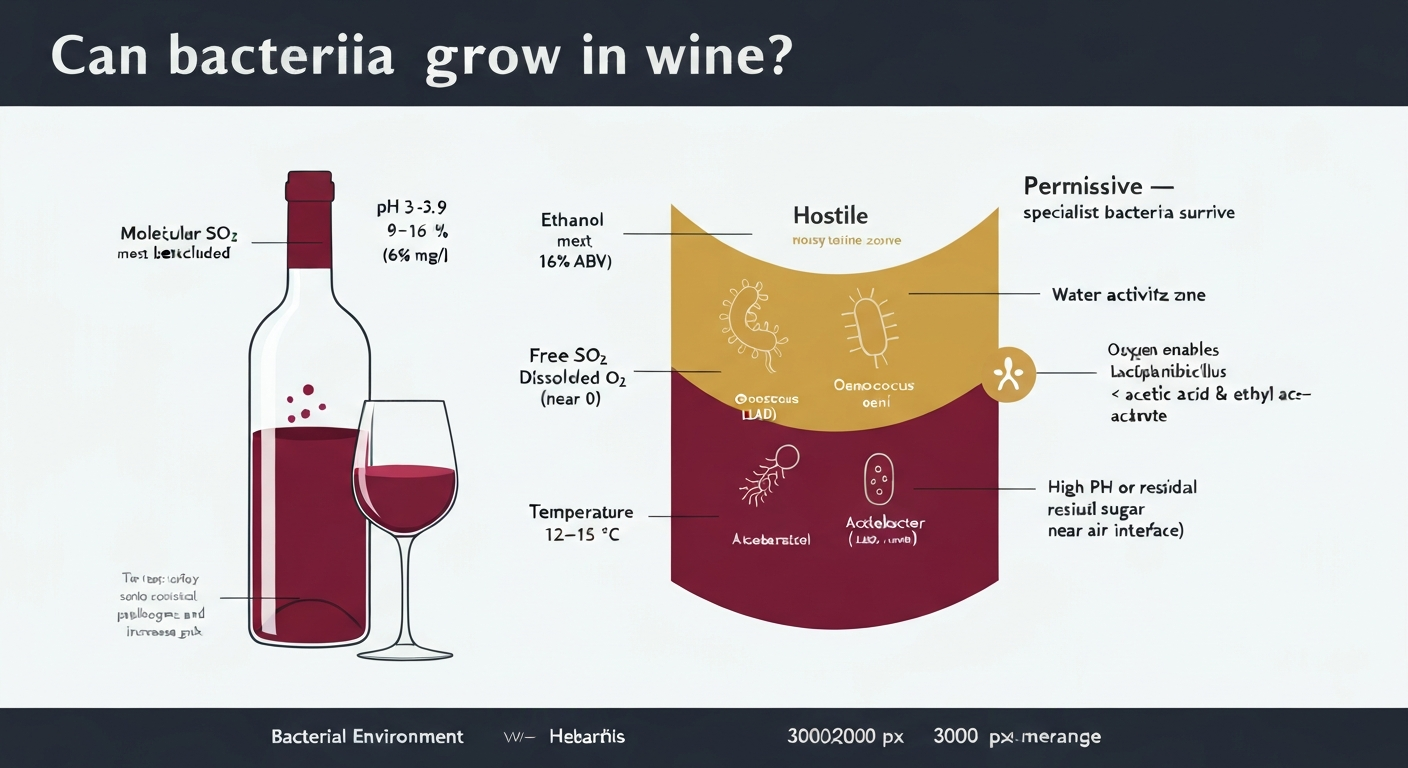
Wine is not simply a dilute ethanol solution. It is a chemically complex matrix where several independent stress factors overlap, and their combined effect is what determines whether a bacterial cell can establish, persist, or die. Looking at any single parameter in isolation will give you an incomplete picture. The table below summarizes the typical ranges for the parameters that matter most microbiologically.
| Parameter | Typical range in finished wine | Microbiological significance |
|---|---|---|
| pH | 3.0–3.9 (most table wines 3.2–3.6) | Primary barrier; most pathogens cannot grow below pH 4.0 |
| Ethanol | 9–16% v/v (table wines 11–14%) | Disrupts cell membranes; inhibits most bacteria above 10–12% |
| Water activity (aw) | 0.938–0.959 (typically ~0.948) | Permissive for most bacteria; not the primary barrier in wine |
| Residual sugar | Dry: ≤4–5 g/L; sweet: >30 g/L | Higher RS fuels spoilage bacteria and yeast re-fermentation |
| Free SO2 | 20–50 mg/L typical (varies by pH and winemaker target) | Antimicrobial primarily as molecular SO2 (~0.5–0.8 mg/L) |
| Dissolved oxygen | Near zero in sealed wine; spikes during racking/bottling | Essential for aerobic AAB; controlled by winemaking practice |
| Temperature | Cellar: 12–15 °C; warm storage accelerates growth | Modifies all other stresses; cold slows or arrests LAB/AAB |
The key insight is that no single parameter fully excludes bacteria on its own. A wine that is low in SO2 but high in ethanol may still support LAB. A wine high in SO2 but elevated in pH may allow AAB if oxygen enters. Effective microbial control means managing all these parameters together, not optimizing just one.
pH: the frontline barrier
Most table wines sit between pH 3.2 and 3.6, a range that is genuinely hostile to the majority of bacteria. Common foodborne pathogens such as Salmonella and Listeria monocytogenes have minimum growth pH values around 4.0–4.5, which means finished wine sits comfortably below those thresholds. They can survive for hours to a few days in wine-like conditions, but they cannot multiply and establish a growing population.
The lactic acid bacteria that do survive in wine are acid-adapted specialists. Oenococcus oeni performs malolactic fermentation (MLF) reliably at pH 3.2–3.6. Lactiplantibacillus plantarum can survive and even grow near pH 3.2–3.5 and is notably more ethanol-tolerant than O. oeni. Pediococcus parvulus and P. damnosus operate in a similar low-pH window. All three are acidophiles compared with most bacteria, but they still have limits: sustained growth below pH 3.0 becomes progressively unreliable for all wine LAB.
| Organism | Approximate minimum growth pH | Typical wine pH range tolerated | Notes |
|---|---|---|---|
| Oenococcus oeni | ~3.0–3.2 | 3.2–3.6 | Primary MLF bacterium; acid-adapted |
| Lactiplantibacillus plantarum | ~3.2 | 3.2–3.5 | More ethanol-tolerant than O. oeni; used in higher-pH wines |
| Pediococcus parvulus / damnosus | ~3.2–3.4 | 3.2–3.6 | Can cause ropiness via exopolysaccharides |
| Acetobacter aceti | ~4.0–4.5 optimal, survives lower | Usually surface films; needs oxygen | Aerobic only |
| Salmonella spp. | ~4.0 | Does not grow in wine pH | Survives short-term only |
| Listeria monocytogenes | ~4.3 | Does not grow in wine pH | Survives short-term only |
| E. coli O157:H7 | ~4.0 | Does not grow in wine pH | Survives short-term only |
One practical implication: wines with higher pH (3.7 and above, which can occur in low-acid red wines or in wines made from over-ripe fruit) provide a less hostile environment and require higher free SO2 doses to achieve the same molecular SO2 protection. pH management is therefore central to winery microbiology, not just to sensory profile.
Ethanol: a powerful but imperfect inhibitor
Ethanol disrupts bacterial cell membranes and denatures proteins, and its presence at 10–15% v/v in table wine is a genuine stress factor. For most common food bacteria, this level of ethanol is prohibitive. However, wine-adapted LAB have evolved specific membrane adaptations that allow them to function at ethanol concentrations that would kill more sensitive organisms.
O. oeni strains commonly used in commercial winemaking can perform MLF at 10–13% v/v ethanol, and some selected strains tolerate up to approximately 15% ABV, though growth rates drop substantially at the higher end. Oenococcus oeni is acidophilic and ethanol‑tolerant: many wine strains grow and perform malolactic fermentation at pH 3.2–3.6 and 10–13% v/v ethanol, and some adapted strains tolerate up to approximately 15% ethanol depending on strain and prior adaptation. L. plantarum isolates from wine have demonstrated tolerance at 11–15% v/v ethanol in wine-like media. Pediococcus strains occupy a similar tolerance window. The critical takeaway is that ethanol alone does not protect wine from bacterial activity; a 12% ABV wine can still undergo MLF or develop ropiness if pH and SO2 are not also managed.
Ethanol tolerance is also strain-specific and can be enhanced by prior adaptation. Winery conditions during fermentation (gradual ethanol accumulation) can select for more tolerant populations. This is part of why spontaneous MLF in tanks can still proceed even at moderately high alcohols, particularly if SO2 was not dosed promptly after primary fermentation.
Water activity and residual sugar: permissive numbers that still matter
Wine has a measured water activity (aw) in the range of approximately 0.938–0.959, with sparkling wines often clustering around a mean of 0.948. To put that in context, bacterial growth typically requires aw above 0.90, and most pathogens need aw above 0.94–0.95. So wine's aw is right at or just above the permissive threshold for bacterial activity, which means water activity is not wine's primary defense. Ethanol and other solutes do reduce aw somewhat (roughly 0.015 reduction per 4% ethanol), but not enough to create a dry-environment barrier the way, say, high-sugar confectionery or dried foods do.
Residual sugar matters mainly as a fermentable substrate. Dry wines (under 4–5 g/L) give bacteria and spoilage yeasts little to feed on, which limits both the energy available for growth and the risk of re-fermentation. Off-dry and sweet wines (30 g/L residual sugar and above) present a meaningfully different risk profile: Acetobacter can oxidize glucose directly, LAB can metabolize fructose and pentoses, and the higher aw in sweet wine models slightly narrows the margin. This is why dessert wines and any back-sweetened products require stricter microbial controls: higher SO2 targets, cold stabilization, or sterile filtration before bottling. This relationship between sugar and microbial risk is something you also see clearly when looking at which bacteria grow in sugar water, where dissolved sugars can support a broader range of organisms than wine's combined stresses allow. See the article can bacteria grow in sugar water for a focused explanation of how dissolved sugars support a broader range of bacterial growth than wine's multifactor stresses.
Oxygen and redox state: the switch that activates acetic acid bacteria
Acetic acid bacteria are the clearest example of how oxygen availability determines which organisms can grow in wine. Acetobacter aceti and Gluconobacter oxidans are obligate aerobes: they cannot grow in the oxygen-depleted environment of a sealed tank or bottle, but the moment oxygen enters, they become a serious spoilage threat. Their metabolic pathway oxidizes ethanol to acetic acid and produces ethyl acetate as a byproduct, both of which are detectable by sensory evaluation at relatively low concentrations.
Optimal dissolved oxygen concentrations for acetic acid production in Acetobacter continuous culture work fall in the range of approximately 1–7 ppm, meaning even small oxygen ingress events are enough to fuel activity. In practice, the highest-risk moments are racking, barrel topping, clarification, and poorly sealed bottles. Surface films (the classic 'flowers of wine' or acetic film) form when AAB colonize the wine-air interface in open or poorly sealed containers, particularly in low-SO2, low-ethanol wines stored warm.
Volatile acidity (VA) is the practical measurement winemakers use to track AAB activity. Acetic acid becomes aromatically detectable around 0.5–1.0 g/L depending on wine type and taster sensitivity, and U.S. regulatory limits set fault thresholds at roughly 1.2–1.4 g/L acetic acid. Ethyl acetate, which smells of nail polish remover, has an olfactory detection threshold around 100–200 mg/L in wine. Both compounds accumulate progressively with AAB activity and oxygen exposure, making early oxygen control far more effective than remediation after the fact.
Temperature: growth rates and the compounding effect on other stresses
Temperature affects bacterial growth in wine the same way it does in any food system: lower temperatures slow enzyme kinetics and reduce growth rates; higher temperatures accelerate them. What makes temperature particularly important in wine is that it modifies the effectiveness of the other barriers. Cold wine holds SO2 better, slows LAB MLF activity, and reduces AAB metabolism. Warm wine (above 20 °C) can allow MLF to run quickly in an uninoculated tank and significantly shortens the time between oxygen exposure and detectable VA increase from AAB.
O. oeni grows optimally in the range of about 18–22 °C for MLF purposes, though strains vary. At cellar temperatures of 12–15 °C, MLF slows considerably, which is sometimes deliberately used to pace or prevent the reaction. Acetobacter species have optimal growth temperatures around 25–30 °C, meaning warm storage environments (above 20 °C) are a real risk multiplier for aerobic spoilage. The practical storage recommendation for finished bottled wine is 12–15 °C, not primarily for flavor reasons, but because this temperature range substantially reduces the metabolic rate of any residual bacteria and preserves SO2 efficacy.
| Organism | Approximate growth temperature range | Optimal temperature | Effect of cold (12–15 °C) |
|---|---|---|---|
| Oenococcus oeni | 15–30 °C | ~20–22 °C | MLF slowed significantly; used to manage or halt MLF |
| Lactiplantibacillus plantarum | 15–35 °C | ~25–30 °C | Growth arrested or very slow |
| Pediococcus spp. | 15–35 °C | ~25–30 °C | Growth arrested; ropiness risk reduced |
| Acetobacter aceti | 15–34 °C | ~25–30 °C | VA production slowed; still active with oxygen present |
| Salmonella / Listeria | 4–45 °C | ~37 °C | Cannot grow at wine pH regardless of temperature |
Sulfur dioxide: the winemaker's primary microbial tool
Sulfur dioxide (SO2) is the single most used antimicrobial agent in winemaking, and understanding its chemistry is essential for using it effectively. Total SO2 in wine exists in several forms: free SO2 (undissociated, bisulfite, and sulfite) and bound SO2 (attached to aldehydes, ketones, and other compounds). Only the undissociated molecular SO2 form has meaningful antimicrobial activity, and it represents only a fraction of the free SO2, with the proportion determined almost entirely by pH.
The commonly accepted antimicrobial target for molecular SO2 is approximately 0.5–0.8 mg/L, though some protocols targeting higher-risk situations such as elevated pH, sweet wines, or post-filtration protection may aim for up to 0.8–1.5 mg/L. Because the relationship between pH and molecular SO2 is logarithmic, achieving 0.8 mg/L molecular SO2 at pH 3.2 requires roughly 15–20 mg/L free SO2, while at pH 3.8 the same molecular SO2 target may require 40–50 mg/L free SO2 or more. This is why winemakers use pH-corrected SO2 tables or calculators for dosing decisions rather than a flat free SO2 target.
The interaction between SO2, pH, and ethanol also matters. Ethanol slightly increases the antimicrobial potency of SO2 by synergistic membrane stress, meaning a wine at 14% ethanol needs marginally less SO2 for equivalent protection than an 11% wine at the same pH. In practice, winemakers adjust SO2 based on pH and sugar level, and check free SO2 regularly (typically by the Ripper titration or aeration-oxidation methods) especially after any racking, blending, or filtration step that might expose wine to oxygen or reduce free SO2.
Spoilage bacteria vs. pathogens: different threats, different risk levels
The bacterial species most likely to actively grow in wine are spoilage organisms, not human pathogens. This is an important distinction for food safety professionals. LAB such as O. oeni, L. plantarum, and Pediococcus spp. change the sensory character of wine (completing MLF, increasing diacetyl, causing ropiness) but are generally not pathogenic to healthy adults. AAB such as Acetobacter reduce wine quality by increasing volatile acidity. The spoilage concern is primarily economic and sensory.
Pathogens are a different story. Salmonella, E. coli O157:H7, and Listeria monocytogenes can survive for hours to a few days in typical wine, but the combined effect of pH below 4. A J Food Science review, 'Contribution of Wine Components to Inactivation of Food‑Borne Pathogens (J Food Sci review)', summarizes lab and model beverage studies showing pathogens can persist hours–days in typical wine matrices and that pH, ethanol, and SO2 strongly influence survival and risk. 0, ethanol at 10–15%, and SO2 prevents them from growing. Research using back-sweetened wine models (pH 4.0, 12% ethanol) showed that pathogen populations declined over 36 hours under simulated conditions, but the rate of die-off depended heavily on pH, temperature, and SO2 level. Products that raise wine pH above 4.0 or dilute ethanol below 8%, such as wine spritzers, homemade wines at low ethanol, or fortified wines that have been diluted, represent a meaningfully higher pathogen risk than finished commercial wine.
Signs of bacterial spoilage in wine
Recognizing bacterial spoilage early allows for intervention before the wine is unsalvageable or before bottling locks in a defect. The sensory and analytical signs depend on which organism is active.
- Vinegar smell or sharp acidity: acetic acid from Acetobacter or Gluconobacter; often accompanied by ethyl acetate (nail-polish note)
- Ropiness or oiliness: viscous, thread-like texture caused by beta-glucan exopolysaccharides from Pediococcus parvulus or P. damnosus, typically at cell concentrations above 10^5–10^6 CFU/mL
- Buttery or diacetyl off-note: excessive diacetyl from incomplete MLF or Pediococcus activity; normal at trace levels post-MLF but a defect at concentrations above sensory threshold
- Mousiness: a rare but serious fault associated with certain LAB metabolites (acetyl tetrahydropyridines), detectable only at elevated mouth pH
- Turbidity or haze in finished wine: bacterial populations sufficient to cause cloudiness, often above 10^6 CFU/mL
- Re-fermentation in bottle: gas formation in sealed bottles, caused by LAB fermenting residual sugars, most common in off-dry or sweet wines bottled without adequate SO2 or filtration
Contamination sources to monitor
Understanding where bacteria enter wine is as important as understanding the conditions that allow them to grow. In a commercial winery or home-production setting, the highest-risk contamination points include the following. For related contamination pathways and surface persistence, see the discussion on whether bacteria can grow on plastic (internal link: can bacteria grow on plastic).
- Equipment biofilms: hoses, pumps, tanks, and barrel staves harbor LAB and AAB in biofilm form; standard cleaning without sanitization does not remove biofilms effectively
- Plastic contact surfaces: scratched plastic hoses and fittings provide physical niches where bacteria lodge and resist cleaning (plastic surfaces in food environments are a well-documented biofilm reservoir)
- Open bottles and partial-fill containers: oxygen headspace enables AAB; wine stored in partly emptied bottles should be refrigerated and consumed within days
- Fermentation carryover: uninoculated MLF bacteria from fermentation tanks can contaminate finished wine lines if equipment is not sanitized between batches
- Grapes and grape solids: fresh grapes carry native LAB and AAB populations; must processing equipment is a primary introduction point
- Homemade wine with low ethanol or elevated pH: small-scale producers who do not monitor ethanol or pH create conditions where the combined barriers are insufficient
Testing and monitoring methods
Routine microbial monitoring is standard practice in commercial wineries and is increasingly accessible for laboratory use. The main methods each have practical trade-offs.
| Method | What it detects | Practical use | Limitations |
|---|---|---|---|
| Traditional culture (MRS, APT agar) | Viable LAB and AAB colonies | Quantitative CFU counts; inexpensive | 48–72 h incubation; slow-growing O. oeni may take longer |
| Selective media (e.g., Rogosa agar, AAB-selective) | Targeted group detection | Distinguishes LAB from AAB from yeast | May miss stressed or VBNC cells |
| qPCR (quantitative PCR) | Specific gene targets for O. oeni, Pediococcus, Acetobacter, Brettanomyces | Rapid (hours), species-level ID, sensitive | Does not distinguish viable from dead cells without modifications (RT-qPCR) |
| ATP bioluminescence | Total microbial biomass | Very fast (minutes); useful for sanitation verification | Cannot distinguish bacteria from yeast or dead cells; not species-specific |
| Flow cytometry | Cell counts including membrane integrity | Rapid, quantitative, can distinguish live/dead | Requires dedicated instrument; used in larger wineries |
| Volatile acidity (Ripper/enzymatic) | Acetic acid accumulation from AAB | Indirect but practical routine check | Detects damage after it has occurred; not predictive |
For most commercial operations, a combination of regular VA monitoring, free SO2 checks, and periodic microbiological culture or qPCR testing before bottling provides adequate oversight. qPCR has become increasingly cost-effective and is particularly valuable for detecting Pediococcus or Brettanomyces (a spoilage yeast often monitored alongside bacteria) early enough to intervene.
Practical controls: prevention and remediation
Prevention
- Adjust and monitor free SO2 to hit a molecular SO2 target of 0.5–0.8 mg/L, recalculated every time pH changes or wine is racked
- Manage pH during winemaking: target pH 3.2–3.6 for table wines where possible; high-pH wines require proportionally more SO2
- Exclude oxygen during storage, racking, and bottling using inert gas (nitrogen, argon, CO2 blankets) and low-oxygen transfer equipment
- Store finished wine at 12–15 °C to reduce metabolic rates of residual organisms and preserve SO2 efficacy
- Sanitize all equipment (hoses, pumps, valves, tanks) with food-grade sanitizers after cleaning; replace scratched plastic contact surfaces regularly
- Use sterile filtration (0.45 micron membrane) before bottling sweet or off-dry wines, or any wine that will not be pasteurized
- Test free SO2 before and after bottling; test for microbiological load by culture or qPCR before release if there is any doubt
Remediation options
Once active bacterial spoilage is underway, options depend on how far it has progressed. Early-stage MLF in an undesired wine can sometimes be halted by chilling to below 10 °C, adding SO2, and filtering. Ropiness from Pediococcus exopolysaccharides can often be addressed by vigorous stirring (the polymer network breaks down mechanically) followed by fining and filtration, though the wine may retain elevated diacetyl. High volatile acidity from AAB is the most difficult defect to remediate: reverse osmosis can reduce acetic acid concentrations, but the process is costly and not available to all producers. Prevention through oxygen management remains far more effective than correction.
How wine compares to other substrates
Wine's combination of low pH, ethanol, SO2, and limited oxygen makes it considerably more resistant to bacterial growth than most common food and beverage substrates. Compared with sugar water, which at typical concentrations has a near-neutral pH and no ethanol, wine excludes a far wider range of organisms. Sugar water's main microbial limitation is osmotic stress at very high concentrations, but at moderate sugar levels it supports growth from a much broader population of bacteria. Canned food presents a different risk profile: the sealed anaerobic environment and heat processing target Clostridium botulinum as the primary hazard, which is an organism that would not survive in wine's low pH and ethanol environment. For more on which bacteria grow in canned food, consult resources on Clostridium botulinum and the thermal processing controls used in commercial canning. The bacterial ecology of wine is therefore quite specific: the species that actually grow in it are a small, highly specialized subset of the bacterial world, adapted to conditions that most organisms find prohibitive.
Coffee offers another useful comparison. Like wine, brewed coffee has some antimicrobial properties (low pH, organic acids, temperature if served hot), but its ethanol content is essentially zero and its pH is higher, which means the bacterial exclusion it offers is narrower and more temperature-dependent than wine's. The fundamental principle across all these substrates is the same: multiple overlapping stresses provide more reliable microbial control than any single factor acting alone.
FAQ
Short answer: can bacteria grow in wine?
Yes — some bacteria can grow in wine under permissive conditions. However, standard commercial wines (low pH ~3.0–3.6, ethanol 10–15% v/v, free/molecular SO2 control, low oxygen, and low residual sugar) strongly limit growth of most bacteria. Wine more commonly permits survival (persistence without growth) of non‑adapted bacteria and selective growth of adapted wine bacteria (lactic acid bacteria, acetic acid bacteria) or microbes in modified wines (back‑sweetened, diluted, or oxygenated).
Which environmental factors control bacterial growth in wine?
Primary factors: pH, ethanol (% v/v), molecular/free SO2, dissolved oxygen/headspace O2, temperature, residual sugar (fermentable substrate), and water activity (a_w). Secondary/modulating factors: nutrient availability, prior microbial adaptation, biofilm presence, and redox potential. These factors interact (e.g., required free SO2 to reach a target molecular SO2 increases as pH rises).
What parameter ranges in wine inhibit vs permit bacterial growth?
Typical inhibitory/allowing ranges observed in wine: - pH: most bacteria are strongly limited below pH 3.3–3.5; some wine LAB (Oenococcus oeni, Lactiplantibacillus plantarum) can grow around pH 3.0–3.6 (strain dependent). - Ethanol: general bacteriostatic/lethal effects increase with % v/v; many nonadapted bacteria struggle above ~8–10% ABV; wine LAB can function in 10–13% and some strains tolerate up to ~15% ABV. - Free/molecular SO2: molecular SO2 ≈0.5–0.8 mg/L commonly targeted for antimicrobial protection; required free SO2 depends on pH. - Oxygen: Acetic acid bacteria require oxygen (strictly aerobic) — even low dissolved O2 (ppm range) enables AAB activity. - Temperature: lower temperature slows growth — refrigeration (<10 °C) largely prevents growth of wine spoilage microbes; room temperature (15–25 °C) accelerates spoilage risk. - Residual sugar: dry ≤4–5 g/L limits fermentable substrate; off‑dry/sweet (>5–30 g/L and >>30 g/L) increases risk of re‑fermentation or bacterial growth. - Water activity: wine a_w ≈0.94–0.96, which is permissive for bacteria; a_w is not the primary barrier in wine.
Which bacterial species are most likely to grow or cause spoilage in wine, and what are their tolerances?
Key wine bacteria: - Oenococcus oeni: primary malolactic bacterium; acidophilic, many strains active at pH 3.2–3.6 and ethanol 10–13% (some strains tolerate ≤15% with adaptation). - Lactiplantibacillus (Lactobacillus) plantarum: frequently isolated, tolerant of low pH (~3.2–3.5) and 11–15% ethanol; used as MLF starter in higher‑pH wines. - Pediococcus spp. (P. parvulus, P. damnosus): tolerate low pH and ethanol; can produce exopolysaccharides causing ‘ropiness’ at high cell counts (typically ≥10^5–10^6 CFU/mL). - Acetobacter and Gluconobacter (acetic acid bacteria, AAB): strictly aerobic; oxidize ethanol to acetic acid and ethyl acetate when oxygen is present; active at wine temperatures and generate volatile acidity. - Zymomonas mobilis and other non‑classic species: can spoil sugar‑rich/low‑acid beverages and occasionally contaminate wine or juice if conditions are permissive (pH >3.4, moderate ethanol, warm temps). Note: intra‑species strain variability is large; tolerances above are approximate and strain‑ and matrix‑dependent.
Do bacteria in wine pose a food‑safety risk to consumers (pathogens)?
True human pathogens (E. coli, Salmonella, Listeria) generally do not grow in typical finished wines because of the combined hurdles (low pH, ethanol, SO2). They may survive for limited times (hours to days) and survival increases if wine is back‑sweetened, diluted, has higher pH, low ethanol, low SO2, or is stored warm. Therefore finished commercial wine presents low pathogen growth risk, but modified products (home‑made, back‑sweetened, fermented beverages with higher pH or lower alcohol) can present higher food‑safety risk.
What’s the difference between spoilage organisms and human pathogens in wine?
Spoilage organisms are microbes able to metabolize wine components in ways that produce sensory faults (acetic acid, ethyl acetate, diacetyl, H2S, ropiness). They can grow in wine (if conditions permit) or produce metabolites during survival. Human pathogens are bacteria that cause disease; in wine they rarely grow but can survive transiently. Spoilage impacts quality and commercial value; pathogens pose health risk — the two sets overlap rarely in finished wine but can both occur in improperly treated/modified products.
Next Article
Can Bacteria Grow on Plastic? Biofilms, Risk, Cleaning Guide
Learn how bacteria grow on plastic and biofilms persist, plus fast risk checks and effective cleaning steps.