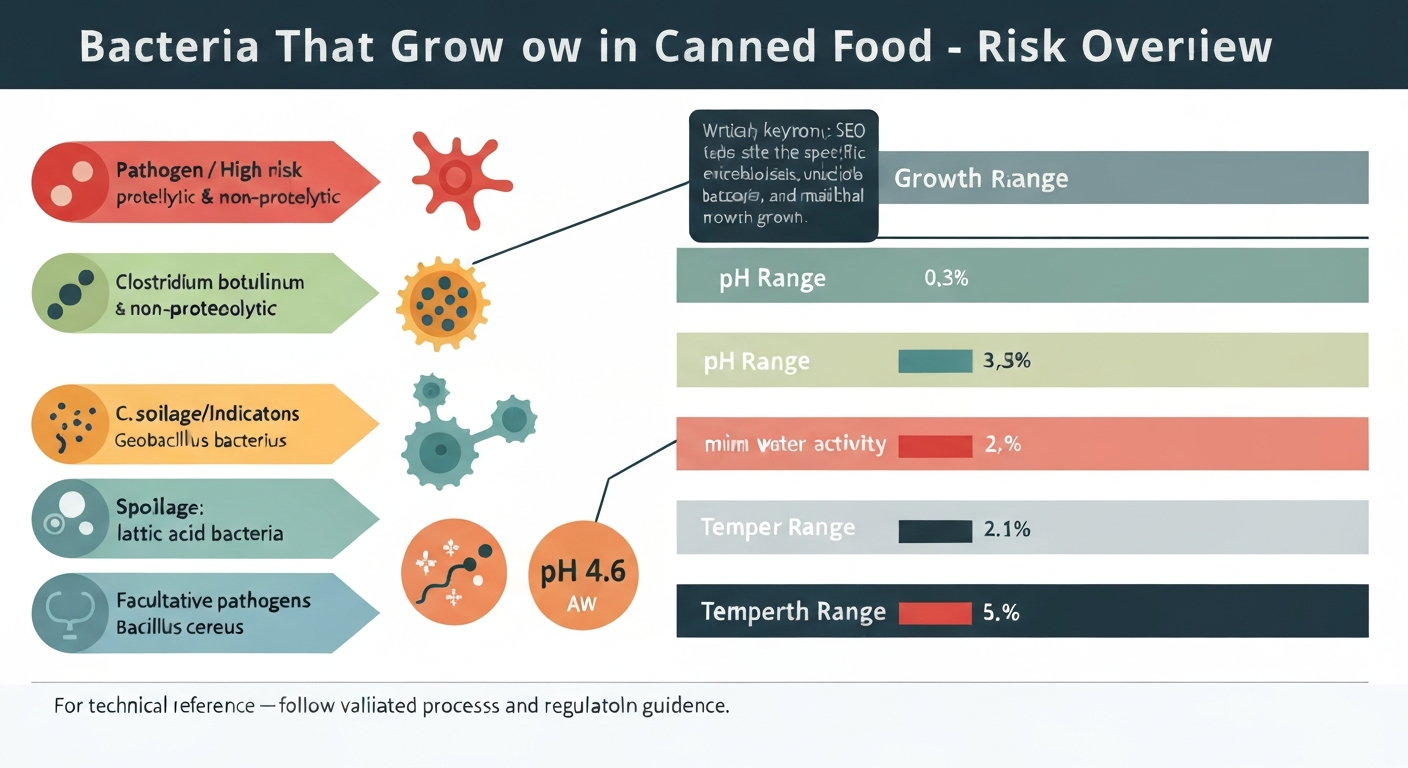
The bacteria most likely to cause serious harm in canned food are Clostridium botulinum, Bacillus cereus, B. Planning and engineering data 2. Fish canning, Canning principles (FAO), ventilation/cooling/seam/leaker discussion notes that Common retort failure modes that cause underprocessing or contamination include: inadequate venting (air/condensate in retort → cold spots), condensate pooling contacting cans, incorrect probe placement (not at cold spot), inappropriate come‑up or cooling profiles, contaminated cooling water (post‑process leakers), and seam defects leading to post‑process ingress, all documented in industry guidance and inspection reports Planning and engineering data 2. Fish canning — Canning principles (FAO) — ventilation/cooling/seam/leaker discussion. coagulans, and putrefactive clostridia like C. sporogenes. In low-acid foods (pH above 4.6) that were underprocessed or improperly sealed, C. botulinum is the dominant safety concern because it produces one of the most potent toxins known and gives no reliable visible warning. Spoilage organisms including lactic acid bacteria and gas-producing clostridia are also common in canning failures, though they typically announce themselves with swollen cans and foul odors. Understanding which organisms grow, under what conditions, and why processing works (or fails) is the foundation of safe canning practice.
Which Bacteria Grow in Canned Food: Risks, Detection, Prevention

What this reference covers and who it is for
This article is a technical reference covering the microbiology of commercially and home-canned foods. It is written for food safety professionals, microbiologists, educators, and informed consumers who want precise, evidence-based answers about which organisms survive or grow in canned goods, what environmental conditions permit that growth, and how thermal processing is designed to prevent it. The scope includes spore-forming pathogens, spoilage bacteria, lactic acid bacteria, yeasts, and molds, with numeric thresholds for pH, water activity, temperature, and thermal lethality drawn from regulatory guidance and peer-reviewed literature.
The organisms that matter most, ranked by risk
Not all bacteria in a canning context carry the same risk. Some produce dangerous toxins in foods that look and smell perfectly normal. Others spoil the product visibly but pose little direct health threat. The table below summarizes the main organisms by risk category and typical conditions for growth or survival in canned foods.
| Organism | Category | pH range | Water activity (aw) min | Temperature range | Primary concern |
|---|---|---|---|---|---|
| C. botulinum (proteolytic, Group I) | Pathogen / high risk | >4.6 | ≥0.94 | 10–50°C (opt. 35–40°C) | Toxin production, no reliable spoilage signal |
| C. botulinum (non-proteolytic, Group II) | Pathogen / high risk | >5.0 | ≥0.97 | 3.3–45°C (opt. 25–28°C) | Psychrotrophic; risk in mildly processed product |
| C. sporogenes / other putrefactive clostridia | Spoilage / indicator | >4.6 | ≥0.94 | 15–50°C | H2S/CO2 gas, swollen cans, foul odor |
| Bacillus cereus | Pathogen / moderate risk | 4.3–9.3 | ≥0.91 | 4–50°C (opt. ~30°C) | Emetic and diarrheal toxins; spores heat-resistant |
| B. coagulans | Spoilage (thermoduric) | 4.0–6.8 | ≥0.93 | 30–60°C (thermophile) | Flat-sour spoilage; no gas, acid accumulation |
| Geobacillus stearothermophilus | Spoilage (extreme thermophile) | 5.0–8.0 | ≥0.93 | 45–75°C | Spoilage in inadequately cooled canned goods |
| Lactic acid bacteria (LAB) | Spoilage | 3.5–8.0 | ≥0.90 | 5–50°C | Gas, souring; less common in hermetically sealed cans |
| Yeasts / molds | Spoilage | <4.6 preferred | ≥0.70 (molds) | 10–37°C | High-acid products; rarely survive retort if properly sealed |
How canning creates a shelf-stable environment
Commercial canning works by sealing food in a hermetically closed container and applying enough heat to destroy or inactivate all organisms that could grow under normal storage conditions. The retort (a pressurized steam cooker) raises internal product temperatures to 116–121°C, conditions that kill vegetative bacteria quickly and reduce heat-resistant spores to a commercially acceptable level. The sealed container then prevents recontamination, so the product remains stable at room temperature for years when the process is executed correctly.
Home canning operates on the same principles but with far less process control. The critical distinction is the choice of equipment. Acid foods with pH at or below 4.6 (jams, pickles, tomatoes acidified to target pH) can be safely processed in a boiling-water canner because the boiling point of water (100°C at sea level) is sufficient to kill vegetative pathogens, and the acidity itself prevents C. botulinum spore germination and outgrowth. Low-acid foods (vegetables, meats, fish, beans) have pH above 4.6 and must be processed in a pressure canner capable of reaching 116–121°C (240–250°F). Using a boiling-water canner for low-acid foods is one of the most common and dangerous home-canning mistakes because it cannot achieve the temperatures needed to address C. botulinum spores. USDA and NCHFP tested recipes specify pressures, times, and jar sizes that should be followed exactly.
Commercial processors have additional obligations. Under 21 CFR Part 113, they must have a validated scheduled process established by a qualified Process Authority, file Form FDA-2541d (or 2541f for water-activity-controlled processes), maintain complete process records, and comply with all FDA requirements for thermally processed low-acid canned foods (LACF). Heat-penetration studies must identify the slowest-heating point (SHP) in the specific container geometry used, and process lethality (Fo) is calculated by integrating time and temperature at that point, not at the retort itself.
Environmental conditions that control microbial growth in canned goods
pH
pH 4.6 is the regulatory dividing line between acid and low-acid canned foods, and it is not arbitrary. Below pH 4.6, C. botulinum spores cannot germinate and outgrow even if they survive processing. Above pH 4.6, the organism is fully capable of growth and toxin production. This is why improperly acidified tomato products (tomatoes have natural pH variation that can reach 4.8 or higher) are treated as low-acid foods unless acidified with citric acid or lemon juice to confirmed pH ≤4.6 before canning.
Water activity (aw)
Water activity expresses how much free water is available for microbial use, on a scale of 0 to 1.0. Most fresh foods have aw ≥0.99. Proteolytic C. botulinum has a minimum aw of approximately 0.94; non-proteolytic strains need at least 0.97. Concentrated products like fruit preserves, brined vegetables, or products with high sugar or salt content may have aw below these thresholds, which contributes to their safety even at pH values above 4.6. However, aw values are solute-specific: a product with aw 0.94 achieved using glycerol behaves differently from one using sodium chloride, so single-parameter thresholds should not be relied on without matrix-specific validation.
Oxygen and redox potential
Canned foods are hermetically sealed, and oxygen is consumed or evacuated during the process. The resulting anaerobic, low-redox environment is exactly what obligate anaerobes like C. botulinum require. This is an important distinction from aerobic substrates: in coffee or wine, for example, the presence of oxygen and other inhibitory factors creates a very different environment for microbial activity. For more detail on microbial survival in wine, see can bacteria grow in wine. See can bacteria grow in coffee for a concise discussion of microbial survival and growth in brewed coffee, including the roles of oxygen, acidity, and temperature. In canned goods, the anaerobic headspace supports anaerobes while suppressing aerobic spoilage organisms like surface molds and most yeasts.
Temperature
Storage temperature affects both the rate and the probability of growth from surviving spores or post-process contaminants. Proteolytic C. botulinum grows between approximately 10°C and 50°C, with an optimum of 35–40°C. Non-proteolytic strains are psychrotrophic and can grow from as low as 3.3°C, which makes them a concern in mildly heat-treated or vacuum-packed refrigerated products as well as any canned goods stored at near-refrigerator temperatures with inadequate processing. Thermophilic spoilage organisms like Geobacillus stearothermophilus require temperatures above 45°C to grow and are rarely a problem in ambient storage, but they can cause spoilage in canned goods that are stacked and held in warm warehouses without adequate cooling after retorting.
Nutrients and preservatives
Protein-rich, low-acid foods (meats, fish, legumes) provide the most favorable nutrient matrix for pathogen growth and are consistently the highest-risk categories for C. botulinum. Nitrites added to canned meats inhibit C. botulinum outgrowth and are part of the validated hurdle system for those products. Organic acids used in pickling (acetic acid in vinegars) lower both pH and effective aw in the product matrix. Processors should not assume that any single preservative provides a safety margin without knowing the combined effect of all hurdles at product-specific concentrations.
Numeric thresholds and thermal lethality targets you need to know
Canning process design is built around a small set of well-established numeric targets. Understanding these numbers is essential for anyone evaluating a process or troubleshooting a failure.
- pH 4.6: the regulatory acid/low-acid boundary. Below this level, C. botulinum spores cannot germinate; products at or below this pH can be processed in boiling-water canners.
- aw ≥0.94: minimum water activity for proteolytic C. botulinum growth. Non-proteolytic strains require aw ≥0.97.
- Minimum growth temperature: ~10°C for proteolytic C. botulinum (Group I); ~3.3°C for non-proteolytic (Group II).
- D121.1 ≈ 0.21 min: the decimal reduction time for C. botulinum spores at 121.1°C (250°F), with a z-value of approximately 10°C. This is the thermal resistance value used in standard process calculations.
- 12D (12-log) reduction target: the conventional commercial sterilization standard for low-acid canned foods, requiring a 12 log reduction of C. botulinum spores. Using D121.1 = 0.21 min, the minimum Fo is 12 × 0.21 = 2.52 min at 121.1°C.
- Fo: the cumulative process lethality expressed as equivalent minutes at 121.1°C at the slowest-heating point of the container. Retort combinations delivering the same Fo provide equivalent lethality.
- B. cereus spore D-values at 100°C: highly variable across strains, ranging from approximately 0.1 to 7 minutes depending on strain and food matrix. No single universal value should be assumed.
- Geobacillus stearothermophilus spore strips: the industry standard biological indicator (BI) for moist-heat/retort validation because of their high, well-characterized heat resistance. BI results are used alongside physical temperature records to confirm process adequacy at the SHP.
Clostridium botulinum and other high-risk spore-forming clostridia
C. botulinum is the primary target organism for low-acid canned food processing, and for good reason. It forms highly heat-resistant spores, grows under anaerobic conditions, and produces botulinum neurotoxin, one of the most potent biological toxins known. The dangerous characteristic from a canning standpoint is that proteolytic strains (Group I, types A, B, and F) can produce lethal toxin without making the food smell or look spoiled. A can that appears normal may still contain active toxin if the process was inadequate.
Two major groups matter in canning. Proteolytic strains (Group I) are the classic canning hazard: minimum growth temperature around 10°C, minimum pH approximately 4.6, minimum aw approximately 0.94, and optimum growth at 35–40°C. Non-proteolytic strains (Group II, types B, E, and F) are more relevant to mildly processed or refrigerated products: they are psychrotrophic with a minimum growth temperature of approximately 3.3°C, minimum pH around 5.0, and minimum aw around 0.97. Their lower heat resistance means a properly validated retort process will destroy them, but any underprocessing scenario opens a risk window.
The 2007 multistate botulism outbreak linked to commercially canned hot-dog chili sauce (Castleberry's) is a documented real-world example of what happens when process controls fail at scale. A peer‑reviewed investigation of the 2007 multistate Type A botulism outbreak linked to Castleberry’s canned hot‑dog chili sauce is documented in the article titled "National Outbreak of Type A Foodborne Botulism Associated With a Widely Distributed Commercially Canned Hot Dog Chili Sauce." National Outbreak of Type A Foodborne Botulism Associated With a Widely Distributed Commercially Canned Hot Dog Chili Sauce (peer‑reviewed outbreak investigation, PMC). Investigations identified process control failures and inadequate validation as root causes. It remains one of the most cited U.S. commercial LACF botulism events and drove renewed regulatory attention to 21 CFR Part 113 compliance. U.S. surveillance data covering 2001 to 2017 consistently identifies home-canned or improperly processed preserved foods as the leading setting for foodborne botulism outbreaks.
Other clostridia, particularly C. sporogenes and related putrefactive species, are not toxigenic in the same way but are important spoilage and indicator organisms. They produce hydrogen sulfide and carbon dioxide as metabolic byproducts, causing the characteristic swollen, bulging can and a rotten-egg or sulfurous odor. Because C. sporogenes has very similar heat resistance to proteolytic C. botulinum, its survival in a can is a direct indicator that the botulinum safety target was not met. Processors sometimes use inoculated-pack studies with C. sporogenes as a surrogate in process validation work.
Bacillus species: spoilage, toxin, and thermophilic concerns
Bacillus cereus
B. cereus is a facultatively anaerobic spore-former capable of growing across pH 4.3 to 9.3 and temperatures from 4°C to 50°C, with an optimum around 30°C. It produces two distinct types of toxins: an emetic toxin (cereulide) associated with rice and starchy foods, and diarrheal toxins that affect a wider range of substrates. B. cereus spores are heat-resistant, with D-values at 100°C ranging from roughly 0.1 to 7 minutes depending on strain and food matrix. This wide variability is operationally significant because a process designed around a low-D-value assumption may leave viable spores in a product. In canned goods, B. cereus is less often the primary safety target than C. botulinum, but it is relevant in marginally processed acid foods and in products where post-processing contamination is possible.
B. coagulans and flat-sour spoilage
B. coagulans is a thermoduric, facultatively anaerobic spore-former that causes flat-sour spoilage in canned tomatoes, tomato products, and other acidic goods. The name describes the outcome: the can remains flat (no gas production, no swelling) but the contents are acidified and off-flavored. Growth range is approximately pH 4.0 to 6.8 and 30–60°C, making it tolerant of the mildly acidic conditions typical of tomato products. Because the can shows no external sign of spoilage, flat-sour incidents are typically detected through routine microbiological sampling or consumer complaints about taste and not by visual inspection.
Geobacillus stearothermophilus
G. stearothermophilus (formerly Bacillus stearothermophilus) is an extreme thermophile with a growth range of approximately 45–75°C. It does not grow at ambient warehouse temperatures and is not typically a health hazard, but it can cause spoilage in canned goods held at elevated temperatures (above 43°C) during distribution or storage in hot climates. Its primary practical role in the industry is as the reference biological indicator for moist-heat sterilization validation: its highly characterized, high heat resistance makes it the standard for confirming that retort cycles achieve the required lethality.
Lactic acid bacteria, fermentative spoilers, and flat-sour phenomena
Lactic acid bacteria (LAB) are gram-positive, non-spore-forming organisms with relatively low heat resistance. A correctly executed retort process will destroy them. However, they can appear in canned goods in a few specific scenarios: post-process contamination through seam defects or leakers, survival in products that received only a mild heat treatment (some naturally acidic or pasteurized products), or in improperly processed home-canned goods where temperatures were insufficient.
In canned foods, LAB activity presents as acidification, gas production, and altered texture. Heterofermentative LAB produce both lactic acid and carbon dioxide, which can cause can swelling in sealed containers. Homofermentative LAB produce only lactic acid, resulting in a flat-sour-type spoilage phenotype similar to B. coagulans, though the two are distinguished microbiologically. LAB growth in canned goods is most commonly seen in fruit products, tomato products, and other acidic items where the processing was borderline.
The flat-sour phenomenon specifically refers to spoilage characterized by marked acid production without gas formation, so the can end remains flat and gives no external warning. It is primarily caused by thermophilic Bacillus species (B. coagulans in acid products, G. stearothermophilus in low-acid products), but homofermentative LAB can produce a similar result. Routine microbiological incubation testing of product samples at both 37°C and 55°C is standard practice in commercial canning quality programs to detect both mesophilic and thermophilic spoilers that would otherwise go undetected.
Yeasts, molds, and other organisms
Yeasts and molds are relevant primarily in high-acid canned goods (pH below 4.6): fruits, fruit juices, jams, and pickled products. Most molds require a minimum aw of around 0.70 and free oxygen to grow, which means they do not typically survive or grow inside hermetically sealed cans. The exception is osmotolerant yeasts and xerophilic molds, which can grow at lower aw in sugary products, but even these are inactivated by correct thermal processing. Their presence in canned goods usually signals post-process contamination through a seal defect rather than a process temperature failure.
Enterobacteriaceae including Salmonella, E. coli, and related organisms are vegetative (non-spore-forming) and are easily killed by retort temperatures. Their presence in processed canned goods is essentially always an indicator of post-process contamination through leakers or inadequate seam integrity rather than a thermal process failure. Contaminated cooling water is a well-documented route: if can seams are wet and slightly under negative pressure during cooling, contaminated water can be drawn in through microscopic seam imperfections.
How canning processes fail and what signs to look for
Understanding failure modes is as practically useful as knowing which organisms are present. The most common routes to spoilage or pathogen survival in canned goods fall into a few recurring categories.
- Inadequate thermal process: the retort schedule did not deliver the required Fo at the slowest-heating point. Causes include incorrect come-up time, inadequate venting (trapped air creates cold spots in steam retorts), incorrect probe placement, or use of a non-validated process.
- Seam defects and leakers: poorly formed or damaged double seams allow post-process ingress of microorganisms during cooling, particularly if cooling water is not adequately chlorinated or sanitated.
- Cooling-water contamination: non-chlorinated or contaminated cooling water drawn into seams during can cooling is a documented source of post-process contamination with gram-negative organisms and LAB.
- Condensate pooling: pooled condensate in the retort contacting cans can cause uneven temperature distribution and localized underprocessing.
- Incorrect product formulation: changes in fill weight, solid-to-liquid ratio, or pH without revalidating the scheduled process can shift the thermal center location and alter heat penetration.
- Home canning with inappropriate equipment: using a boiling-water canner for low-acid foods, modifying USDA-tested recipes, or failing to vent the pressure canner properly before pressurizing (minimum 10 minutes of venting is required to purge air and establish consistent steam conditions).
- Inadequate initial microbial load control: using raw materials with exceptionally high initial contamination levels can overwhelm a validated process designed for a standard microbial load assumption.
Visual warning signs include swollen or bulging can ends (indicating gas production by anaerobes or gas-producing LAB), spurting liquid when the can is opened, and off-odors ranging from sour (acid spoilage) to sulfurous or rotten (putrefactive clostridia). Flat-sour spoilage produces none of these signs: the product looks and smells approximately normal but tastes sour and may have altered texture. Any can that is dented along a seam, deeply dented on the body, or that shows rust penetration should be discarded without tasting the contents.
Detection and testing methods
Microbiological testing of canned goods includes several complementary methods depending on the question being asked.
- Culture-based methods: standard aerobic plate counts, anaerobic incubation for clostridia, thermophilic incubation at 55°C for B. coagulans and G. stearothermophilus. Destructive testing of sample cans is standard in commercial quality programs.
- Toxin assays: mouse bioassay remains the regulatory gold standard for botulinum toxin detection in food samples; ELISA-based and mass spectrometry methods are increasingly used for rapid screening, though confirmation is often still performed by bioassay.
- PCR and molecular methods: real-time PCR targeting toxin-gene sequences can detect C. botulinum DNA rapidly, but a positive PCR result does not confirm active toxin production. PCR is useful for environmental monitoring and outbreak investigation.
- Biological indicators (BI): G. stearothermophilus spore strips placed at the slowest-heating point and incubated after the retort cycle confirm moist-heat sterilization adequacy as part of process validation and routine monitoring.
- Physical process records: continuous recording thermometers and automated data logging systems document the time-temperature profile at the retort and at the SHP; these records are required by 21 CFR Part 113 and are the first evidence reviewed in any process failure investigation.
- Seam inspection: destructive seam teardown and measurement are conducted at defined frequencies to verify double-seam integrity and detect trends before defects become severe enough to cause leaker contamination.
Prevention, storage, and corrective actions
For commercial processors, prevention is built into process design, validation, and ongoing monitoring. The scheduled process must be established by a Process Authority using validated heat-penetration data at the SHP for each container size and product type. Any reformulation, container change, or equipment modification requires revalidation before resuming production. FDA filings must be current, process records must be retained as required, and any deviation from the scheduled process must trigger a documented hold-and-evaluate procedure before affected product is released.
For home canners, the practical rules are straightforward. Always use tested, up-to-date USDA or NCHFP recipes and do not modify them. Use a pressure canner for all low-acid foods. Vent the canner for at least 10 minutes before pressurizing to purge air and ensure uniform steam distribution. Check pressure gauge calibration annually. Discard any jar with a broken seal, bulging lid, or off-odor without tasting. If C. botulinum toxin contamination is suspected in home-canned food, public health guidance recommends detoxifying the product and containers (boiling in a 1:10 bleach-water solution) before disposal rather than simply throwing the containers in the trash.
Storage conditions matter even for properly processed canned goods. Store cans in a cool, dry location below 25°C where possible; high ambient storage temperatures accelerate the small residual risk from surviving thermophilic spores and degrade quality. Rotate stock and use oldest cans first. Avoid storing cans in environments where temperature fluctuations could cause condensation, which accelerates external corrosion and seam rust.
How canned food compares to other substrates
The conditions inside a sealed can are unusually favorable for anaerobic bacteria: near-neutral to mildly acidic pH, high water activity, very low redox potential, and a nutrient-rich matrix. This is quite different from substrates like coffee, wine, or high-concentration sugar water, where antimicrobial properties (low pH, ethanol, osmolarity, or antimicrobial compounds) create meaningful natural barriers to microbial growth. In sugar water, for instance, water activity suppression at high concentrations can inhibit bacterial growth, though at concentrations typical of dilute solutions growth proceeds readily. Wine's combination of ethanol, low pH, and sulfite content creates a hostile environment for most pathogens. Plastic surfaces present a different challenge altogether, involving biofilm formation and surface adhesion rather than bulk-phase growth in a nutrient medium. See can bacteria grow on plastic for a focused discussion of biofilms and surface colonization on plastics. The canning environment is distinctive because it eliminates oxygen (removing the barrier to anaerobic growth) while concentrating nutrients in a closed, moist system.
A quick reference for environmental limits
| Parameter | Key threshold | Practical meaning for canning |
|---|---|---|
| pH | 4.6 | Below this: C. botulinum cannot grow; product can be boiling-water processed. Above: pressure canning required. |
| Water activity (aw) — proteolytic C. botulinum | 0.94 minimum | Products with aw below 0.94 (high sugar/salt) inhibit Group I strains. |
| Water activity (aw) — non-proteolytic C. botulinum | 0.97 minimum | Higher aw required; very few canned products are dry enough to rely on this barrier alone. |
| Minimum growth temp — C. botulinum Group I | ~10°C | Ambient storage below 10°C inhibits proteolytic strains but is not a sterilization substitute. |
| Minimum growth temp — C. botulinum Group II | ~3.3°C | Psychrotrophic; relevant for mildly processed refrigerated products. |
| D121.1 for C. botulinum spores | ~0.21 min | Foundation of Fo calculation; z-value ≈10°C. |
| 12D sterilization target (Fo) | ≥2.52 min at 121.1°C | Minimum integrated lethality for commercial LACF sterilization at the SHP. |
| B. cereus D-value at 100°C | 0.1–7 min (strain-dependent) | High variability; matrix-specific data required for process design. |
FAQ
Which microorganisms can grow in commercially and home‑canned foods?
Primary microorganisms of concern: Clostridium botulinum (proteolytic Group I and non‑proteolytic Group II) — cause botulism and can grow in improperly processed low‑acid cans; other anaerobic/putrefactive Clostridia (e.g., C. sporogenes) — gas‑producing spoilage; Bacillus spp. (thermoduric spore‑formers such as B. coagulans, B. cereus group) — cause flat‑sour or sour spoilage and sometimes toxigenic risk; facultative anaerobic Enterobacteriaceae (e.g., Enterobacter, Klebsiella, some E. coli) — indicate post‑process contamination or leakers; lactic acid bacteria (Lactobacillus, Leuconostoc, Pediococcus) — cause souring/acidification of acidified cans; yeasts and molds — grow in high sugar or acid products and in cans with oxygen ingress (surface spoilage); thermophilic spore‑formers (e.g., Alicyclobacillus) — cause taints in acidic fruit products. Relative risk depends on product pH, water activity, redox, temperature, and processing.
What are the key environmental thresholds (pH, water activity, temperature, oxygen) that determine which organisms can grow?
Numeric thresholds (approximate — matrix dependent): pH — C. botulinum proteolytic: minimum ≈4.6; non‑proteolytic: ≈5.0. Lactic acid bacteria and many yeasts can grow well at pH <4.6 (especially tolerant species), molds at even lower pH. Water activity (aw) — proteolytic C. botulinum: ≈0.94 minimum; non‑proteolytic: ≈0.97; many bacteria need aw >0.95, yeasts ~0.88–0.90, molds down to ~0.70–0.80. Temperature — proteolytic C. botulinum: minimum growth ≈10°C, optimum 35–40°C; non‑proteolytic: psychrotrophic minimum ≈3.3°C, optimum ~25–28°C. Oxygen — obligate anaerobes (Clostridia) require low redox or anaerobic niches; facultative anaerobes (Enterobacteriaceae, lactic acid bacteria, Bacillus) tolerate oxygen; yeasts/molds require at least some oxygen or surface oxygen ingress. These thresholds interact (e.g., lower pH or colder temperature raises the aw required for growth).
How do thermal‑resistance values and process lethality concepts apply to canned‑food safety?
Thermal design uses D‑values (time for 1 log reduction at a reference temperature) and z‑values (°C required to change D by 10×). For C. botulinum, typical reference: D121.1 ≈0.21 min and z ≈10°C are commonly used for commercial process design; industry target for low‑acid canned foods (LACF) is a 12‑D reduction (12‑decimal reduction) of C. botulinum spores, yielding Fo ≈2.52 min at 121.1°C if D121.1=0.21. Spore D‑values vary widely by species/strain and matrix (Bacillus D‑values at 100°C reported from ~0.1 to >7 min), so process validation must be product/matrix specific and use conservative assumptions or validated challenge/heat penetration studies.
What are the common failure modes that result in underprocessing or post‑process contamination of cans?
Common failure modes: inadequate venting or venting errors in retorts → cold spots; incorrect probe placement (not at slowest‑heating point, SHP) or failure to identify SHP; condensate pooling contacting cans during processing/cooling; incorrect come‑up/cool profiles or short hold times; lack of validated scheduled process or use of incorrect process parameters; seam defects or poor flange/compound application → leakers and ingress; contaminated cooling water or post‑process handling → post‑process contamination; use of untested home recipes or pressure‑canner misuse (insufficient pressure or venting). Any of these can leave surviving spores or allow post‑process growth/toxin production.
How can contaminated or spoiled cans be recognized by inspection and sensory signs?
Actionable consumer/inspector signs: swollen/bulging or leaking cans (indicator of gas production by anaerobes); spurting liquid on opening (pressurized gas); off‑odours (rotten egg/H2S for putrefactive Clostridia, sour/fermented for lactic acid bacteria); abnormal turbidity, unexpected colour changes, sliminess; visible mold or yeast growth near lid seam; rapid spoilage after opening at refrigeration temperatures (suggests psychrotrophic organisms). Absence of odour or visible change does NOT guarantee safety (botulinum toxin is odourless and cans may appear intact), so do not taste suspicious cans and follow regulatory guidance for disposal and reporting.
What laboratory and field detection methods identify organisms and toxins in canned foods?
Culture methods: enriched anaerobic culture for Clostridium and C. botulinum isolation (selective enrichment, egg yolk agar, mouse bioassay historically), aerobic culture for Bacillus, Enterobacteriaceae, lactic acid bacteria, yeasts/molds. Toxin assays: mouse bioassay (historical gold standard for botulinum toxin), enzyme‑linked immunoassays (ELISA), Endopep‑MS and mass spectrometry‑based assays, and neutralization assays. Molecular methods: PCR/qPCR for toxin genes (botA/ntnh), species markers, and 16S rRNA sequencing; caution: PCR for genes detects genetic potential but not active toxin. Rapid methods/indicators: ATP bioluminescence (hygiene monitoring), lateral flow tests for some toxins, and commercial ELISAs. Process/validation indicators: biological indicators (Geobacillus stearothermophilus spores) for retort validation. Recommended approach: use culture + toxin assay for botulism confirmation, confirmatory molecular typing as needed; send suspected botulism samples to reference/public health labs.
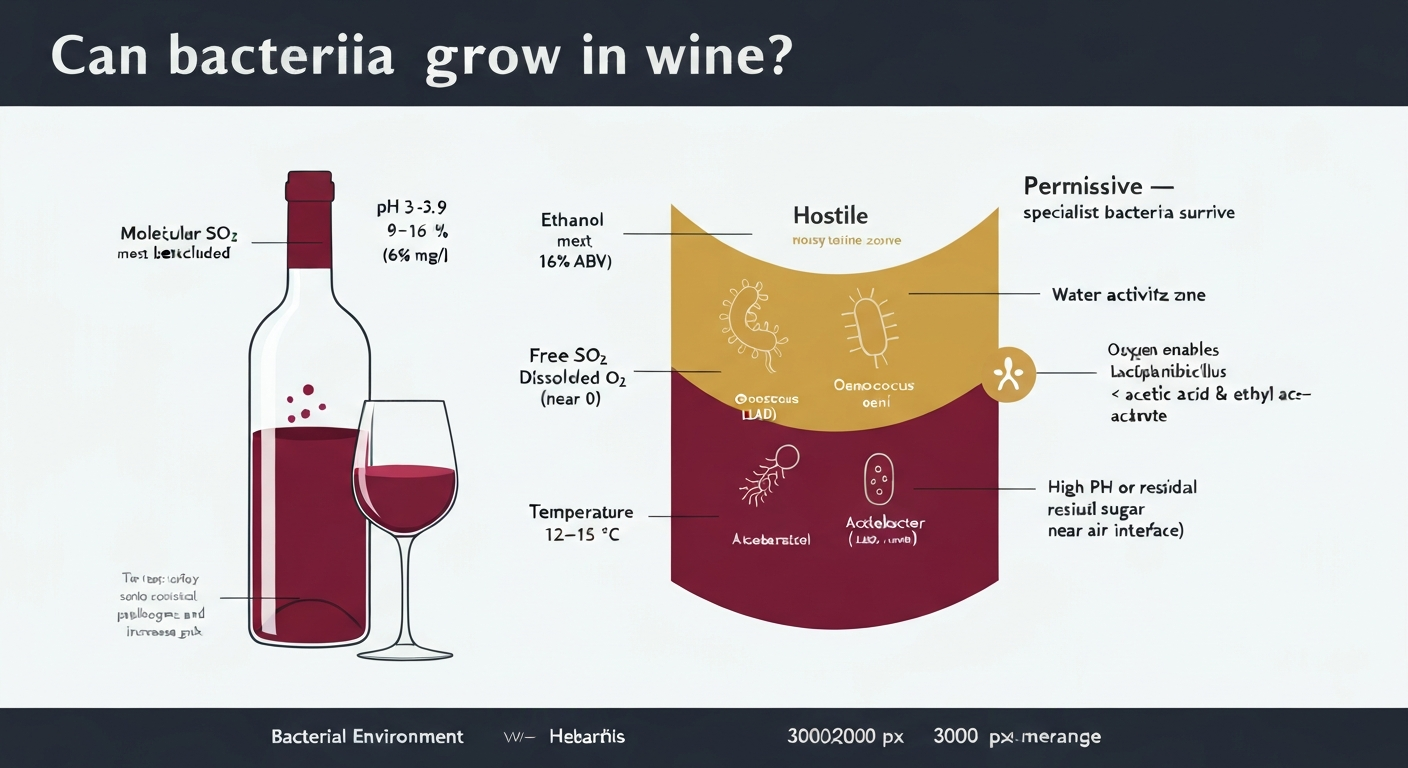
Can Bacteria Grow in Wine? Limits, Risks, and Controls
Can bacteria grow in wine? Yes: pH, EtOH, aw, SO2, O2, temp limit growth; covers spoilage, testing & controls