Most bacteria cannot grow in undiluted apple cider vinegar. Commercial ACV sits at roughly pH 2.5 to 3.5 with around 5% acetic acid, and that combination is lethal or strongly inhibitory to common foodborne pathogens like Salmonella, E. coli O157:H7, Listeria, and Staphylococcus aureus under normal storage conditions. What you will find living in unfiltered, unpasteurized ACV are acid-tolerant organisms: acetic acid bacteria, certain yeasts, and sometimes lactic acid bacteria. These are the microbes responsible for the 'mother' you see in raw ACV, and they are not human pathogens. The situations where bacterial growth becomes a genuine concern involve dilution, added nutrients, warm temperatures, or contamination from utensils and containers that alter the chemistry enough to let pathogens take hold.
Can Bacteria Grow in Apple Cider Vinegar? Safety, Risks & Limits

Why ACV's chemistry stops most microbes cold
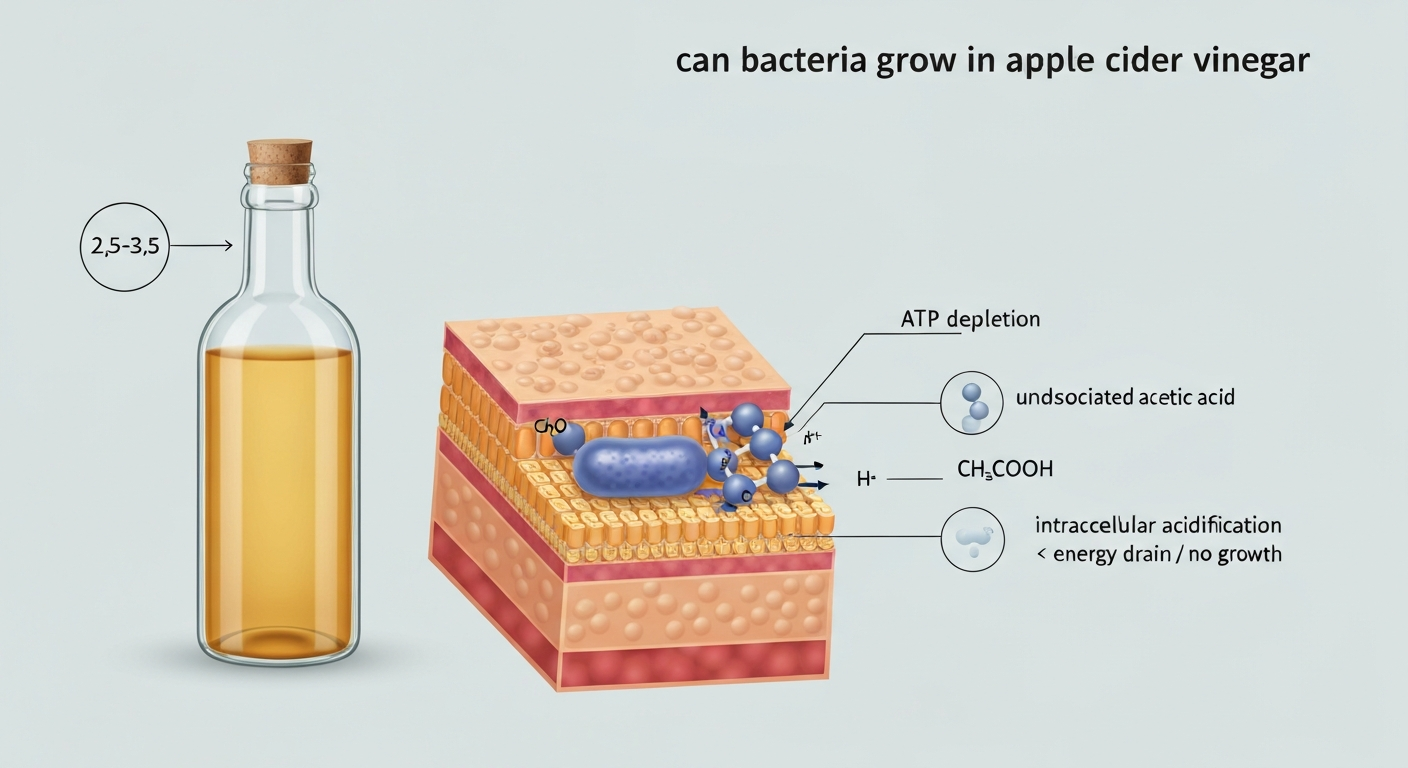
Apple cider vinegar inhibits microbial growth through several overlapping mechanisms, the most important of which is acetic acid itself. At the low pH found in commercial ACV, a large proportion of acetic acid remains in its undissociated form. That undissociated molecule is lipid-soluble, so it crosses bacterial cell membranes freely. Once inside the more neutral cytoplasm, it dissociates, releases a proton, and drops intracellular pH. The bacterium must then spend energy pumping out protons to maintain homeostasis. At concentrations typical in food-grade vinegar, that energy demand becomes unsustainable: enzyme function degrades, ATP is depleted, and the cell cannot divide or survive. This is the core inhibitory mechanism shared by all weak organic acids. Mechanism: the antimicrobial activity of acetic (and other weak) acids is primarily due to the undissociated acid diffusing across cell membranes, dissociating in the cytoplasm, lowering intracellular pH, disrupting enzyme function and ATP homeostasis, and imposing anion stress; effectiveness depends on the fraction of undissociated acid, which increases at lower external pH (Henderson–Hasselbalch behaviour) undissociated acetic acid diffuses across membranes and acidifies the cytoplasm.
The fraction of undissociated acetic acid in solution is governed by the Henderson-Hasselbalch relationship. As external pH falls, more of the acid stays undissociated, making it more membrane-permeable and more potent. This is why acidity and pH work together rather than independently. A solution with 5% acetic acid at pH 3 is considerably more antimicrobial than the same concentration at pH 5 because a far greater proportion is in the undissociated, membrane-active form.
Water activity (aw) in neat vinegar is approximately 0.99, essentially the same as water. This means water availability is not the growth-limiting factor for vinegar the way it is in dry foods, jams, or salted products. Acidity is doing almost all the antimicrobial work. Salt or sugar added to vinegar-based preparations can reduce aw further, as seen in pickled products, but for pure ACV in the bottle, pH and acetic acid concentration are the primary barriers to microbial growth.
The numbers that matter: ACV's pH and acidity
Commercial apple cider vinegar sold for food use is typically formulated to 5% acetic acid (sometimes expressed as 50 grain). National Center for Home Food Preservation guidance for home canning and pickling explicitly calls for vinegar at 5% acidity, because that concentration, when used in validated recipes, reliably brings finished product pH to safe levels. Published measurements of commercial and artisanal apple vinegars report pH values roughly in the range of 2.4 to 4.2, with most commercial products landing around pH 2.5 to 3.5 depending on the product and any dilution.
The regulatory number to know is pH 4.6. Under 21 CFR Part 114, FDA classifies foods with water activity above 0.85 and a finished equilibrium pH at or below 4.6 as acidified foods subject to specific processing controls. That 4.6 threshold is not arbitrary: it is the pH below which proteolytic Clostridium botulinum is generally inhibited from growing and producing toxin under normal conditions. CDC and WHO guidance state that growth and toxin production by proteolytic Clostridium botulinum are generally inhibited at pH ≤4.6 CDC and WHO guidance state that growth and toxin production by proteolytic Clostridium botulinum are generally inhibited at pH ≤4.6.. Undiluted commercial ACV at pH 2.5 to 3.5 sits well below this threshold, but the number becomes critical when ACV is used as an ingredient in recipes, dressings, or home-pickling projects where the final product pH needs to be verified.
| Parameter | Typical commercial ACV | Regulatory threshold (FDA) |
|---|---|---|
| pH | 2.5 to 3.5 | ≤4.6 for acidified foods (21 CFR Part 114) |
| Acetic acid concentration | ~5% (w/v) | 5% minimum specified in NCHFP pickling guidance |
| Water activity | ~0.99 | >0.85 triggers acidified food classification |
| Titratable acidity measurement method | AOAC Official Method 942.15 | Used in regulatory compliance testing |
Survival is not the same as growth
This distinction matters enormously for interpreting food safety data. When a study reports that Salmonella 'was detected' in vinegar after a set contact time, that does not mean the organism was multiplying. Survival means viable cells are still present but not reproducing. Growth means active cell division and population increase. For a pathogen to pose a meaningful infectious risk, it generally needs to be present in sufficient numbers, which usually requires growth. A pathogen that has been reduced by 6 log CFU (99.9999%) and is no longer dividing represents a fundamentally different risk profile from one that is actively proliferating.
Acid-adapted strains and cells protected by food matrices (proteins, fats, sugars) can survive acidic conditions longer than standard laboratory strains in simple buffer. This is a well-documented phenomenon: an acid tolerance response primes bacteria to resist subsequent stressors. In practical terms, it means a high initial contamination load, combined with protective matrix components, could allow some cells to persist in ACV longer than you might expect. They still cannot grow at ACV's normal pH and acidity, but they may not die as quickly either. This is why validated processing and verified starting acidity matter, not just the assumption that vinegar kills everything.
What actually lives in apple cider vinegar
The resident microbiota of unfiltered, unpasteurized ACV is dominated by acetic acid bacteria (AAB) and yeasts. Culture-dependent and culture-independent studies consistently identify Komagataeibacter (formerly Gluconacetobacter), Acetobacter, and Gluconobacter as the primary bacterial taxa, alongside various yeast species. These organisms are specifically adapted to low-pH, high-acetic-acid environments because they either produce acetic acid as a metabolic product or tolerate it as part of their ecological niche. They are the living microbial community that comprises the 'mother.'
The mother in raw ACV is a cellulosic biofilm matrix produced primarily by Komagataeibacter species. It forms as acetic acid bacteria synthesize bacterial cellulose, which aggregates with other microbial cells, proteins, and polyphenols from the apple ferment to create the characteristic stranded, cloudy mass. The mother is not a sign of spoilage or contamination. It is a predictable byproduct of live-culture vinegar and contains organisms that are not considered human pathogens. Lactic acid bacteria (LAB) are sometimes detected in traditional and artisanal apple cider vinegars, particularly in earlier fermentation stages, though AAB typically dominate the finished product.
Pasteurized or filtered ACV has these organisms removed or inactivated. The product is still acidic and still antimicrobial toward pathogens, but it no longer contains the active microbial culture. Both forms, filtered and unfiltered, carry the same antimicrobial chemistry.
How common foodborne pathogens behave in ACV
Laboratory and food-model challenge studies provide a reasonably clear picture of pathogen behavior. Published minimum inhibitory concentrations (MICs) for acetic acid against Salmonella, E. coli, and Listeria in simple media are often in the 0.1% to 1% range, well below the 5% found in commercial ACV. Experimental data show that 5% acetic acid achieves rapid, substantial inactivation of vegetative pathogen cells, with one study reporting a 6.3 log CFU reduction of E. coli O157:H7 after just 10 minutes at 42°C. Similar log reductions for Salmonella on poultry surfaces have been documented with vinegar wash treatments.
| Pathogen | Growth in undiluted ACV? | Survival possible? | Key caveats |
|---|---|---|---|
| Salmonella spp. | No | Brief, at high inoculum | Acid-adapted strains survive longer; matrix protection increases persistence |
| E. coli O157:H7 | No | Brief, diminishing | Rapid log reduction at 5% acetic acid; acid tolerance response can extend survival |
| Listeria monocytogenes | No | Limited | Inhibited well below 5% acetic acid in lab models; no growth at ACV pH |
| Staphylococcus aureus | No | Limited | Growth inhibited; preformed toxins are heat-stable and not neutralized by acid |
| Clostridium botulinum (vegetative) | No | Not relevant | Vegetative cells killed, but spores may survive |
| C. botulinum (spores) | No growth/toxin | Yes, spores persist | Spores resist acid; growth and toxin formation require pH >4.6, appropriate aw and temperature |
Clostridium botulinum deserves specific attention because the risk is not from the vinegar itself but from how it is used. Spores of C. botulinum are resistant to acidic conditions and can survive brief exposure to vinegar. The danger in home pickling arises when vinegar is diluted too much, the wrong type is used, or non-validated recipes create pockets in the food (egg yolks are the classic example) where pH does not fall below 4.6. In that microenvironment, spores can germinate and produce toxin under anaerobic conditions. Undiluted commercial ACV at pH 2.5 to 3.5 prevents this entirely, but the recipe and final product pH, not just the vinegar, must be verified.
One additional caveat for Staphylococcus aureus: while the organism cannot grow in ACV and its cells are inactivated, any heat-stable enterotoxins it may have produced before contact with acid remain biologically active. Acidity does not neutralize preformed staph toxins. This is a contamination-before-exposure scenario rather than a growth-in-vinegar scenario, but it is worth noting for anyone evaluating contaminated-ingredient risks.
Conditions that open the door to microbial growth
Undiluted commercial ACV is not a growth medium for pathogens, but several practical scenarios can change that equation. The most common is dilution. When ACV is mixed with water, juice, or other low-acid ingredients, the effective acetic acid concentration drops and the pH rises. For related guidance on how microbes behave in low-moisture cosmetic materials, see can bacteria grow in dip powder for specifics about contamination risks and handling. For more detail on how dilution and pH changes affect microbial survival and growth, see can bacteria grow in vinegar which explains when pathogenic bacteria can persist or proliferate in vinegar-based mixtures. A 50:50 mix of ACV and water at pH 4 to 5 is a fundamentally different environment from neat ACV at pH 3, and certain acid-tolerant organisms can survive or even grow in that range.
- Dilution with water or other liquids raises pH and reduces acetic acid concentration below inhibitory levels
- Addition of nutrients (sugars, proteins, fruit juices) provides substrates for microbial growth and can buffer acidity
- Warm temperatures (above 20 to 25°C) accelerate the growth of any organisms that have survived the acidic environment, and may also promote AAB growth in unpasteurized products
- Contaminated utensils or hands introduce fresh organisms with higher cell counts and possibly acid-unadapted cells that could transiently persist
- Biofilm formation on container surfaces, caps, or any submerged equipment can harbor acid-tolerant organisms in a matrix that offers additional protection
- Reusing containers without thorough cleaning can accumulate residues that dilute the acid or buffer the pH locally
- Improperly acidified pickled foods create microenvironments where pH exceeds 4.6 even when vinegar was added, particularly in dense foods like eggs or garlic cloves
Biofilms are worth calling out specifically. Acetic acid bacteria naturally form cellulosic biofilms, which is exactly what the mother is. In a production or commercial setting, biofilms on equipment surfaces can harbor microorganisms at reduced susceptibility to disinfection. For home use, the relevant lesson is that jars, lids, and utensils used with diluted vinegar mixtures should be cleaned between uses rather than relying on the residual acidity to sterilize them.
ACV compared to similar acidic substances
Apple cider vinegar is one of several acidic condiments and liquids whose microbial inhibition properties are frequently compared. The chemistry differs enough across them to affect real-world safety decisions. Lemon juice reaches pH 2 to 2.6, similar to ACV or lower, but its primary acid is citric rather than acetic, and citric acid's antimicrobial mechanism and potency differ. Pickle juice combines acetic acid with high salt (sodium chloride at 5 to 8%), which adds osmotic stress and lowers water activity, giving it an additional inhibitory mechanism. For more on microbial risks specific to pickling brines, see can bacteria grow in pickle juice for details on how acidity, salt, and dilution interact to permit or prevent growth. Soy sauce operates largely through very high salt content (often 14 to 18% sodium chloride) and moderate pH. Hot sauce combines low pH with capsaicin and typically salt. White distilled vinegar shares the same 5% acetic acid concentration as food-grade ACV but lacks the organic co-compounds and the live culture found in raw ACV.
| Substance | Typical pH | Primary inhibitory factor | Water activity | Notable pathogen risk scenarios |
|---|---|---|---|---|
| Commercial ACV (5%) | 2.5 to 3.5 | Acetic acid concentration and low pH | ~0.99 | Dilution, added nutrients, improper pickling pH |
| White distilled vinegar (5%) | 2.4 to 3.0 | Acetic acid and low pH | ~0.99 | Same dilution risks; no live culture |
| Lemon juice | 2.0 to 2.6 | Citric acid, low pH | ~0.99 | Lower MIC for citric vs acetic; rapid use recommended |
| Pickle juice | 3.0 to 3.7 | Acetic acid plus NaCl (high salt) | 0.93 to 0.97 | Dilution, cross-contamination from raw foods |
| Soy sauce | 4.4 to 5.4 | High NaCl (osmotic), fermentation compounds | 0.75 to 0.80 | Mold growth if diluted; pathogens at higher pH range |
| Hot sauce | 3.0 to 4.0 | Acetic acid, salt, capsaicin, low pH | ~0.97 to 0.99 | Dilution; spore survival in low-acid variants |
The practical takeaway from this comparison is that ACV is not uniquely antimicrobial compared to other 5% vinegars, but it does differ meaningfully from soy sauce, which relies on salt rather than acidity. Soy sauce has a much higher pH (sometimes above 4.6), meaning C. botulinum growth suppression depends entirely on its salt-driven low water activity rather than pH. ACV and white vinegar share essentially the same acid-based inhibition mechanism, making their failure modes very similar. For more on how soy sauce's high salt and moderate pH affect microbial growth, see can bacteria grow in soy sauce.
Spoilage signs versus normal changes in ACV
Several changes in ACV's appearance are normal and do not indicate contamination or safety concerns. The mother, cloudiness, and sediment in unfiltered ACV are entirely expected and are the result of live acetic acid bacteria and associated cellulose matrix. These are not signs of spoilage. Cloudiness in a previously clear filtered ACV can indicate that acetic fermentation has continued or that the mother has begun to reform if the product was not fully pasteurized, but it still does not indicate pathogen contamination.
Changes that do warrant attention are different in character. An unusual or off smell, one that is distinctly different from the sharp, sour acetic aroma, can indicate competing fermentation or contamination. A slippery, slimy layer that does not have the characteristic strand-like or ropy texture of normal mother could suggest a different microbial community. Any color changes to pink, orange, or dark brown (beyond the expected amber of ACV) especially in combination with an off smell, are worth investigating. A pH that has drifted above 4.0 on a product that was not diluted may indicate over-dilution during preparation or a substandard starting product.
- Normal: cloudy appearance, stranded or ropy mother, sediment at the bottom, strong vinegar aroma
- Normal: slightly different color between batches of artisanal or raw ACV due to apple variety and fermentation conditions
- Investigate: off or fermented smells that are distinctly yeasty, putrid, or otherwise unusual
- Investigate: slimy or mucilaginous texture not consistent with normal AAB cellulose
- Investigate: unusual discoloration in combination with off aromas
- Investigate: any pH measurement above 4.0 in undiluted product, particularly for products intended for pickling or acidification
- Action required for professionals: if a product intended as an acidified food ingredient does not achieve pH ≤4.6 in the finished preparation, do not process or consume without re-evaluation of the formulation
Practical storage, testing, and handling guidance
For standard storage and home use, commercial ACV at 5% acidity stored in a cool location away from direct sunlight and in a tightly sealed container has a very long shelf life. The FDA does not require an expiration date on vinegar because its inherent acidity prevents significant microbial growth or chemical degradation under normal conditions. Once opened, the main concern is dilution or contamination introduced by utensils dipped into the bottle.
- Use clean, dry utensils every time you dip into the bottle. Wet utensils introduce water, which raises local pH and can dilute the acidity near the surface.
- Store vinegar in a sealed glass or food-grade plastic container. Avoid metal containers not designed for acidic foods, as acid can interact with reactive metals.
- For home pickling, always use verified 5% acidity vinegar and follow validated recipes. Do not adjust the ratio of vinegar to water or other ingredients without re-verifying the final product pH.
- If you need to confirm the acidity of homemade or artisanal ACV, titratable acidity can be measured using the AOAC Official Method 942.15 titrimetric approach, which is the standard referenced in regulatory and peer-reviewed work.
- For food safety professionals testing for pathogen survival in ACV-based matrices, dilute the sample into buffered peptone water before enrichment. Direct plating of undiluted acidic samples will kill acid-stressed cells and underestimate viable counts.
- When preparing diluted ACV products for retail or food service (dressings, marinades, beverage shots), verify the finished pH with a calibrated pH meter and ensure it remains at or below 4.6 if the product falls under acidified food regulations.
- Do not rely on vinegar alone to decontaminate surfaces, produce, or equipment where there is a known or suspected high-load pathogen contamination. Log reductions depend heavily on contact time, temperature, concentration, and the protective matrix.
For microbiologists and food safety educators working with ACV as a reference matrix, it is worth noting that the same inhibitory chemistry that makes ACV inhospitable to pathogens also suppresses standard enrichment organisms if samples are not properly neutralized before plating. This is a methodological issue, not a safety issue, but it can lead to false negatives in routine surveillance if protocols are not adapted for highly acidic samples.
FAQ
Can bacteria grow in apple cider vinegar (ACV)?
Undiluted, food‑grade ACV (typically ~5% acetic acid, pH ≈2.5–3.5) is inhospitable to growth of most common foodborne bacteria (Salmonella, E. coli, Listeria, Staphylococcus aureus) because low pH and acetic acid strongly inhibit cell metabolism and are often bactericidal with sufficient contact time. However, some acid‑tolerant microbes (acetic acid bacteria and certain yeasts) can persist and reproduce in unpasteurized or “with‑mother” products. Survival (viable but non‑growing or slowly dying cells) of some pathogens is possible under brief exposure or acid‑adapted strains, but active growth of typical bacterial pathogens requires conditions that raise pH, dilute the acid, add nutrients, or provide protective microenvironments.
What quantitative acidity and pH values are typical for ACV and why do they matter?
Commercial food‑grade vinegars used for pickling are usually formulated at about 5% acetic acid (≈50 grain). Typical measured pH values for apple cider vinegar products range roughly from ≈2.4 to ≈4.2, with many commercial ACVs near ~2.5–3.5. The fraction of undissociated acetic acid (the antimicrobial agent) increases at lower pH, so both % acetic acid and final pH determine antimicrobial potency. Regulatory thresholds use pH 4.6 as a critical cutoff because proteolytic Clostridium botulinum cannot grow or produce toxin at pH ≤4.6 under normal conditions.
Which microorganisms can survive or grow in ACV?
Acetic acid bacteria (Acetobacter, Komagataeibacter, Gluconobacter) and some yeasts are adapted to acidic, ethanolic environments and are the normal microbiota of unpasteurized ACV and the visible “mother.” These organisms can persist and reproduce in vinegar. Certain lactic acid bacteria and specialist acid‑tolerant yeast strains can also survive in acidic matrices. Most common human bacterial pathogens are inhibited from actively growing in undiluted 5% vinegar; spores (including Clostridium species) can survive exposure but will not grow unless conditions become permissive (pH >4.6, adequate aw, temperature and anaerobiosis).
What’s the difference between survival and growth in the context of ACV and pathogens?
Survival means cells remain viable but do not multiply; growth means cells replicate and increase in number. Undiluted vinegar commonly causes inactivation or very slow die‑off of many vegetative pathogens (survival only), whereas growth requires an environment above permissive pH, sufficient nutrients, water activity and favorable temperature. For food safety, surviving cells can still pose a risk if later transferred into a more favorable environment (e.g., when vinegar is diluted or used to make an inadequately acidified product).
Under what conditions could pathogenic bacteria grow despite vinegar’s acidity?
Conditions that can permit growth include: dilution of vinegar (lowering acetic acid concentration and raising pH), addition of nutrients (eggs, proteins, starches, sugars) that buffer acidity, warm storage temperatures, long storage times that allow pH drift or microbial adaptation, contaminated utensils introducing biofilms, and creation of anaerobic microenvironments. Improper home pickling (not using 5% vinegar or not following validated recipes) is a common scenario where acidification may be insufficient and pathogens—especially C. botulinum in low‑acid, anaerobic products—could grow.
Is the ‘mother’ in unfiltered ACV dangerous?
The ‘mother’ is a cellulose‑rich biofilm produced mainly by acetic acid bacteria and associated yeasts. It indicates ongoing or past fermentation and contains live, generally non‑pathogenic acid‑tolerant microbes. The mother itself is not considered a human pathogen, but its presence means the product is unpasteurized and contains living microbes, so it will behave differently from sterile vinegar (e.g., potential for continued fermentation or changes in flavor). Standard hygiene applies when handling.
Can Bacteria Grow in Dip Powder? Risks, Limits & Controls
Can bacteria grow in dip powder or rehydrated dips? Evidence-based growth limits, contamination routes, testing and safe