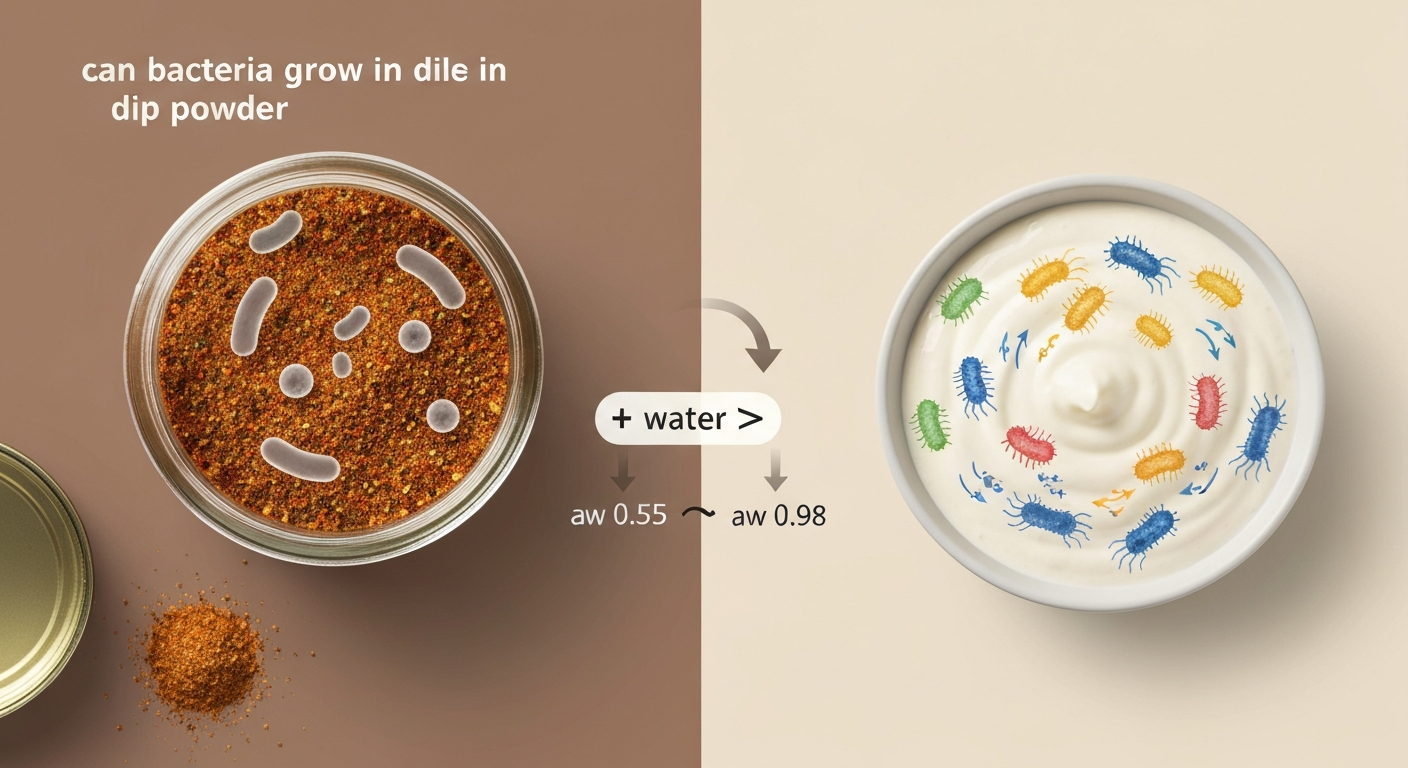
Bacteria can survive in dry dip powder, but they cannot actively grow in it under normal storage conditions. The reason comes down to water activity: most dry seasoning mixes have a water activity (aw) well below 0.90, and virtually all bacterial pathogens of concern need at least aw 0.83 to 0.95 before they can replicate. What the dry state does not do is kill those bacteria. Pathogens like Salmonella can persist in dry powders for months or even years, and once you rehydrate the powder into a dip, growth becomes possible very quickly if temperature, pH, and time are not controlled.
Can Bacteria Grow in Dip Powder? Risks, Limits & Controls

Marcus Reeves
6 Aug 2026
Short answer and key food-safety takeaways
If you are making a food-safety decision right now, here is what the evidence shows. Dry dip powders are low-risk for active bacterial growth during storage, but they are not sterile. Rehydration changes everything: the moment water is added and aw rises above pathogen-specific thresholds, surviving cells can begin multiplying if temperature and pH permit. The pH 4.6 boundary and refrigeration at or below 4 °C are the two most critical control points for a rehydrated dip.
- Dry powders with aw below ~0.60–0.70 do not support any bacterial growth, but pathogens including Salmonella can survive in them for extended periods.
- Rehydrated dips with aw above 0.92–0.95 and pH above 4.6 are capable of supporting growth of Listeria, Salmonella, and other enteric pathogens.
- Staphylococcus aureus has the lowest aw growth threshold of the key pathogens (aw ~0.83) and is the most likely to grow in moderately moist, partially dried dip formulations.
- Refrigeration at or below 4 °C stops growth of most pathogens but does not stop Listeria monocytogenes, which can grow as low as -0.4 °C.
- Acidification with vinegar or lemon juice to pH below the relevant minimum growth pH for each pathogen is a proven hurdle, but only when the acidulant is used at sufficient concentration in the final product.
- Discard rehydrated dips held at room temperature for more than 2 hours, and refrigerated dips after the manufacturer-recommended window (commonly 3–7 days for homemade versions).
What 'dip powder' and 'rehydrated dip' actually mean
A dry dip powder is a low-moisture blend of spices, salt, dehydrated vegetables, powdered dairy bases (such as sour cream or buttermilk powder), hydrolyzed vegetable proteins, and dried herbs, intended to be stored at ambient temperature and mixed with a wet carrier (sour cream, mayonnaise, cream cheese, or water) before serving. In food safety frameworks, these products are classified as low-moisture food ingredients, handled under a separate set of hazard considerations from ready-to-eat wet foods. ICMSF / industrial guidance excerpt, Dry spices and herbs (processing/testing context) classifies dry dip powders as low‑moisture products intended for dry storage and handled separately from ready‑to‑eat wet foods blank" rel="noopener noreferrer">ICMSF / industrial guidance excerpt — Dry spices and herbs (processing/testing context) classifies dry dip powders as low‑moisture products intended for dry storage and handled separately from ready‑to‑eat wet foods..
A rehydrated dip is the product you get after mixing that powder with a wet base. The moment those two are combined, the water activity of the mixture rises substantially, nutrients become soluble and bioavailable, and the matrix transitions from a microbiologically stable dry state to a perishable, ready-to-eat wet food that needs time-temperature control. This distinction between the dry powder and the finished dip is the single most important conceptual point in this article.
Survival versus active growth: why these are not the same thing
Survival means bacterial cells remain viable in the dry matrix without replicating. They may be culturable, or they may enter a viable-but-nonculturable (VBNC) state where standard culture methods miss them but they retain pathogenic potential. Growth means active cell division: population numbers increase, and with them the risk of reaching an infectious dose. Low-moisture foods routinely support long-term survival while completely preventing growth. This distinction matters enormously for risk assessment.
There is a further complication that makes dry powders more hazardous than they might appear. Desiccation stress appears to cross-protect Salmonella and other pathogens against subsequent stresses, including heat and sanitizers. Laboratory studies have documented that desiccated Salmonella strains become harder to kill by heat treatment, and that rehydration does not always fully reverse this tolerance. In practical terms, contaminated powder that survives processing is carrying cells that are potentially more resilient than freshly grown ones.
The factors that control whether bacteria grow at all
Microbial growth in any food matrix is controlled by a combination of intrinsic factors (properties of the food itself) and extrinsic factors (the storage environment). No single parameter tells the whole story. What food safety professionals call 'hurdle technology' works by stacking multiple suboptimal conditions so that even if one hurdle is partially overcome, the others prevent growth. For dip powders and rehydrated dips, the most important factors are water activity, pH, temperature, oxygen availability, and nutrient composition.
| Factor | Relevant to dry powder? | Relevant to rehydrated dip? | Primary concern |
|---|---|---|---|
| Water activity (aw) | Yes — keeps growth impossible | Yes — rises above growth thresholds | Pathogen replication after rehydration |
| pH | Partial — acidulants in mix | Yes — final dip pH determines risk | Growth of enteric pathogens above pH 4.6 |
| Temperature | Yes — ambient or cool storage | Yes — refrigeration vs. room temperature | Rapid outgrowth at temps above 7–10 °C |
| Oxygen / redox | Aerobic during storage | Variable depending on packaging/depth | Anaerobic pathogens in sealed or deep dip |
| Nutrients | Low availability in dry state | High availability after rehydration | Rapid growth once aw/pH/temp allow |
| Preservatives | May be present in mix | Efficacy depends on final pH and concentration | Incomplete protection if pH is too high |
Water activity: the number that determines whether growth is even possible
Water activity (aw) is the measure of free, unbound water available for microbial metabolism. It runs on a scale from 0 (completely dry) to 1.0 (pure water). Most commercially produced dry spice blends and seasoning mixes have aw values well below 0.60, and many fall below 0.50. At these values, no bacterial pathogen of concern can replicate. The general rule supported by extensive experimental data is that bacterial growth stops below approximately aw 0.90–0.91, with the exact cutoff varying by pathogen.
Molds and some yeasts can tolerate lower aw than bacteria, which is why a spice blend might grow visible mold after moisture ingress without posing a bacterial growth risk at the same aw. For bacterial hazard assessment, the thresholds below are the values most relevant to dip powders and their rehydrated counterparts.
| Pathogen | Minimum aw for growth | Minimum aw for toxin formation | Risk in dry powder (aw <0.70)? |
|---|---|---|---|
| Staphylococcus aureus | 0.83 | 0.85 | No growth; survives |
| Listeria monocytogenes | 0.92 | N/A | No growth; survives |
| Salmonella spp. | 0.94 | N/A | No growth; survives |
| Pathogenic E. coli | 0.95 | N/A | No growth; survives |
| Bacillus cereus | 0.92 | N/A | No growth; spores survive |
| Clostridium perfringens | 0.93 | N/A | No growth; spores survive |
When dip powder is mixed with sour cream, mayonnaise, or cream cheese, the aw of the resulting mixture climbs rapidly into the range of 0.96–0.99 depending on the wet base used and the powder-to-base ratio. That puts the rehydrated dip squarely inside the growth window for every pathogen in the table above. This is why the reconstituted product must be treated as a time-temperature sensitive food from the moment it is prepared.
Partial rehydration scenarios deserve attention. If a dry dip mix absorbs ambient humidity during storage (for example, in an unsealed container in a humid kitchen), aw can creep upward toward the 0.83 threshold where Staphylococcus aureus can begin to grow. This is a less-discussed risk: the product does not look or smell different, but the physical conditions may have shifted into a permissive range for at least one key pathogen.
pH and acidulants: the 4.6 line and how acidic ingredients help
pH 4.6 is the critical regulatory boundary in food safety because it is the minimum pH at which Clostridium botulinum can produce toxin. Foods formulated below pH 4.6 are classified as acid or acidified foods and receive different processing requirements. For broader bacterial risk, each pathogen has its own minimum pH for growth, and those minimums are all above the pH achievable with moderate acidification.
| Pathogen | Minimum pH for growth | Minimum pH for toxin production |
|---|---|---|
| Salmonella spp. | 3.7 | N/A |
| Pathogenic E. coli | 4.0 | N/A |
| Staphylococcus aureus | 4.0 | 4.0 |
| Listeria monocytogenes | 4.4 | N/A |
| Bacillus cereus | 4.3 | N/A |
| Clostridium perfringens | 5.0 | N/A |
| Clostridium botulinum | 4.6 | 4.6 |
Many dry dip powder formulations include citric acid, tartaric acid, or dried vinegar powder as part of the flavor profile. When rehydrated, these acidulants lower the pH of the finished dip. Whether they lower it enough to prevent growth depends on the final concentration and on the buffering capacity of the wet base. Sour cream and cream cheese have meaningful buffering capacity, which can blunt the effect of acid additions. A formulation that looks acidic based on the powder ingredients may produce a finished dip with pH well above 4.6 once mixed.
Liquid acidulants used as the rehydration medium tell a clearer story. Bottled lemon juice typically measures pH 2.2–2.6 and household white distilled vinegar (5% acetic acid) typically falls in the range of pH 2.4–3.0. Used at sufficient volume, these can bring the final dip pH below the growth minimum for most enteric pathogens. Apple cider vinegar, like other culinary vinegars, has similar acidity and can inhibit many enteric pathogens when used at sufficient concentration. Soy sauce is less acidic (typically pH 4. For more on soy sauce’s microbial safety and how its acidity and salt content affect pathogen survival, see can bacteria grow in soy sauce. 4–5.5) but carries additional preservative contributions from high salt content, ethanol from fermentation, and fermentation metabolites. The comparison here parallels what you see in other acidic condiments: the inhibitory effect is real, but it is concentration- and matrix-dependent, not categorical.
Weak organic acid preservatives such as sorbates and benzoates, which appear in some commercially produced dip formulations, add a pH-dependent hurdle. They are most effective in their undissociated acid form, which predominates at lower pH values. Above pH 5.0–5.5, much of the preservative dissociates and loses efficacy. This means a sorbate-containing dip that is not acidified sufficiently provides much weaker protection than the label might suggest.
Temperature and time: the practical limits for holding a rehydrated dip
Temperature is the most controllable extrinsic factor in the kitchen and foodservice context. Each pathogen has a minimum growth temperature, and staying below that temperature stops growth, though it does not kill the organism. Listeria monocytogenes is the most challenging because it can grow down to approximately -0.4 °C, meaning standard refrigerator temperatures (typically 2–4 °C) only slow rather than stop it. For most other key pathogens, growth rates at refrigerator temperatures are low enough to provide a meaningful safety window of several days.
| Pathogen | Minimum growth temperature | Stops growing at refrigeration (≤4 °C)? |
|---|---|---|
| Listeria monocytogenes | -0.4 °C | No — grows slowly |
| Bacillus cereus | 4 °C | Borderline — grows very slowly |
| Salmonella spp. | 5.2 °C | Yes — no growth below this |
| Pathogenic E. coli | 6.5 °C | Yes |
| Staphylococcus aureus | 7.0 °C | Yes |
| Clostridium perfringens | 10 °C | Yes |
At temperatures between 11 °C and 21 °C (roughly the range of a warm kitchen counter or inadequate refrigeration), growth windows for most pathogens shrink from days to hours. FDA time-temperature guidance for ready-to-eat and reconstituted foods identifies this range as one where active management is required. The standard two-hour rule for leaving perishable foods at room temperature applies directly to rehydrated dips. Above 21 °C (approximately 70 °F), growth rates accelerate further and the safe holding time shortens accordingly.
For refrigerated rehydrated dips, the practical guidance is to consume or discard within 3–7 days for homemade versions, consistent with the perishable wet base used. Commercially produced refrigerated dips have validated shelf lives based on challenge studies and preservative systems, but once opened, they should be treated as any other open perishable dairy-based product.
Oxygen, redox conditions, and packaging effects
Dry dip powders in their packaged state are aerobic environments. The key pathogens associated with spices and seasonings, including Salmonella, Listeria, pathogenic E. coli, and Staphylococcus aureus, are all facultative anaerobes: they can grow with or without oxygen, which means oxygen removal alone does not eliminate the growth risk in a rehydrated dip.
Modified atmosphere packaging (MAP) and oxygen-scavenging sachets are used in some dry seasoning and spice products primarily to extend shelf life by preventing lipid oxidation and mold growth, not to control bacterial pathogens. Because the dominant spice-associated pathogens do not require oxygen, reducing oxygen in the package does not meaningfully reduce survival of Salmonella or Listeria during storage. It may, however, influence the competitive microflora that limits pathogen numbers in naturally contaminated product.
The risk picture changes when considering anaerobic pathogens after rehydration. Clostridium botulinum types A, B, and F are obligate anaerobes requiring the absence of oxygen to grow and produce toxin. A rehydrated dip that is stored in a sealed container, particularly under vacuum or in a deep-fill configuration where the center of the product is effectively anoxic, could in principle support C. botulinum if pH is above 4.6 and temperature is not controlled. This is a lower-probability scenario for most home-prepared dips made from dry mixes, but it becomes relevant for commercially packaged refrigerated dips with extended shelf lives, where the pH and aw of the formulation must be validated against C. botulinum growth.
From a consumer packaging standpoint, the most practical implication is this: rehydrated dips stored in sealed containers at room temperature face a more complex hazard profile than those left uncovered in the refrigerator. Seal the container and refrigerate, but do not assume sealing provides any additional safety margin against the relevant pathogens. It does not.
Contamination pathways: how pathogens get into dry powder in the first place
FDA risk assessments on spices have documented repeated isolation of Salmonella and other pathogens from commercially available spices and dry seasoning ingredients. The FDA Risk Profile: Pathogens and Filth in Spices documents repeated isolation of Salmonella and other pathogens from low‑moisture spices and experimental evidence that desiccation can prolong survival and increase tolerance to heat, UV, and disinfectants (months–years). The contamination pathways are primarily agricultural and processing-related: raw spice crops grown in or near environments with animal feces, inadequate drying or storage that allows moisture ingress, cross-contamination during blending and packaging, and failure of any pathogen-reduction step (such as steam treatment, irradiation, or ethylene oxide treatment where permitted) to achieve adequate log reduction.
In the home or foodservice context, additional contamination routes include double-dipping (introducing oral flora and potentially Staphylococcus aureus into the dip), using wet or contaminated utensils that transfer moisture and organisms into the dry powder container, and cross-contamination from raw meat or produce during preparation. Once introduced, any viable pathogen in a rehydrated dip will face the same growth conditions described throughout this article.
Testing approaches for powders and rehydrated dips
Standard microbiological testing for dry spice ingredients follows guidance from sources such as the FDA Bacteriological Analytical Manual (BAM), with Salmonella tested as absence in 25 g as the primary criterion for finished ingredient release. Because desiccated cells are often sublethally injured, standard enrichment protocols must be adapted: cells require a careful rehydration and pre-enrichment step in non-selective media before transfer to selective enrichment broth, otherwise recovery rates are significantly underestimated.
Molecular methods including PCR and immunomagnetic separation (IMS) are now common for rapid screening of large ingredient lots, particularly for Salmonella. These methods are faster than culture but require confirmation of any positive result by culture because they detect DNA from dead cells as well as viable ones. For rehydrated dips, testing targets expand to include Listeria monocytogenes, Staphylococcus aureus (including enterotoxin detection in products where temperature abuse may have occurred), and in some commercial contexts, generic E. coli as a hygiene indicator.
Water activity measurement is a routine and inexpensive quality control step for dry ingredient lots and should be used to verify that incoming powder meets the aw specification (typically below 0.60 for most dry seasoning mixes). Instruments such as chilled-mirror dewpoint sensors provide accurate aw readings and are standard in food manufacturing quality control labs.
Practical controls for manufacturers, food-safety staff, and home cooks
For manufacturers and formulators
- Verify aw of incoming spice and seasoning ingredients against specification; reject lots with aw above 0.60 unless immediate processing controls are in place.
- Apply validated pathogen-reduction treatments (steam treatment, irradiation) to spice ingredients destined for ready-to-eat applications; document log-reduction efficacy.
- Formulate rehydrated dip products with a validated pH at or below 4.6 if targeting shelf-stable classification, or below the growth minimum for the relevant pathogen of concern if not acidified.
- Conduct challenge studies with target pathogens in the final rehydrated matrix to validate growth-prevention claims under worst-case conditions.
- Use hurdle combinations: aw plus pH plus preservative provides substantially more robust protection than any single parameter alone.
- Apply MAP or oxygen scavengers for quality and mold control, but do not rely on these for bacterial pathogen control.
For foodservice professionals
- Treat rehydrated dips as time-temperature control for safety (TCS) foods from the moment of preparation.
- Refrigerate at or below 4 °C immediately after preparation; label with preparation date and time.
- Discard rehydrated dips held in the temperature danger zone (4–60 °C) for more than 2 hours cumulative.
- Use dedicated dry utensils when measuring from the powder container to prevent moisture introduction and contamination.
- Do not mix new powder into a partially used batch of rehydrated dip.
For home cooks and consumers
- Store dry dip powder in an airtight container in a cool, dry location; moisture ingress is the primary shelf-stability risk.
- Mix only what you plan to use in a single session when possible; leftovers should be refrigerated immediately.
- Refrigerate rehydrated dip at or below 4 °C and use within 3–7 days, using your judgment and discarding if appearance, smell, or texture changes.
- Do not leave dip at room temperature for more than 2 hours; at warm outdoor temperatures (above 30 °C / 86 °F), reduce that to 1 hour.
- Avoid double-dipping, which introduces oral bacteria including Staphylococcus aureus into the dip.
- Check that the dry powder container is fully sealed between uses and not stored near the stove or sink where humidity fluctuates.
How dip powder compares to acidic condiments
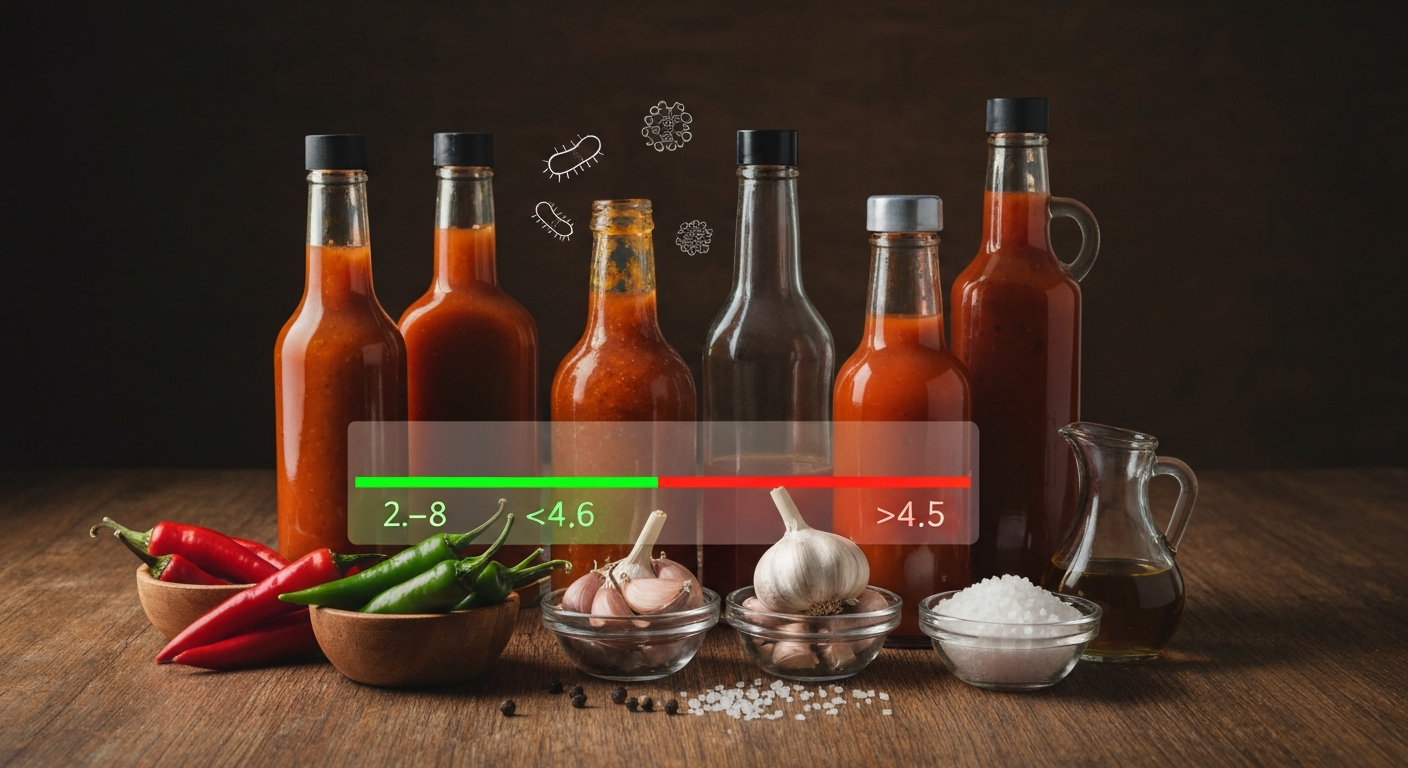
Dry dip powder sits at a very different point on the microbial risk spectrum compared to the acidic condiments it is sometimes compared with. Vinegar, apple cider vinegar, lemon juice, and similar high-acid liquid condiments have pH values in the range of 2.2–3.0, which is well below the minimum growth pH for all the major enteric pathogens. They inhibit growth not only through pH but also through the direct antimicrobial action of undissociated organic acids (acetic acid in vinegars, citric acid in lemon juice) on bacterial cell membranes. Pickle juice and hot sauce operate on a similar principle with the addition of salt and, in hot sauce, capsaicin. For related guidance on acidic brines and microbial survival, see can bacteria grow in pickle juice. See Can bacteria grow in hot sauce? for details on how acidity, salt, and capsaicin affect bacterial survival and growth.
Dry dip powder, by contrast, has no inherent pH-based protection in its dry state, and once rehydrated with a neutral-to-mildly-acidic base like sour cream (pH approximately 4.5–5.0), the finished dip sits at a pH that is permissive for several pathogens. The dry state's protection comes entirely from low water activity, not from acidity. This is a fundamental distinction: when you remove the low aw condition by rehydrating, you lose the primary protective mechanism and must rely on pH, temperature, and time controls instead.
Soy sauce is an interesting middle case: its pH (commonly 4.4–5.5) offers limited acid protection compared to vinegar, but its water activity is significantly reduced by its high salt content (typically 15–20% sodium chloride), and fermentation-derived compounds add to its inhibitory profile. A dip powder that uses soy sauce or a high-salt base for rehydration would benefit from combined aw and pH hurdles rather than relying on either alone.
Summary of growth-limit numbers for quick reference
The table below consolidates the key quantitative thresholds used throughout this article. These values represent minima under otherwise optimal conditions for each pathogen, meaning they represent the outer boundary of growth, not typical conditions. In practice, suboptimal temperature, competing flora, and preservatives push effective growth limits to more restrictive values. The interaction effects between hurdles are cumulative: a dip that is moderately low in aw and moderately low in pH is substantially safer than one that meets only one criterion.
| Pathogen | Min aw (growth) | Min pH (growth) | Min temp (°C) | Oxygen requirement |
|---|---|---|---|---|
| Salmonella spp. | 0.94 | 3.7 | 5.2 | Facultative anaerobe |
| Pathogenic E. coli | 0.95 | 4.0 | 6.5 | Facultative anaerobe |
| Listeria monocytogenes | 0.92 | 4.4 | -0.4 | Facultative anaerobe |
| Staphylococcus aureus | 0.83 (growth); 0.85 (toxin) | 4.0 | 7.0 | Facultative anaerobe |
| Bacillus cereus | 0.92 | 4.3 | 4.0 | Aerobic / facultative |
| Clostridium perfringens | 0.93 | 5.0 | 10.0 | Anaerobe |
| Clostridium botulinum | 0.93 (type A/B) | 4.6 | 3.3 (type E) | Obligate anaerobe |
FAQ
What is the difference between bacterial survival and bacterial growth in dry dip powders and rehydrated dips?
Survival means cells remain viable (culturable or viable-but-nonculturable) while not replicating in the dry matrix; growth means active cell division and population increase after conditions (water activity, pH, temperature, nutrients) become permissive. Low‑moisture powders typically permit long-term survival but not replication until rehydration or formulation change creates a permissive aw/pH/temperature environment. (References: ICMSF/FDA spice guidance; review on Salmonella in low‑moisture foods.)
How are 'dip powder' and 'rehydrated dip' defined for food‑safety assessment?
A dry dip powder (dry seasoning mix) is a low‑moisture food composed of spices, salt, dehydrated vegetables, powdered dairy or hydrolyzed proteins, and preservatives intended to be stored dry. A rehydrated dip is the product after addition of water, oil, or other liquid(s) to the powder to make a ready‑to‑eat or ready‑to‑serve wet product. Risk assessment must treat them differently: powders are low‑moisture ingredient risks (survival), whereas rehydrated dips are potentially growth‑permissive ready‑to‑eat foods. (Reference: FDA/ICMSF guidance on dry spices and low‑moisture foods.)
What quantitative water activity (aw) and pH thresholds determine if common pathogens can grow?
Typical minimum aw and pH growth limits (approximate, matrix‑dependent): - Staphylococcus aureus growth min aw ≈ 0.83; toxin formation min aw ≈ 0.85. - Listeria monocytogenes min aw ≈ 0.92; min pH ≈ 4.4. - Salmonella spp. min aw ≈ 0.94; min pH ≈ 3.7. - Pathogenic E. coli min aw ≈ 0.95; min pH ≈ 4.0. - Bacillus cereus min aw ≈ 0.92; min pH ≈ 4.3. - Clostridium perfringens min aw ≈ 0.93; min pH ≈ 5.0. Note pH and aw interact: lower aw or colder temperatures raise the minimal pH and other conditions needed for growth. Use authoritative tables (e.g., FDA hazards & controls Appendix) for specific values and strain variability. (Reference: FDA Fish and Fishery Products Hazards & Controls Guidance, Appendix 4.)
Can pathogens survive for months or years in dry powders? Which ones are most likely?
Yes. Salmonella, spore‑forming Bacillus spp., and some enteric bacteria can survive months to years in low‑moisture powders. Spores (Bacillus, Clostridium) persist and may germinate upon rehydration; desiccation often increases tolerance to heat and disinfectants, making recovery after standard processing possible. Reports and risk assessments document repeated isolation of Salmonella from spices and dry mixes. (Reference: FDA Risk Profile: Pathogens and Filth in Spices; research on desiccation stress.)
If a dry dip powder contains acidifying ingredients (vinegar, lemon powder) or salt (soy sauce powder), does that prevent growth after rehydration?
It depends on the final rehydrated pH, aw, salt concentration, and preservative activity. Strong acids (lemon juice pH ~2.2–2.6; 5% vinegar pH ~2.4–3.0) can lower rehydrated pH below many pathogens' growth limits if used at sufficient concentration. Soy sauce is less acidic (pH ~4.4–5.5) and relies on salt, ethanol and fermentation metabolites for inhibition; it may not alone prevent growth of acid‑tolerant pathogens. Preservatives (benzoates, sorbates) are pH‑dependent and work best when the matrix is acidic enough to keep them in the undissociated form. Always evaluate final formulated pH, aw and preservative levels rather than ingredient identity alone. (References: NCHFP acidification studies; WHO preservative efficacy review; FDA growth-limit tables.)
Which contamination pathways are most important for dry powders and rehydrated dips?
Key pathways: - Contamination of raw spice/herb ingredients (field, drying, storage). - Cross‑contamination during handling, blending or packaging (personnel, equipment, aerosols). - Post‑processing contamination of powders via rework or contaminated packing materials. - Rehydration step contamination (unclean water, utensils, surfaces, hands). - Consumer or food‑service handling and prolonged holding at permissive temperatures allowing outgrowth. Monitoring both upstream ingredient supply and reconstitution/handling steps is essential. (References: FDA spice risk profile; low‑moisture contamination literature.)},{
Next Article
Can Bacteria Grow in Hot Sauce? Food-Safety Thresholds & Risks
Can bacteria grow in hot sauce? Explains when microbes survive or grow, key pH/aw thresholds, risks & prevention.