Most commercially produced hot sauces are formulated to prevent bacterial growth, primarily through low pH (typically well below 4.6) and the antimicrobial effect of vinegar and salt. However, bacteria can survive in hot sauce even when they cannot actively grow, and certain formulations, especially oil-based or homemade sauces with insufficient acid, can absolutely support pathogen growth under the right conditions. The decisive factors are pH, water activity, salt concentration, thermal processing, and whether the product has been recontaminated after opening.
Can Bacteria Grow in Hot Sauce? Food-Safety Thresholds & Risks

Marcus Reeves
27 Jul 2026
The direct verdict: growth, survival, and the thresholds that matter
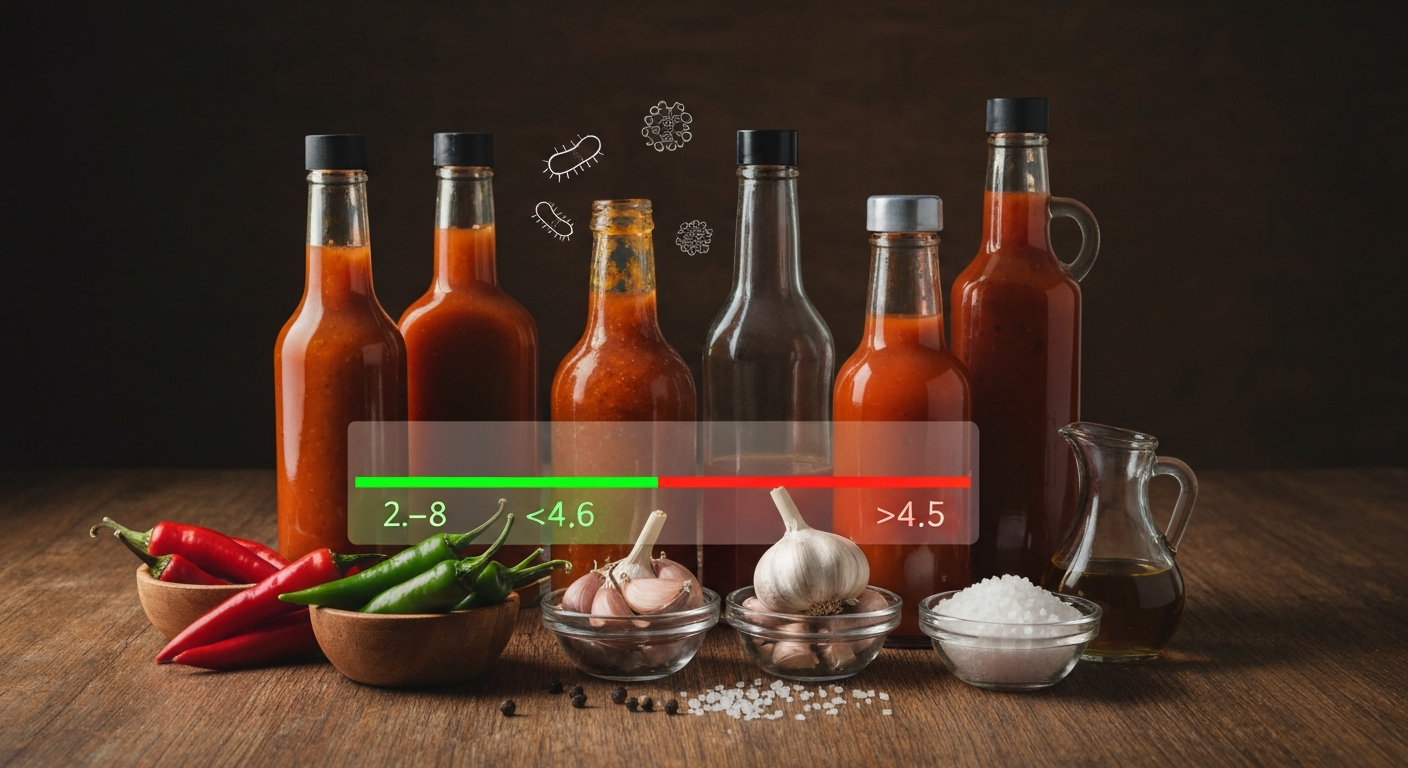
Whether bacteria grow in hot sauce depends almost entirely on formulation, not on the presence of chili peppers alone. A well-acidified vinegar-based sauce with equilibrium pH at or below 4.6 and adequate water activity control will not support growth of the major foodborne pathogens under normal storage conditions. That is the regulatory baseline the FDA uses in its acidified foods framework under 21 CFR Part 114, which requires that covered products reach a finished equilibrium pH of 4.6 or below. The FDA also sets aw = 0.85 as the practical cut-off below which most pathogenic bacteria cannot grow. Products meeting both thresholds are, for practical purposes, hostile to vegetative bacterial growth.
The complication is that 'growth prevented' is not the same as 'bacteria absent.' Spores can persist through the pH and aw barriers that kill vegetative cells, and some pathogens have surprisingly low pH growth limits that can fall inside the range of a poorly formulated or diluted sauce. Understanding exactly which organism behaves how, and under which conditions, is the core of hot sauce safety.
Survival versus growth, and the spore problem
There is a meaningful technical distinction between a bacterium surviving in a food and actively multiplying in it. Survival means the organism persists without replicating, its population slowly declining but remaining detectable. Growth means the population is increasing, which is when toxin production, spoilage, and infection risk escalate sharply. Most well-formulated hot sauces prevent growth but do not guarantee the absence of survivors.
Spore-forming bacteria add a layer of complexity. Endospores, produced by genera such as Clostridium and Bacillus, are extraordinarily resistant to heat, acid, and desiccation. A terminal heat treatment that destroys all vegetative cells may leave viable spores behind. If those spores later encounter a more permissive environment, such as an oil-based sauce that raises aw without providing acid, they can germinate and grow. This is why spore risk cannot be assessed by pH alone and why thermal process design in commercial production accounts for spore destruction, not just vegetative cell kill.
Acidic condiments with similar profiles, such as vinegar, pickle juice, and lemon juice, share this same survival-versus-growth distinction. The strong acidity of those media prevents vegetative growth but does not sterilize. Hot sauce sits in this same category, with the additional variables of salt, capsaicinoids, and (in fermented products) competing microbial communities.
The environmental controls that enable or block microbial growth
pH
pH is the primary hurdle in most hot sauces. The FDA's 4.6 threshold reflects the minimum pH for growth of proteolytic Clostridium botulinum types A, B, and F. Most commercially acidified hot sauces target a finished equilibrium pH well below this, often in the 3.0 to 4.0 range when vinegar-based. Equilibrium pH matters more than the pH of individual components: a sauce made from low-acid ingredients like garlic or fruit must be tested after equilibration to confirm the acid has fully penetrated the solid particles.
Water activity (aw)
Water activity measures the fraction of water available for microbial use. An aw at or below 0. The 2022 FDA Food Code - Print Version provides practical pH/aw decision tables used to determine whether a food is Time/Temperature Control for Safety (TCS), showing combinations of pH and aw that require time/temperature control for safety. 85 prevents growth of the vast majority of pathogenic bacteria. Many thin vinegar-based hot sauces have aw above 0.95, meaning water activity alone provides no protection, and the pH must do the heavy lifting. Thicker sauces with high salt or sugar concentrations may achieve meaningfully lower aw values that contribute to control. Products with aw ≤ 0.85 fall outside the FDA's acidified/low-acid canned food filing requirements because the low moisture itself is considered a sufficient safety hurdle.
Salt (NaCl)
Salt contributes to safety through two mechanisms: it directly reduces aw, and it exerts ion-specific toxicity on many bacteria at sufficient concentrations. In fermented hot sauces, a brine concentration of 2 to 3 percent NaCl is commonly used to select for lactic acid bacteria and suppress pathogens during the fermentation process. In finished sauces, salt works synergistically with low pH rather than as a standalone barrier.
Temperature
Even a well-acidified sauce stored at abusive temperatures can present risk if recontamination has introduced acid-tolerant spoilage organisms or if the formulation is borderline. Refrigeration (at or below 4°C / 40°F) further slows or stops growth of the organisms that can still function at low pH, including psychrotrophic pathogens like Listeria monocytogenes. Commercial shelf-stable hot sauces typically do not require refrigeration before opening because their pH and processing provide adequate control at ambient temperature.
Oxygen and anaerobic risk
Oxygen level matters primarily for Clostridium botulinum, which is an obligate anaerobe. Oil-based garlic-infused sauces and vacuum-packed products create the anaerobic, low-acid, low-salt conditions that are the textbook hazard scenario for botulinum toxin production. This is why oil infusions with garlic or fresh herbs are a recognized food safety concern, separate from the typical vinegar-based sauce discussion.
Capsaicin
Capsaicin and related capsaicinoids have genuine in vitro antimicrobial activity. Reported minimum inhibitory concentrations (MICs) vary considerably by organism and test method, with some studies reporting activity against Listeria monocytogenes at approximately 0.2 mg/mL, and many values across the literature falling in the tens to hundreds of micrograms per milliliter range. Raw and fermented peppers can contain capsaicin in the hundreds to thousands of micrograms per gram. However, finished hot sauces are diluted with vinegar, water, and other ingredients, and matrix effects, including binding to fats and proteins, substantially reduce the free capsaicin available for antimicrobial action. Capsaicin should be considered a minor contributing factor in formulated products, not a reliable primary hurdle.
Preservatives and fermentation state
Many commercial hot sauces include sodium benzoate, potassium sorbate, or calcium disodium EDTA as supplementary preservatives, which extend shelf life by suppressing yeasts and molds at the low pH already present. Fermented hot sauces carry an additional biological hurdle: active or residual populations of lactic acid bacteria compete with pathogens for nutrients and produce bacteriocins and additional organic acids. A fully fermented, properly acidified sauce is generally more microbially stable than a vinegar-acidified product made without fermentation, assuming both achieve equivalent final pH.
How specific pathogens behave in hot sauce conditions
| Organism | Minimum pH for growth | Minimum aw for growth | Key concern in hot sauce | Notes |
|---|---|---|---|---|
| Clostridium botulinum (proteolytic A/B/F) | ~4.6 | 0.94 | Spore survival; toxin in anaerobic, low-acid products | Oil-based and low-acid sauces are the primary hazard; spores resist heat |
| Clostridium botulinum (non-proteolytic E/B/F) | ~5.0 | 0.97 | Spore survival; psychrotrophic growth risk at refrigeration temps if pH is insufficient | Can grow at 3°C if pH and aw are permissive |
| Salmonella spp. | ~3.8–4.2 (strain-dependent) | 0.94 | Survival in inadequately acidified products; risk from recontamination | Acid type and buffering capacity affect real-food behavior |
| Listeria monocytogenes | ~4.4 | 0.92 | Psychrotrophic growth in borderline pH products, especially after opening | Combination of pH ≤ 5.0 and aw ≤ 0.94 used as 'not supporting growth' criterion |
| Staphylococcus aureus | ~4.0 | 0.83 (growth); ~0.86 (enterotoxin) | Growth and toxin production in higher-pH, post-opening products | Enterotoxin is heat-stable; must prevent growth before thermal steps |
| Bacillus cereus | ~4.9 | 0.93 | Spore survival; germination risk in higher-pH homemade products | Spore heat resistance varies with sporulation pH |
| Clostridium perfringens | ~5.5–5.8 | 0.93 | Low risk in well-acidified sauces; relevant in mixed dishes containing sauce | Primarily a cooked-food, cooling-control concern |
| Spoilage yeasts and molds | Wide range; some active at pH < 3.5 | ~0.61 (molds) / 0.88 (yeasts) | Visible spoilage, off-flavors, potential mycotoxin production | Primary practical spoilage organisms in acidified hot sauces |
Clostridium botulinum deserves the most attention because of the lethal consequence of toxin production. Proteolytic strains cannot grow or produce toxin below pH 4. The Occurrence, Growth and Survival (ACMSF review) states that proteolytic Clostridium botulinum (types A/B/F) is generally unable to grow or produce toxin at pH ≤ 4.6, while non‑proteolytic strains (type E and non‑proteolytic B/F) have a higher inhibitory pH often cited around pH ≈ 5.0. 6, which is why this value is the regulatory line for acidified foods. Non-proteolytic strains are inhibited around pH 5.0, which makes any fermented or improperly acidified sauce formulated above pH 4.6 a potential concern. Neither type is inhibited by refrigeration temperature alone if pH and aw are permissive.
Staphylococcus aureus is notable for its relatively low minimum pH for growth (approximately 4.0) and for producing a heat-stable enterotoxin. Toxin production requires aw of at least approximately 0.86, so high-salt products that achieve aw well below this threshold suppress toxin formation even if growth conditions are otherwise present. Critically, if staph toxin forms before a heat step, it survives cooking, meaning the prevention window is before and during fermentation or initial preparation, not at pasteurization.
Spoilage yeasts and molds are often the first organisms a consumer actually notices. Molds can grow at pH values well below those that support most bacteria and at relatively low aw (some molds at aw as low as 0.61). An opened bottle of hot sauce left at room temperature with compromised headspace packaging can develop visible mold growth even though the sauce itself would inhibit bacterial proliferation. Potassium sorbate and sodium benzoate in the formulation specifically address this yeast and mold risk.
Hot sauce types and their comparative risk profiles
Not all hot sauces carry the same risk profile. The formulation type, processing method, and ingredients determine which organisms pose realistic threats.
| Sauce type | Typical pH range | Typical aw | Primary safety hurdle(s) | Main microbial risks |
|---|---|---|---|---|
| Commercial vinegar-based (e.g., Louisiana-style) | 2.9–4.2 | >0.95 | Low pH from acetic acid | Spoilage yeasts/molds; Salmonella from recontamination |
| Fermented (naturally acidified) | 3.4–4.5 | >0.95 | Combined pH + competing LAB microflora | C. botulinum if pH above 4.6 at bottling; mold during fermentation |
| Oil-based / oil-infused (with garlic, herbs) | Variable; often >4.6 | Variable | None inherent; depends on added acid or drying | C. botulinum (anaerobic, low-acid environment); the highest-risk category |
| Homemade / small-batch | Highly variable | Highly variable | Inconsistent; depends on recipe and testing | All major pathogens; risk level depends on pH verification and process |
Commercial vinegar-based sauces are, as a category, the lowest risk. Their acidity is well above any threshold for pathogen growth, they are thermally processed, and their manufacturing is subject to FDA registration and scheduled-process requirements under 21 CFR Part 114. The practical risk from these products centers on post-opening recontamination and yeast or mold spoilage.
Fermented hot sauces, such as Tabasco-style mash fermented in barrels or Korean gochujang, rely on lactic acid bacteria to acidify the mash over weeks to months before being finished and bottled. The safety of these products depends on achieving adequate final pH before anaerobic packaging. Products pulled from fermentation too early or improperly finished can have pH values above 4.6, placing them in a hazard zone for C. botulinum and other pathogens. This category shares some characteristics with fermented pickles, which also rely on the reliability of acidification as a primary hurdle.
Oil-based sauces infused with fresh garlic, peppers, or herbs are the category with the highest inherent risk and require the most careful formulation. The combination of anaerobic conditions, neutral-to-low-acid pH, protein from garlic or other ingredients, and aw above 0.94 creates conditions permissive for C. botulinum growth and toxin production. No amount of capsaicin or salt at typical sauce concentrations reliably addresses this risk without verified acidification or drying. Health Canada and FDA guidance for garlic-in-oil products is explicit: these require refrigeration and limited shelf life, or verified acidification.
Homemade and small-batch products present the widest range of actual risk because the formulation is often untested, pH meters are not always used, and thermal processing may be informal. A home cook using sufficient white vinegar in a chili sauce recipe may produce a product that is effectively safe, while one who relies on fresh lime juice with low-acid fruits may not achieve pH 4.6 at equilibrium. Without measurement, there is no way to know.
Recontamination, dilution, and cross-contamination after opening
The most underappreciated bacterial risk in hot sauce is not the product itself but what happens to it after opening. Several scenarios consistently introduce bacteria into an otherwise safe product. For related guidance on contamination risks in dry mixes, see can bacteria grow in dip powder.
- Double-dipping or using a contaminated utensil introduces food residue and bacteria directly into the bottle, providing nutrients that were not present in the original formulation.
- Dilution by adding the sauce to a higher-pH food, such as eggs or meat on a plate, then reusing the bottle can gradually shift the local pH in residual sauce at the bottle neck.
- Storing an opened bottle at room temperature for extended periods allows psychrotrophic organisms like L. monocytogenes to multiply slowly if pH is at the borderline of its growth range (approximately pH 4.4 to 5.0).
- Cross-contamination during production at small-batch or foodservice scale, such as using the same cutting board for raw proteins and sauce ingredients, can introduce Salmonella or Staph aureus at levels that overwhelm the protective pH in the first hours after mixing.
- Backflow contamination from squeeze bottles used repeatedly in foodservice creates a low-pH, nutrient-enriched environment in the nozzle that can support yeast and mold growth even when the bulk sauce is safe.
Temperature abuse after opening amplifies all of these risks. A contaminated bottle left on a table during a four-hour dinner service at 25°C (77°F) can allow organisms introduced through recontamination to multiply significantly in nozzle residue, even if the sauce body itself remains inhibitory. Refrigerating opened bottles and using clean dispensing utensils are the most consistently effective consumer-level controls.
Testing and verification for risk assessment
For food safety professionals and producers evaluating whether a hot sauce formulation is safe, there is a structured sequence of measurements and tests to work through.
pH measurement
Calibrated electrode-based pH meters (not pH strips, which are insufficiently precise) should be used to measure the equilibrium pH of the finished product after all ingredients have been fully combined and the acid has had time to diffuse into solid particles. For chunky sauces, blend a representative sample before measuring. FDA guidance for acidified foods requires pH measurement of the finished product, and process authorities typically require equilibration studies to confirm that the stated pH is achieved throughout the matrix. Target pH at or below 4.6 is the regulatory baseline; most safety-focused formulators target pH 4.2 or below for margin.
Water activity measurement
Water activity meters (capacitance, dew point, or resistance-based instruments calibrated against certified salt standards) provide the aw value needed to evaluate whether the product requires pH control alone or has additional protection from reduced aw. Most vinegar-based hot sauces have aw above 0.95 and rely entirely on pH. If a sauce contains sufficient salt or sugar to bring aw toward or below 0.85, that provides an independent safety hurdle and may change regulatory classification.
Microbiological culture and enrichment
Standard plate counts, selective media (e.g., XLD agar for Salmonella, Oxford or PALCAM agar for Listeria, Baird-Parker agar for Staph aureus), and enrichment broths allow detection and quantification of target organisms. For a product claiming to be shelf-stable at ambient temperature, end-product testing at the time of release and after accelerated shelf-life conditions provides baseline assurance. For Clostridium species, anaerobic culture conditions and spore-specific enrichment methods are required.
Rapid molecular and immunoassay methods
Quantitative PCR (qPCR) and lateral flow immunoassays are widely used in commercial settings for faster pathogen screening, particularly for Salmonella, Listeria, and Staph aureus enterotoxins. These methods do not distinguish live from dead cells (for PCR) and have matrix-specific performance that must be validated for each product type. They are best used as screening tools combined with confirmatory culture, not as standalone safety verification.
Challenge studies and predictive modeling
For any novel formulation, particularly one with borderline pH (4.4 to 5.0) or unusual ingredient combinations, inoculated challenge studies with target pathogens provide direct evidence of whether the product supports growth. Tools like ComBase provide validated growth and no-growth models that account for interactions of temperature, pH, NaCl, and aw, and are widely used by industry and regulators for preliminary assessment. ComBase models are strain- and matrix-dependent, and their outputs should be treated as screening predictions confirmed by actual challenge testing, not as definitive safety determinations.
Practical controls and what producers and consumers should actually do
Formulation targets
The most reliable control for hot sauce safety is formulation. Target a finished equilibrium pH at or below 4.2 (providing margin below the 4.6 regulatory line). For fermented products, verify pH after fermentation is complete and before filling. If using oil as a base or major carrier, either acidify the non-oil phase to pH ≤ 4.6 and document that acid equilibration reaches all particulates, or restrict the product to refrigerated storage with a defined short shelf life. Salt additions at 2 percent or above (by weight) contribute both to flavor and to mild aw reduction. Adding approved preservatives such as potassium sorbate at 0.1 percent effectively suppresses yeasts and molds in the finished product.
Thermal processing and bottling
Hot-fill processing (filling at product temperatures of 82 to 88°C / 180 to 190°F and inverting to sterilize the cap and headspace) is the most common approach for commercial vinegar-based sauces. This destroys vegetative cells and reduces spoilage organism load. It does not achieve spore destruction, but spores cannot germinate and grow in a properly acidified product. For higher-pH or low-acid products, retort processing with a validated scheduled process (submitted to FDA) and a defined botulinum cook (a 12-D process for C. botulinum spores) is required. Thermal process parameters, including D-values and z-values for target organisms, should be obtained from a recognized process authority.
Cold chain and packaging
Products with pH above 4.6 or aw above 0.85 that have not undergone validated retort processing must be maintained under refrigeration (≤ 4°C / 40°F) at all times. Packaging should minimize headspace oxygen for products where anaerobic conditions are not themselves a risk. For oil-based products, modified atmosphere or vacuum packaging without adequate acidification intensifies the C. botulinum hazard rather than reducing it, and should only be used when pH and aw controls are verified.
Labeling
If a product requires refrigeration for safety (not just quality), the label must say so prominently. This is not a marketing choice. Products meeting 21 CFR Part 114 requirements must include the name of the acidifying ingredient and meet labeling standards. For homemade or small-batch producers entering commerce, FDA registration of the processing facility and process filing are legal requirements for qualifying acidified or low-acid canned foods.
Consumer handling
- Refrigerate opened hot sauce, particularly homemade, fermented, or oil-based products, even if the label does not require it.
- Use a clean spoon or pour directly from the bottle rather than dipping contaminated utensils into it.
- Discard any sauce that shows visible mold, unusual cloudiness (in a previously clear sauce), or off-odors.
- Do not store oil-based sauces containing fresh garlic or herbs at room temperature unless the product label explicitly states it has been verified safe for ambient storage.
- Check the pH of homemade sauces with a calibrated meter before storing, targeting pH 4.2 or below for ambient-stable products.
- Follow best-by dates; low pH limits but does not entirely stop the slow degradation of product quality and safety margin over time, particularly after opening.
How hot sauce compares to related acidic media
Hot sauce sits within a broader category of acidic condiments and preserving liquids that share the core pH-as-primary-hurdle model. Pure vinegar and apple cider vinegar typically reach pH 2.4 to 3.4, which is more strongly inhibitory than most finished hot sauces, and their low buffering capacity means added food materials must be present in meaningful quantity to raise pH to hazardous levels. For specific information on bacterial survival and growth in acetic acid solutions, see can bacteria grow in vinegar. Lemon juice is similarly acidic (pH approximately 2. For more detail on whether bacteria can grow in lemon juice, see can bacteria grow in lemon juice. 0 to 2.6) but with lower acetic acid content, meaning its antimicrobial mechanism is citric-acid-dependent and somewhat different in spectrum. Pickle juice combines acetic acid with salt and often added preservatives, achieving multi-hurdle control similar to a vinegar-based hot sauce. See can bacteria grow in pickle juice for focused information on microbial survival and growth in pickle brines. Soy sauce achieves safety through high salt content and moderate acidity rather than through extreme pH, which means its microbial control profile is quite different from that of acetic-acid-dominant products. For details on microbial survival and whether bacteria can grow in soy sauce, see can bacteria grow in soy sauce. The key point across all these media is the same: pH and aw establish whether bacteria can grow, not merely whether they can be detected.
FAQ
Short direct answer: can bacteria grow in hot sauce?
Yes — bacteria can both survive and, under certain formulations and storage conditions, actively grow in hot sauce. Whether growth occurs depends on critical environmental controls (pH, water activity, salt, temperature, oxygen, preservatives, capsaicinoid level, and whether the product is fermented or has been acidified and heat‑processed). Many commercial vinegar‑acidified sauces are formulated and processed to be shelf‑stable; other products (some fermented, homemade, oil‑based or diluted sauces) can permit survival or growth of spoilage organisms and, in some cases, pathogens if critical limits are not met.
What are the key physicochemical controls that prevent bacterial growth in hot sauce and their target thresholds?
Main controls and useful thresholds: - pH: ≤4.6 prevents growth/toxin production by proteolytic Clostridium botulinum (regulatory 'botulinum' line); many industry targets are ≤4.2–4.6 for safety. For Listeria growth prevention, practical criteria are pH ≤4.4 (often used in combination rules). - Water activity (aw): ≤0.85 prevents growth of most pathogenic bacteria (FDA guidance). - Combined pH/aw: the Food Code and industry use decision matrices (e.g., pH ≤4.6 with aw >0.85 is an acidified food requiring controls; pH and aw together determine whether a food is TCS). - Salt and osmotic factors: increased NaCl lowers aw and inhibits growth (effect depends on species). - Temperature: refrigeration slows or prevents growth; many pathogens multiply between ~5–60°C (danger zone); Listeria grows at refrigeration temperatures but more slowly. - Oxygen: obligate anaerobes (C. botulinum) can grow in anaerobic, low‑acid, low‑salt, warm environments; aerobic spoilage organisms are limited by low pH/aw. - Preservatives and organic acids: benzoate, sorbate, sulfites, and sufficient levels of acetic/citric acids suppress growth; effectiveness depends on undissociated acid concentration and matrix buffering. - Capsaicinoids: have antimicrobial activity in vitro but, in finished sauces, matrix dilution and binding reduce practical inhibitory effect; not a reliable primary control.
What is the difference between survival and growth (including spore risks) in hot sauce?
Survival means organisms (vegetative cells or spores) remain viable but do not multiply; growth means population increases and may produce toxins. Spores (e.g., Clostridium, Bacillus) can survive heating and acidic conditions better than vegetative cells; some spores may germinate and grow if environmental barriers (pH, aw, temperature, oxygen) allow it. Heat processing can inactivate vegetative cells but may leave spores; acidification, low aw, refrigeration and appropriate preservatives prevent spore germination and outgrowth. Thus a sauce can be microbiologically 'safe' because organisms survive but cannot grow — but spores that survive processing represent a risk if the finished environment becomes permissive (e.g., dilution, neutralization, thermal abuse, anaerobic packaging without low pH).
Which specific pathogens are of concern in hot sauces and what are their typical tolerances?
Key pathogens and practical tolerances: - Clostridium botulinum (proteolytic types A/B/F): growth and toxin production inhibited at pH ≤4.6; non‑proteolytic strains have higher pH limits (~5.0) and can grow at lower temperatures. Spores are heat‑resistant. - Listeria monocytogenes: can grow at refrigeration temperatures; growth generally supported above ≈pH 4.4 and aw ≥0.92 (minimum values interact with temperature and acid type). - Salmonella spp.: acid tolerance varies by strain and matrix; growth may occur at pH values below 4.2 in lab media but in real foods conservative control pH targets are used (e.g., ≤4.2–4.6 plus other hurdles). - Staphylococcus aureus: can grow at relatively low pH (reported down to ≈4.0) and can produce heat‑stable enterotoxins if conditions (aw and temperature) permit; toxin production generally requires aw ≥0.86 and growth to high cell densities. - Clostridium perfringens: typically requires higher pH (≈5.5–5.8) and is primarily a concern in high‑protein foods and cooling abuse. - Bacillus cereus: vegetative growth generally inhibited below ≈pH 4.9; spores heat‑resistant and can survive processing. - Spoilage organisms: yeasts and molds can tolerate lower aw and lower pH than many bacteria; some yeasts tolerate pH ≤3.5 and can cause fermentation, gas, or visible spoilage even when bacterial growth is limited.
How do different hot sauce types compare: vinegar‑based, fermented, oil‑based, and homemade?
Vinegar‑based commercial sauces: Typically acidified (vinegar), often target pH ≤4.2–4.6, possibly heat‑processed and formulated with preservatives — usually shelf‑stable if aw and processing meet regulatory/validation requirements. Fermented sauces (pepper pastes): Microbiota perform acidification; finished pH may be low but products vary. If fermented then diluted or buffered later, pH may rise; some fermented sauces are shelf‑stable but others require refrigeration or additional hurdles. Oil‑based sauces: Oil alone has low water activity, but emulsions or sauces containing water components can support growth; anaerobic oil layers can conceal growth of anaerobes if pH and other hurdles are insufficient. Homemade sauces: Highly variable — risks include inconsistent acidity, inadequate acidification or heat treatment, reuse of utensils (recontamination), and lack of process validation; homemade and small‑batch products are more likely to permit survival or growth if not properly controlled.
How does recontamination or dilution with other foods affect risk?
Recontamination (e.g., using dirty utensils, adding cooked food into sauce, infrequent bottle top cleaning) can introduce vegetative pathogens or spores. Dilution (mixing sauce into other foods, adding oil or water) can raise pH and/or aw and remove preservative concentrations, turning a non‑permissive matrix into a permissive one and enabling growth/toxin formation. Always treat opened bottles and post‑processing handling as potential recontamination points; avoid using an acidified shelf‑stable sauce as a medium to store other foods or as a long‑term marinade unless validated.
Next Article
Can Bacteria Grow in Lemon Juice? Growth Risk Explained
Learn if bacteria can grow in lemon juice, how acidity affects survival vs multiplication, and safe storage steps.