Bacteria cannot grow and multiply on copper surfaces under normal conditions. Copper actively kills bacteria through a process called contact killing, and the science is pretty clear: viable bacterial counts drop significantly within minutes to hours of contact with metallic copper. That said, "cannot grow" is not the same as "instantly dead in every situation.
Can Bacteria Grow on Copper? Survival vs Growth Explained

Marcus Reeves
28 Apr 2026
If you are wondering whether bacteria can grow in water bottles, the key factors are how long the bottle stays wet, any residue inside, and how it is cleaned and dried between uses can bacteria grow in water bottles. Because soda has sugars and a liquid environment, it can support bacterial survival and growth under the right conditions, unlike copper contact killing bacteria grow in water bottles.
These results also help explain why do loofahs grow bacteria when they stay damp and trap organic material. Loofahs are different from copper surfaces, but the damp, residue-trapping conditions can still support bacterial survival do loofahs grow bacteria. " Moisture, organic residue, surface condition, and alloy composition all affect how fast copper works and whether a small number of cells might persist temporarily. So the honest answer is: copper suppresses and kills bacteria rather than feeding their growth, but it is not a self-cleaning substitute for regular sanitation.
What copper actually does to bacteria
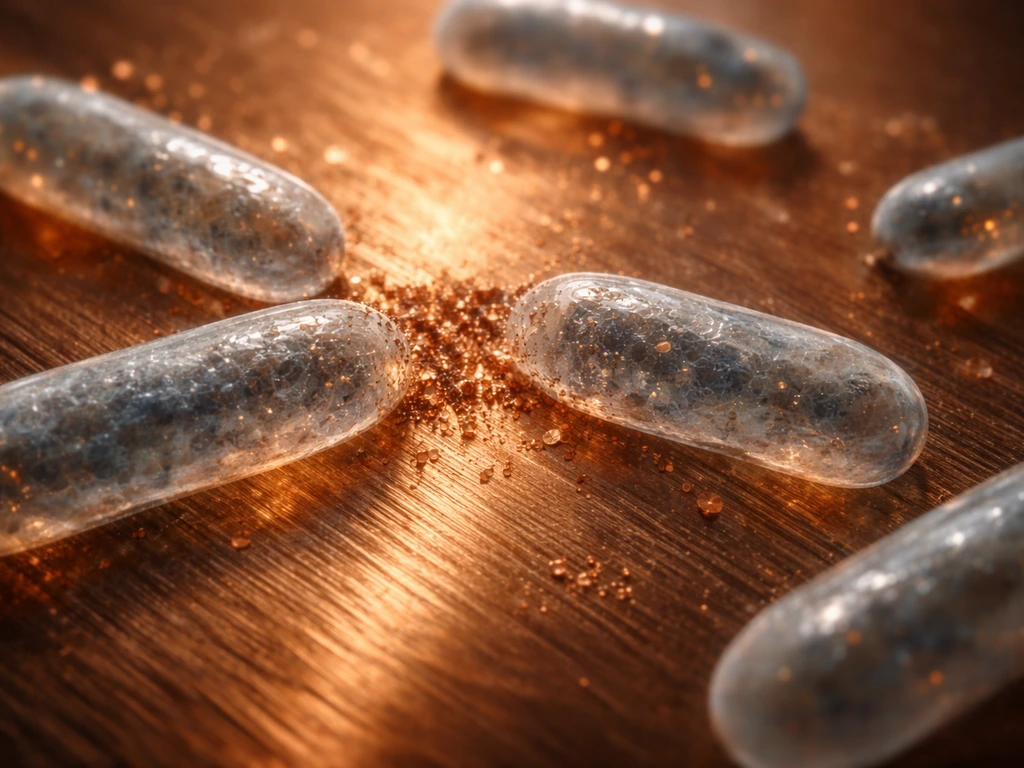
When bacteria land on a copper surface and make direct contact with the metal, a cascade of damage starts almost immediately. Copper ions (Cu+ and Cu2+) attack the bacterial cell membrane, binding to electronegative groups like thiols and carboxyl groups and causing the membrane to rupture. Once the membrane is compromised, copper ions enter the cell and drive oxidative stress through a Fenton-like chemistry reaction, generating reactive oxygen species (ROS) that damage lipids, proteins, and DNA. The result is that the cell's systems fail together, not one at a time, which is part of why bacteria have a hard time developing resistance to copper.
Lab assays confirm this with hard numbers. Studies using 99. 9% pure copper coupons ([C11000 grade](https://pmc. ncbi.
nlm. nih. gov/articles/PMC3028699/)) show rapid loss of viability measured in colony-forming units (CFU), with cells showing intracellular copper loading early in exposure. One study summarized in the PMC article reports that 99%+ pure copper (copper alloy C11000) produced complete killing of E.
coli after 1 minute at 23°C under its experimental conditions, along with rapid early viability decreases [99. 9% pure copper coupons (C11000 grade)](https://pmc. ncbi. nlm.
nih. gov/articles/PMC2258564/). Importantly, surviving cells did not show continued growth on the copper surface during the exposure window. In hospital-relevant alloy studies, copper surfaces delivered what researchers call "continuous kill," meaning bacteria on copper kept dying with repeated inoculations, while bacteria on stainless steel continued to survive and accumulate.
That contrast is the practical takeaway: copper is actively hostile to bacterial growth, not just neutral.
Growth vs. survival: there is a difference worth understanding
"Growth" in microbiology means cells are dividing and the population is increasing. "Survival" means cells are still viable but not multiplying. "Killing" means viable counts are dropping. On copper, the direction is toward killing, not growth. But survival for a limited time is possible, especially when conditions slow copper's action down. The same idea applies to cold surfaces, but you can still ask, can bacteria grow on ice when moisture is present bacteria can grow on ice.
In the timeframes studied in dry copper contact assays, exposure windows of up to roughly three hours showed progressive viability loss, not regrowth. For specific pathogens like Salmonella enterica and Campylobacter jejuni, CFU reductions progressed over four to eight hours depending on conditions, which means early in the window a small number of cells might still be recoverable even though the trend is firmly downward. This is not the same as growth. It just means copper kills bacteria over time rather than instantaneously, and the rate depends on the variables below.
The four factors that change how well copper performs
Moisture and water film
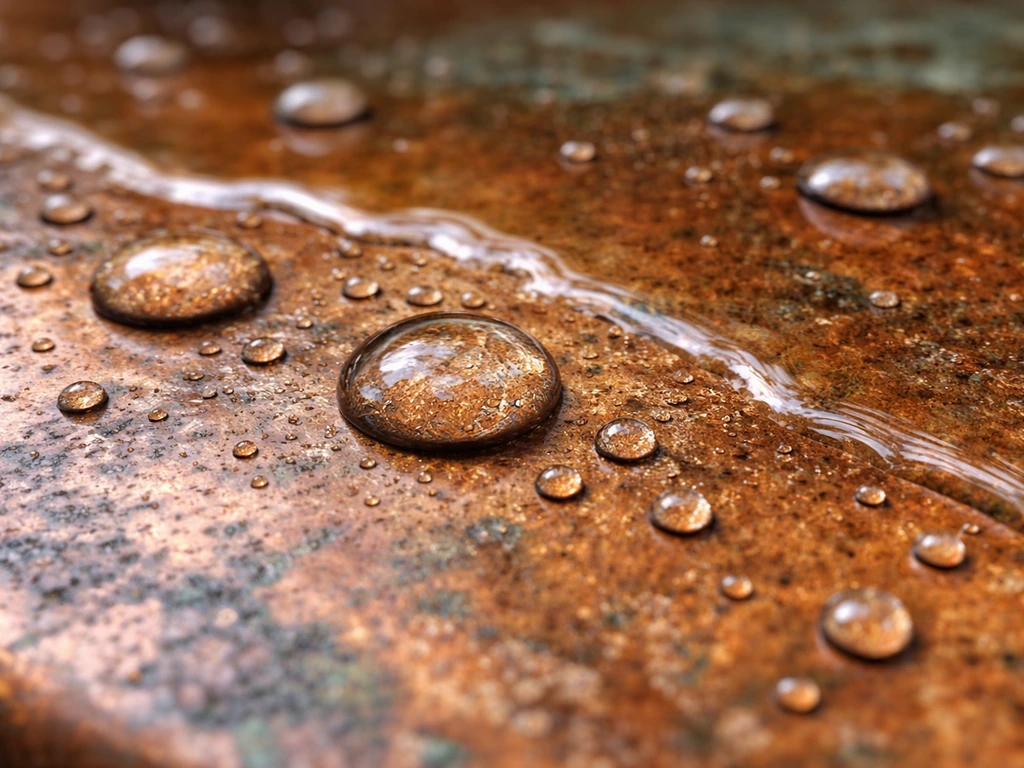
Moisture is the biggest variable. Wet inocula consistently allow longer bacterial survival on copper compared with dry inocula. When there is a water film on the surface, it dilutes copper ion concentration at the point of contact and physically separates bacteria from the metal. Research on E. coli and other organisms has shown that reducing inoculum moisture substantially decreases survival time. This is also why copper performs better as a surface dries out and why a wet copper kitchen sink or tray that stays chronically moist will not self-sanitize nearly as reliably as a dry copper surface.
Temperature
Higher temperatures generally accelerate copper-mediated killing because chemical reaction rates increase with temperature. Conversely, cooler environments slow the kill kinetics. This matters for real-world settings like refrigeration, where food is stored at temperatures that already slow bacterial growth broadly, so copper's slower kill rate at low temperatures is less of a concern for food safety purposes. Where it matters more is in ambient or warm conditions where bacteria would otherwise grow rapidly.
Organic residue and food soils
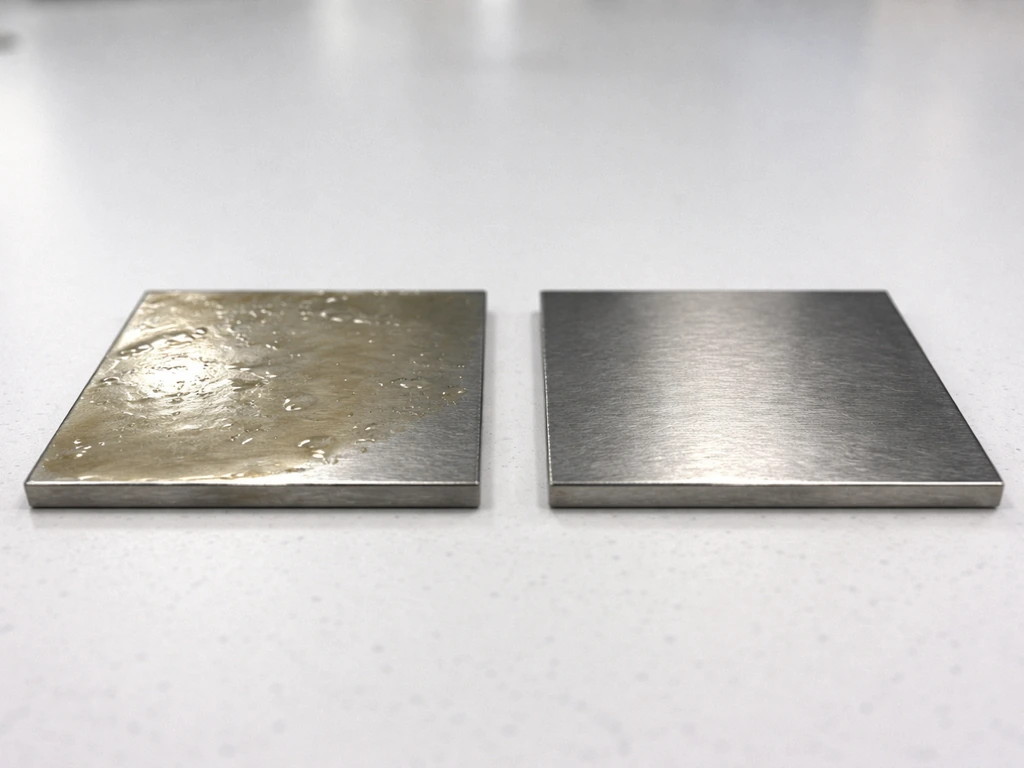
This is the factor most relevant to food safety. If bacteria are sitting in a layer of food soil, grease, protein, or biofilm, they are physically shielded from direct copper contact. Research demonstrates clearly that contact killing is suppressed when direct bacteria-to-metal contact is prevented. That means a copper tray or prep surface covered in food residue can still harbor viable bacteria, not because copper is failing, but because the bacteria never actually touch the copper. Cleaning the surface is not optional. Organic load blocks the mechanism entirely.
Oxygen and surface condition
Copper's ROS-generating mechanism involves redox cycling, so oxygen availability plays a role in how copper generates the reactive species that damage bacterial cells. Surface condition also matters: a heavily oxidized or patinated copper surface, or one coated with corrosion products, behaves differently from fresh polished copper. A green patina layer can reduce direct metal contact and slow ion release. Studies on copper corrosion rates and moisture content show that the local microenvironment at the surface (corrosion products, pH, humidity) influences how copper ions are released and therefore how effectively bacteria are inactivated.
Pure copper vs. alloys, and what patina and residue do in practice
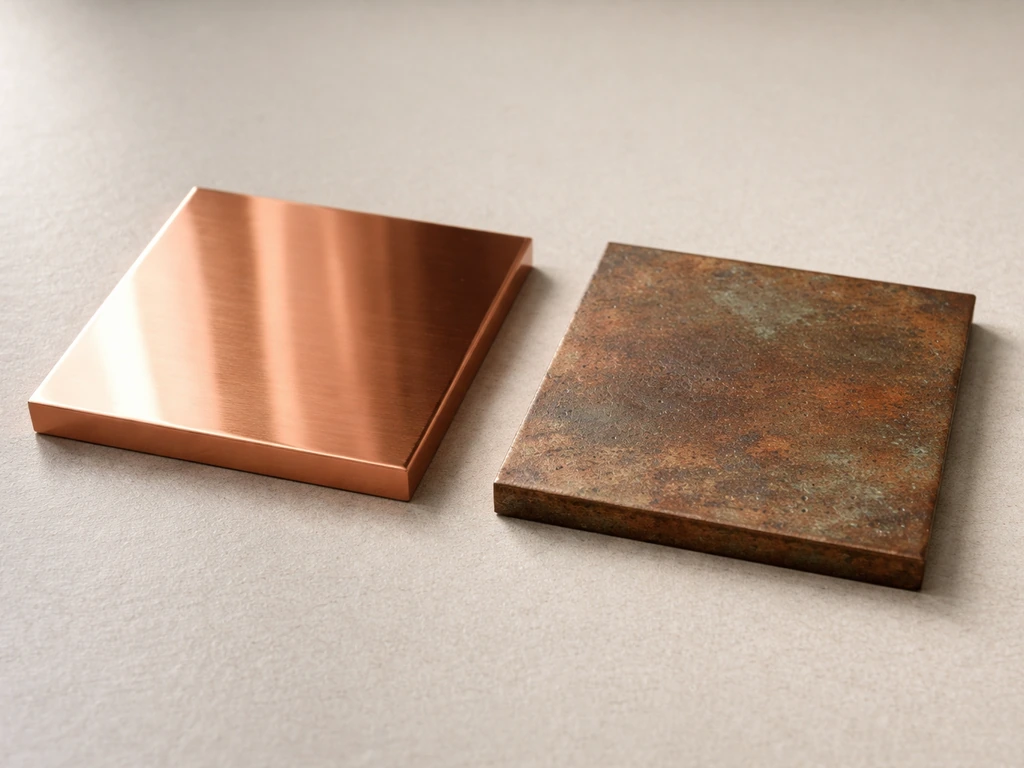
Not all copper surfaces are equal. Pure metallic copper (like C11000 at 99.9% Cu) performs best. Copper alloys work too, but effectiveness depends directly on copper content. In comparative studies on Acinetobacter species, pure copper was most effective, followed by tin bronze, with brass and nickel silver performing weakest. A brass surface with 60% copper content required longer contact times to achieve full inactivation of E. coli compared with higher-copper alloys. If you are evaluating a copper surface product and antimicrobial performance matters, check the actual copper percentage, not just whether the word "copper" appears in the product name.
| Surface Type | Approximate Cu Content | Relative Kill Speed | Practical Notes |
|---|---|---|---|
| Pure copper (C11000) | 99.9% | Fastest | Best antimicrobial performance; still needs cleaning |
| Tin bronze | ~90% Cu | Fast | Good performance, more durable than pure copper |
| Brass (high-Cu) | ~70-85% Cu | Moderate | Common in fixtures; still antimicrobial but slower |
| Brass (low-Cu) | ~60% Cu | Slower | Noticeably reduced efficacy; longer contact times needed |
| Nickel silver | Variable, often low | Weakest among alloys | Least reliable for antimicrobial purposes |
| Copper-impregnated materials | Varies widely | Variable | Depends heavily on copper availability at surface |
Patina is a real-world complication. A thick patina (the greenish-blue copper carbonate layer that forms on aged copper) reduces the amount of free copper at the surface available for ion release and direct contact. For decorative copper that has not been maintained, antimicrobial performance is likely reduced compared with a clean, polished surface. If you are relying on copper for any antimicrobial function, keeping the surface clean and reasonably polished is not just aesthetics. It is part of making the chemistry work.
What copper can and cannot replace in food safety and cleaning
Copper's antimicrobial properties are real and well-documented, but they come with firm limits. If you are wondering whether port wine stains grow over time, that is a separate condition with different underlying biology than how copper affects bacteria do port wine stains grow. The EPA registers copper alloy surfaces as residual-use antimicrobial products, meaning they are designed to supplement routine cleaning and disinfection, not replace it. That language is deliberate. Copper does not remove physical contamination, does not clean biofilm once it is established, and does not work through layers of food soil.
The FDA Food Code includes a specific section on copper use limitations as a food-contact surface material. Copper and copper alloys can react with certain acidic foods (like tomatoes, vinegar-based products, and acidic beverages), leaching copper ions into the food at levels that can be harmful. Whether bacteria can grow in soda depends on factors like sugar content, pH, and preservatives, rather than copper killing effects discussed elsewhere can bacteria grow in soda.
This is why copper-lined cookware intended for food contact is usually lined with tin or stainless steel, and why raw copper surfaces are not generally approved for direct contact with most foods in commercial food service. If you work in food service, the relevant question is not just "does copper kill bacteria" but "is this surface approved for this food contact application. " Those are different questions.
- Copper can reduce bacterial bioburden on touch surfaces between cleaning cycles
- Copper cannot clean itself of organic residue or food soils
- Copper does not work through layers of grease, protein, or biofilm
- Copper is not approved for direct contact with acidic foods under standard food codes
- Copper surfaces still require regular cleaning for effective performance
- Copper alloy content directly affects how well antimicrobial properties work
The comparison to other surface materials is instructive here. Unlike wood cutting boards, where bacteria can physically migrate into surface cracks and be protected from sanitizers, copper surfaces kill bacteria on contact rather than harboring them. Similarly, fabric like linen is porous and does not behave like copper surfaces, so it is a different situation for bacterial growth. But unlike stainless steel, which is inert and fully approved for most food-contact applications, copper has both benefits and chemical reactivity that limit where it can be used. Knowing which category a surface falls into matters more than looking for a single material that "solves" contamination.
How to verify copper's performance for your specific situation
If you are a food safety professional or researcher who needs to verify how a specific copper surface is actually performing, the EPA has published a formal protocol for evaluating bactericidal activity of hard, non-porous copper-containing surface products. The framework uses log10 reduction (LR) of viable bacteria as the performance metric, with defined pass/fail thresholds for antimicrobial registration claims. This is the standard testing approach for anyone making or evaluating formal efficacy claims.
For repeated-use or residual-effect scenarios, the EPA's continuous reduction test method is the right framework. It uses repeated inoculation challenges over time rather than a single contact test, which maps better to real-world conditions where surfaces are re-contaminated regularly. If you are designing a validation study for a copper surface in a healthcare or food processing context, that repeated-challenge design will tell you more than a one-time coupon assay.
For a simpler decision framework, ask three questions before relying on copper for any antimicrobial function in your workflow. First: what is the copper content of the alloy? Lower copper content means slower or weaker killing. Second: is the surface kept clean of organic residue?
If not, contact killing is blocked. Third: does the surface stay wet or dry in normal use? Chronically wet copper surfaces perform less reliably than surfaces that dry between uses. If all three conditions are favorable (high copper content, clean surface, dry conditions), copper's antimicrobial properties are real and meaningful.
Even though copper surfaces can be antimicrobial, you still should not assume that bacteria can grow on linen will be prevented without proper cleaning and hygiene practices bacteria grow on linen. If any of those conditions are consistently not met, copper is not providing the protection you might assume it is.
One practical note on testing: if you recover bacteria from a copper surface in a lab or field test, make sure the recovery protocol includes EDTA or a similar copper-chelating agent in the buffer. Without it, copper ions continue damaging cells after you remove them from the surface, which artificially inflates your apparent kill number. This is a known issue in copper surface assays and worth flagging if you are reviewing or designing any test of copper antimicrobial performance.
FAQ
If copper kills bacteria, can I skip regular cleaning and disinfection on copper surfaces?
No. Copper can suppress and kill bacteria, but it is not a substitute for removing food or grime and then applying an appropriate disinfectant. Copper mainly helps with microbes that directly touch the metal, so residues and biofilm can keep cells away from effective contact killing.
How does moisture level change whether bacteria survive on copper?
If a copper surface stays wet, bacteria can persist longer because the water film can physically separate cells from the metal and dilute copper ions at the point of contact. The surface can still be hostile overall, but performance is less reliable than on surfaces that dry between uses.
Does copper prevent re-contamination on contact, or just kill cells that land on it?
Copper can reduce viable counts, but you should not assume it prevents new contamination from being present. If the surface is re-contaminated repeatedly, copper can still deliver “continuous kill,” yet you still need workflow controls (cleaning, touch-point management) to prevent buildup of organic soil.
Why might my lab test show “extra kill” from copper even if the real contact effect is smaller?
Some recovery methods can mislead results. In testing, if you do not neutralize and chelate copper after sampling (for example with EDTA in the recovery buffer), copper ions can keep damaging cells after removal, making copper look more effective than it is.
How can I tell if a “copper” product will work well, for example a copper alloy handle or tray?
It depends on alloy composition. “Copper” products vary widely, and antimicrobial performance generally tracks with the actual copper percentage. Checking the alloy grade or stated copper content matters more than trusting labels that simply include the word “copper.”
Does green patina on copper reduce its ability to kill bacteria?
Patina can reduce effectiveness because it changes what is available for direct metal contact and ion release. If a surface is heavily oxidized or has a thick green patina, antimicrobial performance may be slower compared with a clean, polished surface.
If I can still recover bacteria from copper after a short time, does that mean they grew on it?
Yes, some bacteria can remain recoverable early in an exposure window depending on moisture, temperature, and the organism. That does not mean they are growing on copper, it means the kill trend has not fully eliminated all viable cells yet.
Can I use copper cookware or containers directly with acidic foods like tomatoes or vinegar?
For food-contact use, copper can leach copper ions into acidic foods or beverages, which is a safety and compatibility issue. That is why many copper-lined cookware designs use an approved lining material and why raw copper is often not approved for direct contact with most foods.
What happens if bacteria are embedded in food residue or biofilm on a copper surface?
Copper suppresses growth when conditions allow direct contact, but it does not “clean” existing contamination. If bacteria are protected inside a layer of grease, protein, soil, or an established biofilm, copper chemistry may not reach them effectively, so viable cells can persist.
Is copper less effective in refrigerators or other cold environments?
On cold surfaces or at refrigeration temperatures, copper kill kinetics can slow because chemical reactions proceed more slowly. Food safety risk is still managed primarily by proper temperature control and sanitation, but copper may act more slowly than at room temperature.
Next Article
Do Loofahs Grow Bacteria? Causes and How to Clean Safely
Yes, wet loofahs can grow microbes. Learn why, how fast buildup happens, and step-by-step cleaning, drying, and replacem