Yes, Alcaligenes faecalis can grow on EMB (Eosin Methylene Blue) agar under typical lab incubation conditions (37°C, 18–24 hours, aerobic). Micrococcus luteus can grow on MSA, which is why this medium is commonly used to screen for salt-tolerant staphylococci does micrococcus luteus grow on msa. What it will not do is produce the classic metallic green sheen or dark-centered colonies you associate with E. coli or other strong lactose fermenters. Expect colorless, translucent, or pale colonies with no significant dye uptake. That result is easy to misread as contamination or a failed plate, but it actually makes sense once you understand what EMB is doing and what Alcaligenes faecalis is.
Does Alcaligenes faecalis Grow on EMB Agar? Expected Results

Marcus Reeves
2 Jul 2026
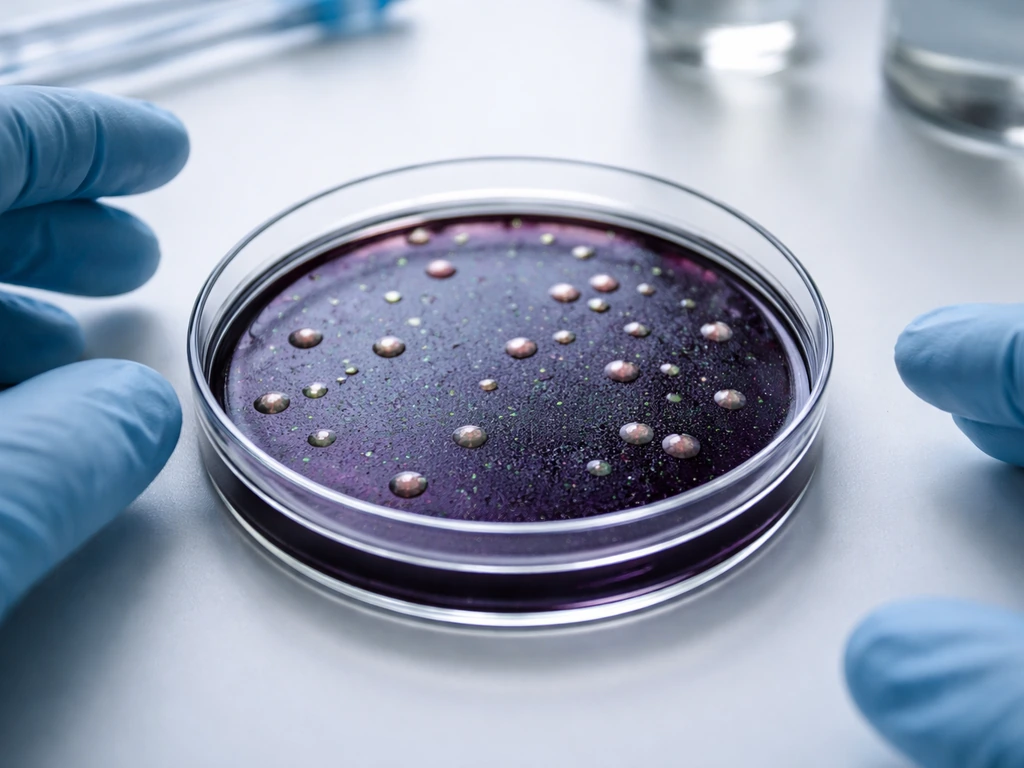
What Alcaligenes faecalis is and why you'd test it on EMB
Alcaligenes faecalis is a Gram-negative, obligately aerobic, non-glucose-fermenting rod found in soil, water, and clinical environments. It is oxidase positive, catalase positive, indole negative, and urease negative. It grows comfortably in the mesophilic range, with an optimum somewhere between 20 and 37°C. Because it lacks pigmentation and does not ferment common sugars, it tends to look unremarkable on most differential media.
The reason you might plate it on EMB is straightforward: EMB is a common first-pass screen in clinical and food microbiology labs. When you isolate an unknown Gram-negative from a clinical sample, water source, or food matrix, EMB is often one of the first plates in the workflow. If A. faecalis shows up in that sample, it will land on EMB whether you expected it or not. Knowing what it looks like there saves you from chasing a false lead or discarding a real isolate.
What EMB agar actually does
EMB (Levine formulation) contains peptone, lactose, eosin Y, and methylene blue, with a final pH of 7. The EMB (Levine) TDS notes that the medium uses lactose and sucrose for differential fermentation with eosin Y and methylene blue dyes, supporting its use for teaching and clinical-style coliform or enteric isolation contexts EMB (Levine) contains peptone, lactose, eosin Y, and methylene blue. 1 ± 0.2. Some formulations also add sucrose for broader differential utility. The medium works on two levels simultaneously: it is selective and it is differential.
The selective part
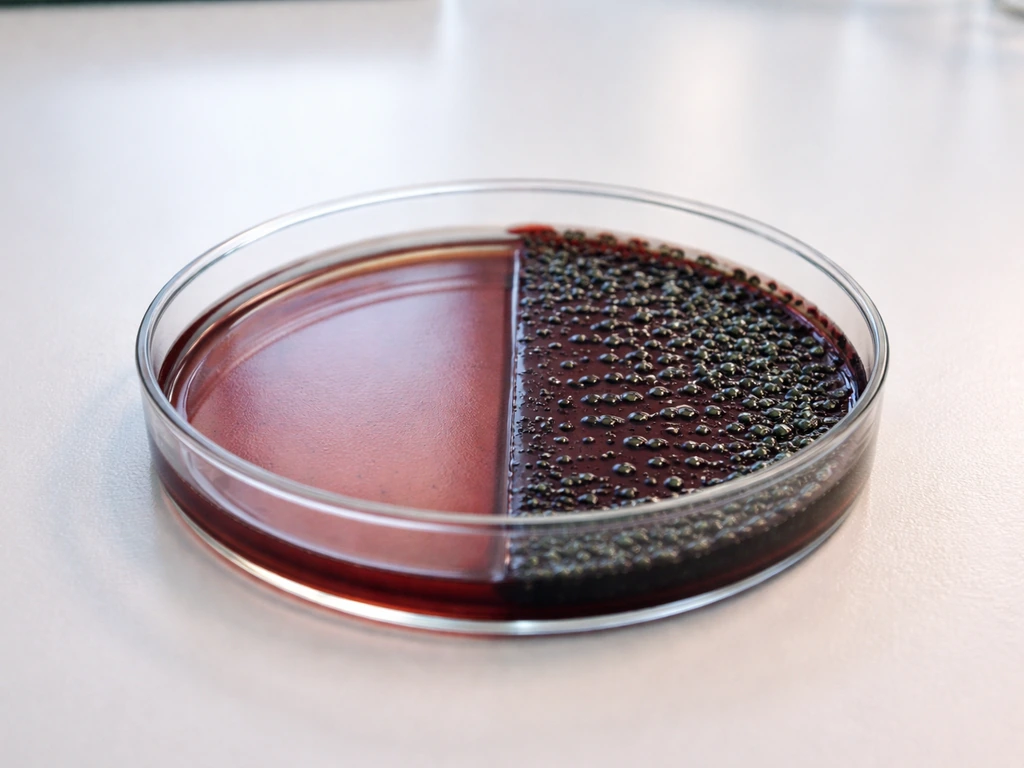
The two dyes, eosin Y and methylene blue, inhibit Gram-positive organisms. That is why Enterococcus faecalis is listed as inhibited (0% recovery) on standard EMB quality control tables. The medium is therefore designed to let Gram-negative organisms through while blocking most Gram-positive interference.
The differential part
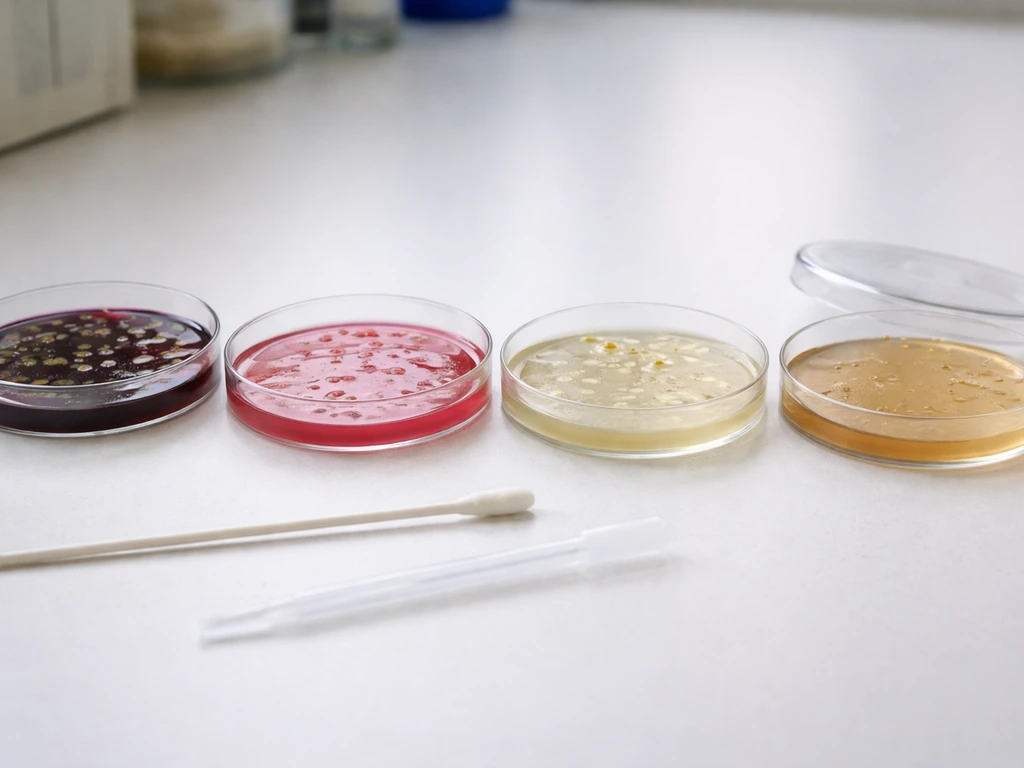
Differentiation is driven by lactose fermentation. When an organism ferments lactose, it produces acid. That local drop in pH causes eosin Y and methylene blue to combine and precipitate as a dark dye complex inside the colony. Strong acid producers like E. coli generate enough acidity to produce the dramatic metallic green sheen (due to light refraction off the dense dye precipitate). Weaker fermenters produce pink or purple-brown colonies without any sheen. Non-fermenters, which do not acidify the medium at all, do not trigger dye precipitation and appear colorless or translucent.
Does Alcaligenes faecalis grow on EMB: the direct answer
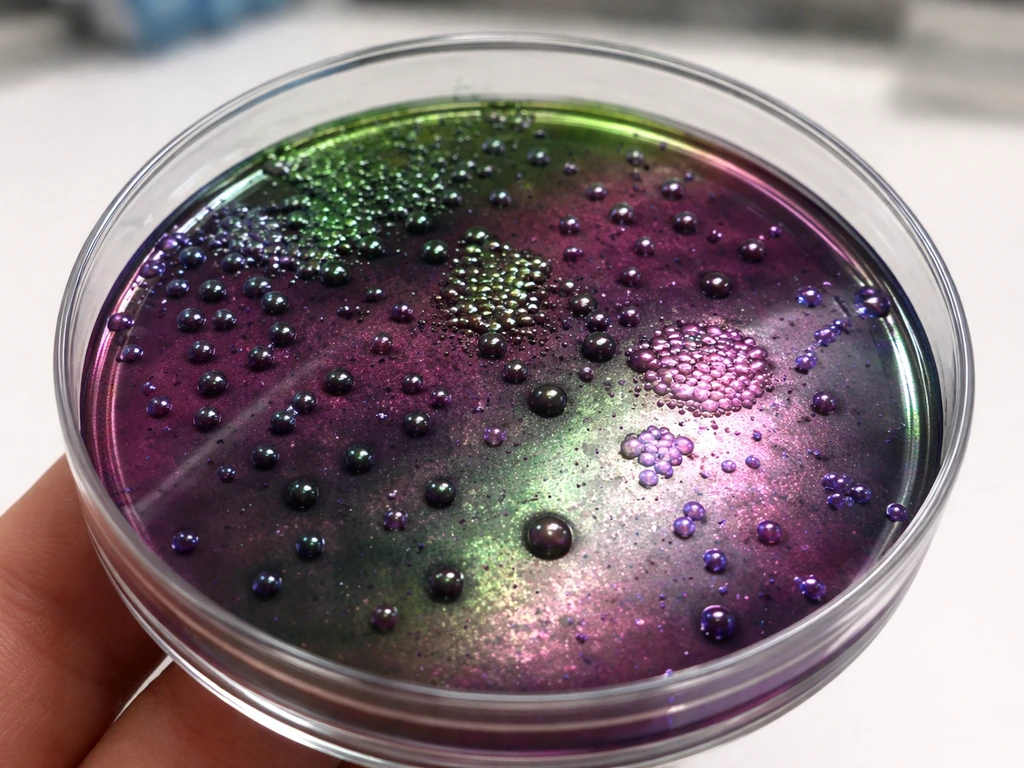
It grows. Published research has described distinct colonies of A. faecalis recovered from EMB plates incubated at 37°C for 24 hours, with those colonies subsequently sub-cultured for pure culture recovery. So EMB does not kill or suppress this organism under standard conditions. The organism is Gram-negative, which means the selective dyes do not block it the way they would a Gram-positive.
What you should not expect is any classic EMB differential reaction. A. faecalis does not ferment lactose or sucrose. Without acid production, the dyes stay in solution rather than precipitating into the colony. The result is colorless or pale, translucent colonies with no metallic sheen and no dark center. Do not mistake this for a negative result. The organism grew. It just does not produce the acid-dependent color reactions EMB was designed to highlight.
Incubation conditions that affect what you see
Getting interpretable results on EMB requires getting the incubation conditions right. Here is what actually matters:
Temperature
A. faecalis has an optimum growth range of 20–37°C, and ATCC lists a growth temperature of 30°C for the type strain. Standard EMB incubation at 35–37°C sits right at the top of that range but is workable. You may see slightly slower or smaller colony development compared to a true enteric like E. coli. If your lab incubates at 35°C rather than 37°C, that is fine and may actually produce slightly more robust colonies.
Time
Standard EMB reads are 18–24 hours. HiMedia's quality control guidelines allow up to 48 hours. For A. faecalis, reading at 24 hours is appropriate. Extended incubation beyond 48 hours can alter colony appearance on EMB for any organism because dye diffusion and colony spreading change the picture. One practical issue worth knowing: on Reddit microbiology threads, extended incubation (24h vs 48h) is a common source of confusion when colony color or sheen changes between reads. Stick to the 24-hour window as your primary read point.
Oxygen
This one matters more for A. faecalis than it does for most organisms you would routinely test on EMB. A. faecalis is an obligate aerobe. It requires oxygen and will not grow under anaerobic conditions. Standard aerobic incubation (no modifications needed) is correct. If your incubator runs CO2-enriched conditions or anaerobic conditions, expect no growth or severely reduced growth. This is not an EMB failure; it is an oxygen problem.
pH
EMB is formulated at pH 7.1 ± 0.2, which is neutral and well within the range A. faecalis tolerates. The pH of the medium itself is not a growth obstacle. The pH dynamics that matter on EMB are local, driven by whether the growing organism acidifies its immediate microenvironment through fermentation. Since A. faecalis does not ferment lactose, the medium pH around its colonies stays close to neutral, and the dyes remain unreacted.
Reading the plate correctly and avoiding false conclusions
The biggest interpretive trap on EMB is treating all colorless or pink growth as "non-significant" and dark/metallic growth as the only meaningful result. That mindset works when you are screening specifically for E. coli or coliforms, but it breaks down when your sample could contain non-enteric Gram-negatives like A. Although focused on colistin-resistant Acinetobacter baumannii, this study supports that methylene blue and eosin methylene blue agar formulations can exert antimicrobial or selective effects, which can help explain why some non-target Gram-negatives show poor growth or atypical colony development non-enteric Gram-negatives like A. faecalis may show poor growth or atypical colony development. faecalis.
Here is how to read EMB plates in a way that does not lead you astray:
| Colony appearance on EMB | What it suggests | Next step |
|---|---|---|
| Dark center with metallic green sheen | Strong acid producer (e.g., E. coli) | Confirm with oxidase, indole, IMViC |
| Pink or purple-brown, no sheen | Weak lactose fermenter (e.g., Klebsiella) | Confirm with lactose fermentation and biochemicals |
| Colorless or translucent, no dye reaction | Non-fermenter (could be A. faecalis, Pseudomonas, others) | Oxidase, catalase, TSI, non-fermenter panel |
| No growth | Gram-positive organism, inhibited non-target, or conditions issue | Check organism type, incubation, and plate quality |
If you see colorless or translucent colonies on EMB and your Gram stain confirms Gram-negative rods, do not discard the plate. You are looking at a potential non-fermenter. A. faecalis is one candidate, but Pseudomonas, Acinetobacter, and other non-glucose fermenters can also appear this way. The EMB plate alone cannot tell you which one it is.
Also worth knowing: even organisms that should produce metallic sheen do not always do so. Thermo Fisher's own EMB documentation warns that E. coli does not always produce a green metallic sheen, and that the sheen alone is not sufficient for identification. This means you should treat EMB results as a starting point, not a final answer, for any organism.
What to do when growth looks atypical or absent
If your EMB plate does not give you a clear result, the right move is confirmatory testing, not a repeat plate. Here is the pathway that makes sense for a suspected A. faecalis isolate:
Biochemical confirmatory tests
A. faecalis has a reliable and fairly distinctive biochemical fingerprint. Oxidase positive and catalase positive results immediately separate it from Enterobacteriaceae, which are oxidase negative. From there, indole negative and urease negative results help narrow the field. On TSI agar, expect alkaline slant and alkaline or neutral butt (K/K or K/NC), with no gas and no H2S. That pattern is consistent with a non-glucose fermenter, which is exactly what A. faecalis is.
Alternative and complementary media
If EMB is giving you ambiguous results, these alternatives are worth running in parallel: MSA, unlike EMB, is designed to select for staphylococci, so you would only expect staphylococcal growth if Staphylococcus species are present.
- MacConkey agar: Another lactose-based differential medium that uses neutral red as the indicator rather than EMB dyes. Non-fermenters like A. faecalis will appear as colorless colonies (no acid, no pink/red color change). It confirms the non-fermenter classification through a different dye system.
- Blood agar (BA): A. faecalis produces alpha-hemolysis on blood agar, which is a useful morphological marker when confirming identity from a non-selective base medium.
- Nutrient agar or tryptic soy agar: Non-selective media confirm the organism can grow without any dye inhibition and let you observe true colony morphology (typically small, opaque, unpigmented).
- Non-fermenter identification panels: Commercial systems like API 20NE or Vitek 2 NF card are designed specifically for non-glucose fermenters and will give a reliable species-level ID when EMB alone is insufficient.
UK Standards for Microbiology Investigations guidance reinforces this point directly: for organisms that do not match typical enteric EMB patterns, the correct pathway is an oxidase-positive, non-fermenter identification route rather than continuing to interpret a differential enteric medium.
This is broadly the same logic that applies to other organisms on selective media. The question of whether organisms like Serratia marcescens behave predictably on EMB, or how organisms like Bacillus subtilis respond on MSA, all follow the same principle: selective media are designed for specific organism categories, and organisms outside that category require a different interpretive approach. In a similar way, you can check whether Bacillus subtilis grows on MSA by comparing its expected growth behavior to the selective mannitol fermentation reactions MSA is designed to highlight.
Practical troubleshooting checklist for your EMB plate
Use this checklist when your EMB result does not match what you expected:
- Confirm incubation temperature: Was the plate incubated aerobically at 35–37°C? A. faecalis is an obligate aerobe; anaerobic or CO2-only conditions will suppress or eliminate growth.
- Check incubation time: Read the plate at 24 hours as your primary time point. Beyond 48 hours, colony appearances on EMB can shift and create interpretive confusion.
- No growth at all: If a Gram-negative is not growing, verify the organism is not being suppressed by the dyes. Also confirm the plate was not expired, dried out, or improperly stored (EMB plates are light-sensitive and should be stored in the dark at 2–8°C).
- Colorless or translucent colonies with Gram-negative rods: This is the expected A. faecalis appearance. Do not discard. Run oxidase test immediately. Oxidase positive + catalase positive + Gram-negative rod = proceed to non-fermenter pathway.
- Pink or purple colonies where you expected colorless: Consider whether a weak lactose fermenter contaminated the plate, or whether a mixed culture was inoculated. Subculture to isolation and retest.
- Metallic sheen on colonies you think might be A. faecalis: This would be unusual. A. faecalis does not ferment lactose and should not generate the acid needed for metallic sheen. Recheck your Gram stain and run oxidase. If oxidase negative, suspect a coliform contaminant.
- Ambiguous colony morphology: Subculture from the EMB plate to a non-selective medium for pure culture recovery, then run the full biochemical panel (oxidase, catalase, TSI, indole, urease) before drawing conclusions.
- Need species-level confirmation: Use a commercial non-fermenter ID system (API 20NE, Vitek 2 NF) or molecular identification (16S rRNA sequencing) if biochemicals alone are inconclusive.
FAQ
If Alcaligenes faecalis grows on EMB, what colony appearance should I expect?
Yes, but it is typically “non-differential” growth. Expect colorless, translucent, or pale colonies with minimal or no dye precipitation, and usually no dark center or metallic sheen because A. faecalis does not acidify the EMB microenvironment via lactose or sucrose fermentation.
Can I identify A. faecalis just by how colonies look on EMB?
Not reliably. EMB can show the same near-colorless outcome for multiple non-lactose-fermenting Gram-negative rods (for example Pseudomonas and Acinetobacter), so you cannot identify A. faecalis from EMB color alone. Use it as a screening signal, then confirm biochemically.
Why might my plate show no colonies if I inoculated A. faecalis on EMB?
If you incubate anaerobically or in otherwise oxygen-restricted conditions, you may see no growth or very weak growth, even though EMB itself is fine. Because A. faecalis is an obligate aerobe, oxygen availability is usually the first variable to check.
Does packaging or incubation atmosphere (sealed plates, stacking, CO2) affect growth on EMB for A. faecalis?
Yes, oxygen demand can be affected by plate handling. If the plate is sealed too tightly, heavily loaded with inoculum, or incubated in a manner that limits gas exchange, growth can be reduced or patchy. In routine workflows, standard aerobic incubation without special atmospheres is the expectation.
What read time should I use for EMB when I suspect A. faecalis?
Yes, but interpret reads carefully. A 24-hour read is usually the most consistent point for A. faecalis on EMB. Extending incubation can change how much the dye diffuses and how colony edges look, which may make pale colonies appear slightly darker without adding a true fermentation-based EMB reaction.
If I see colorless colonies on EMB, can I assume the plate failed or the organism didn’t grow?
Do not treat colorless growth as a negative result. If Gram stain shows Gram-negative rods and colonies are present, you should proceed with confirmatory testing (oxidase and catalase, then indole and urease, plus a non-glucose fermenter pattern on TSI).
What is the most common mistake when interpreting EMB results with suspected A. faecalis?
A common mismatch is expecting “classic” EMB reactions. If your sample contains non-enteric Gram-negatives, EMB will not give the lactose-based metallic sheen or dark-centered look. In those cases, the correct approach is confirmatory ID rather than re-optimizing EMB interpretation.
What should I do next if my EMB result is unclear for A. faecalis?
If EMB is ambiguous, running confirmatory tests is usually better than repeating the plate. For suspected A. faecalis, oxidase and catalase positivity help separate it from many Enterobacteriaceae, and non-glucose fermenter behavior on carbohydrate media supports the ID pathway.
Why would I run MSA alongside EMB when suspecting A. faecalis?
Yes, but only if the goal is differential routing. MSA is selective for staphylococci rather than for A. faecalis, so using MSA in parallel can clarify whether staphylococci are also present in the sample. It should not be used as a direct confirmation for A. faecalis.
How does incubator temperature (for example 30°C vs 37°C) change EMB results for A. faecalis?
If your incubator temperature is lower than typical enteric conditions, A. faecalis may grow more slowly and colonies can be smaller at early reads. Since A. faecalis can grow across a broad mesophilic range, a slight slowdown is more likely than total failure, but you still need an appropriate read window.
Next Article
Can Bacteria Grow in Apple Cider Vinegar? Safety, Risks & Limits
Can bacteria grow in apple cider vinegar? Causes, acid-tolerant microbes, safety thresholds and storage tips.