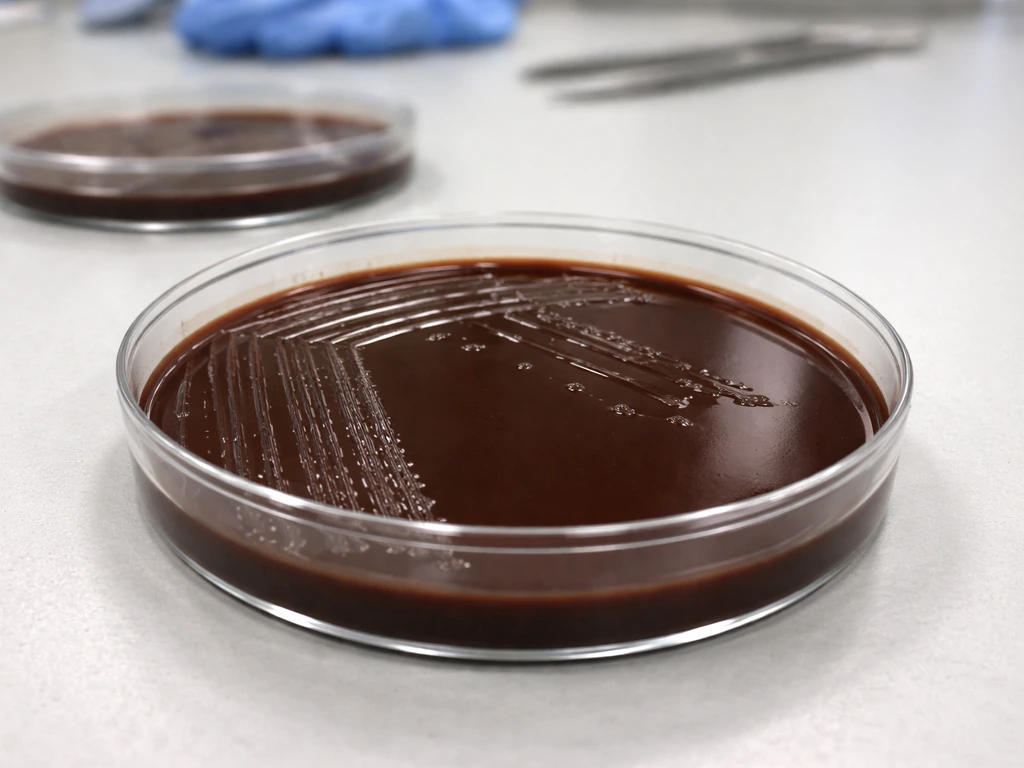
Yes, Haemophilus influenzae grows on chocolate agar, and it actually grows better on chocolate agar than on regular blood agar. On plain or regular blood agar, H. influenzae usually does not grow well unless NAD and related factor conditions are provided, which helps explain the more reliable chocolate agar approach does haemophilus influenzae grow on blood agar. Chocolate agar is considered the medium of choice for isolating H. influenzae because the heating process used to make it releases hemin (factor X) and NAD (factor V) from red blood cells, giving this fastidious organism exactly what it needs to grow. Under the right incubation conditions, you should see small, grayish, dewdrop-like colonies within 24 to 48 hours.
Does Haemophilus influenzae grow on chocolate agar?

Marcus Reeves
6 Jul 2026
Why H. influenzae needs both X and V factors to grow
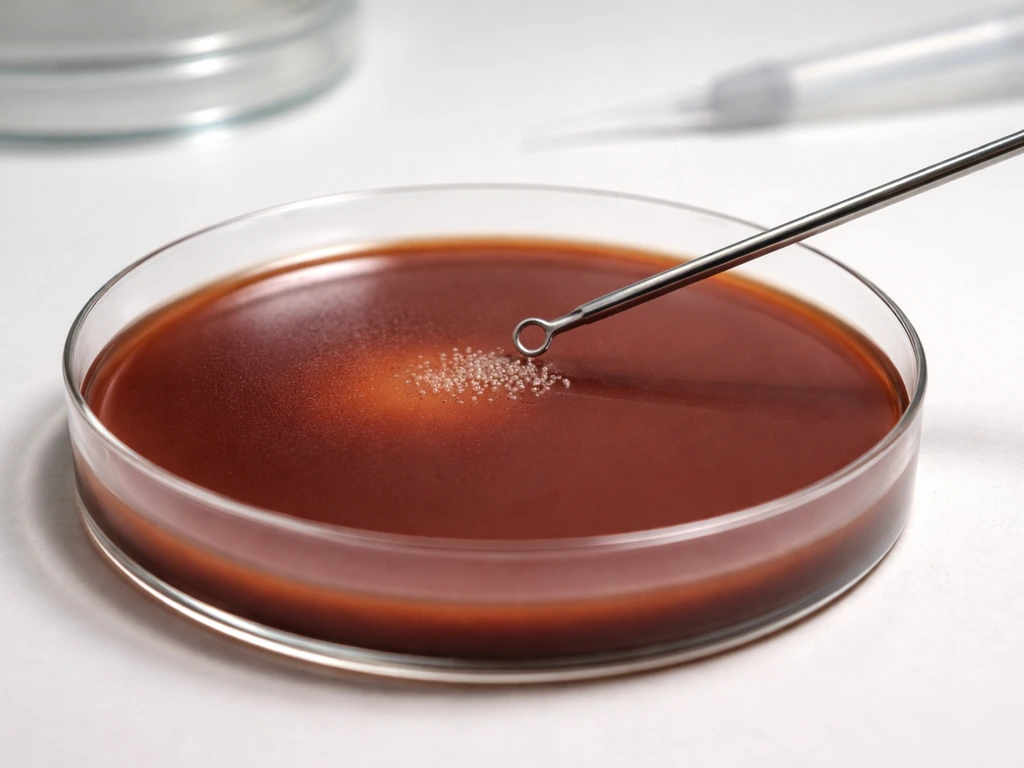
Haemophilus influenzae is what microbiologists call a fastidious organism. It cannot synthesize two specific compounds on its own, so it must get them from the growth medium. Those two compounds are hemin (called factor X) and nicotinamide adenine dinucleotide or NAD (called factor V). Without both factors present simultaneously and accessible in the medium, H. influenzae simply will not grow, regardless of how well everything else is set up.
Factor X (hemin) is an iron-containing porphyrin that H. influenzae uses for its respiratory enzyme systems. Factor V (NAD) is an intracellular cofactor involved in oxidation-reduction reactions. Both are found inside red blood cells, but the tricky part is getting them out and keeping them stable in the medium. Concentrations around 10 micrograms per mL of each factor are generally sufficient to support growth.
This is also why the satellitism phenomenon exists on regular blood agar plates. If you streak H. influenzae on sheep blood agar and also streak Staphylococcus aureus nearby, the staph produces enough NAD as a byproduct that H. influenzae colonies will appear as tiny satellite colonies growing close to the staph streak. It is a useful confirmatory trick and a good reminder that V factor availability is the limiting issue on plain blood agar.
How chocolate agar preparation determines whether growth happens
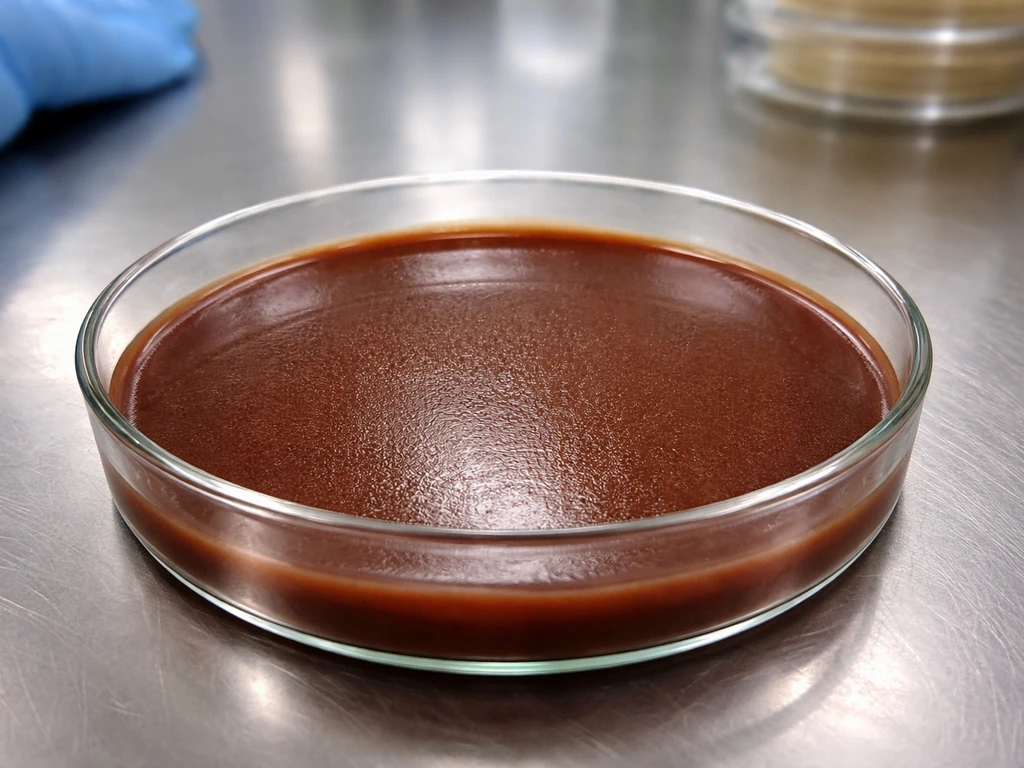
Chocolate agar gets its name from its brown color, which comes from lysed red blood cells. The key step in making it is adding defibrinated blood (typically horse blood) to a warm agar base held above 60°C, then gently mixing for 15 to 20 minutes. That heat treatment lyses the red blood cells and releases both hemin and NAD into the medium, making them freely available for H. influenzae to use. This is fundamentally different from regular blood agar, where the cells remain intact and the factors stay locked inside.
The blood source matters. Horse blood is the standard recommendation because it provides reliable amounts of both factors and lacks the NADase activity that can degrade V factor. NAD is susceptible to NADase enzymes, which is one reason why blood agar using other blood sources can be an unreliable V factor source. Even on properly made chocolate agar, V factor degrades over time, which is why plate freshness is critical.
Preparation temperature is also important. If you add blood to agar that is too hot (above about 80°C), you can destroy the factors before they are even incorporated. If the agar is too cool when you add the blood, you will not get adequate lysis. The window around 70°C to 80°C is where lysis happens effectively without destroying the factors you need.
Pre-made commercial chocolate agar plates, like those from major suppliers, have a shelf life of approximately 12 weeks when stored at 2°C to 8°C in their original sealed packaging. Thermo Fisher’s chocolate sensitivity specification also lists a 12-week shelf life for chocolate agar plates stored at 2°C to 8°C in the original packaging 12-week shelf life for its chocolate agar plates. Once you open and use them, factor activity, especially V factor, begins to decline. Plates stored outside the refrigerator or past their expiration date are a very common and underappreciated reason for failed H. influenzae cultures.
Getting the incubation conditions right
Even with perfect chocolate agar, H. influenzae will not grow well without the right atmosphere and temperature. The standard incubation conditions are 35°C to 37°C with 5% CO2 for 18 to 24 hours. A candle jar is an acceptable field alternative that generates approximately 3% CO2, but a calibrated CO2 incubator is more reliable for consistent results. Humidity matters too, ideally above 80%, to prevent the plates from drying out during incubation.
The CO2 requirement is not optional. H. influenzae is capnophilic, meaning it grows better in elevated CO2. Incubating in ambient air without CO2 enrichment is one of the more common procedural errors that leads to poor or absent growth. If your lab uses a standard non-CO2 incubator for everything, that alone could explain why you are not seeing colonies.
What to expect when you read the plate
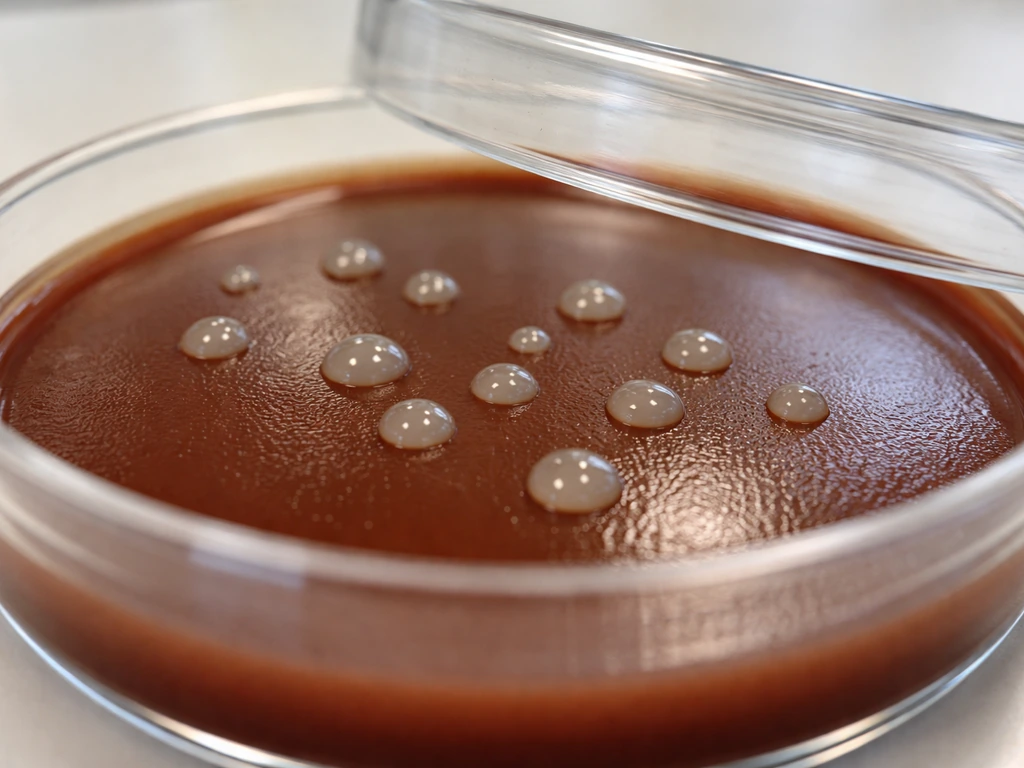
H. influenzae colonies on chocolate agar are small, smooth, grayish, and slightly translucent. They are often described as resembling tiny dewdrops. After 24 hours at 37°C in 5% CO2, colonies should be visible, though some strains may need a full 48 hours to develop to a size that is easy to read. Encapsulated strains, including type b (Hib), tend to produce slightly larger, more mucoid-appearing colonies compared to non-typeable strains.
No hemolysis occurs on chocolate agar because the blood is already lysed during preparation. This is actually a useful distinguishing point. On regular blood agar, H. influenzae does not produce hemolysis either, but the satellite colony pattern around S. aureus is the tell. On chocolate agar, you should simply see colonies directly, without any hemolytic halo.
If you need to confirm that what you have is H. influenzae, factor disc testing is the standard next step. You streak your isolate on a nutrient agar base that contains no X or V factors, then apply paper discs for X factor alone, V factor alone, and X plus V together. H. influenzae will only grow around the disc that supplies both X and V together. This definitively confirms the factor requirements and rules out other Haemophilus species, some of which need only one factor or neither. It is worth noting that other organisms like Neisseria species also grow on chocolate agar, so confirmation matters when identification is important.
No growth on chocolate agar: how to troubleshoot it
If you are not seeing growth, work through this checklist systematically before concluding the organism is absent.
- Check the plate expiration date and storage conditions first. Plates stored at room temperature or past 12 weeks from manufacture may have degraded V factor. This is the most common culprit.
- Verify your incubation atmosphere. Confirm CO2 concentration is at 5% and temperature is 35°C to 37°C. A malfunctioning CO2 incubator or a candle jar that was not sealed properly will kill your results.
- Check incubation time. Read at 24 hours, but do not discard until 48 hours. Some strains are slow growers.
- Evaluate your inoculum. Too light an inoculum can produce no visible growth even on good medium. Use a 0.5 McFarland standard as a baseline for suspension preparation if you are working from a pure culture.
- Run a positive control. Use a known H. influenzae reference strain (ATCC 49247 or ATCC 10211 are commonly used QC strains) on the same batch of plates. If your positive control grows and your clinical isolate does not, the issue is with the specimen or inoculation, not the medium.
- Run a negative control. An uninoculated plate should show no growth and confirm the medium is not contaminated.
- Consider whether the medium was enriched. Standard chocolate agar should suffice, but some labs use supplemented chocolate agar (sometimes called CAP or Chocolate II) with additional growth supplements added. If H. influenzae isolates from clinical specimens are consistently failing on standard chocolate agar, a supplemented version may perform better.
- If you are working from a direct clinical specimen rather than a pure culture, consider whether competing flora, sample quality, or transport conditions could have affected viability.
Chocolate agar vs. blood agar for H. influenzae: a quick comparison
| Feature | Chocolate Agar | Regular Blood Agar |
|---|---|---|
| X factor (hemin) availability | Yes, released by heat lysis of RBCs | Limited, locked inside intact RBCs |
| V factor (NAD) availability | Yes, released by heat lysis; horse blood preferred | Unreliable, degraded by NADase; intracellular |
| H. influenzae direct growth | Yes, reliable growth in 24–48 hours | Weak or none without satellitism |
| Satellitism observation possible | Not applicable | Yes, near S. aureus streaks |
| Recommended for isolation | Yes, medium of choice | No, not reliable for primary isolation |
| Incubation atmosphere needed | 5% CO2, 35–37°C | 5% CO2, 35–37°C (same, but growth still poor) |
If you are choosing between the two for H. influenzae work, chocolate agar wins clearly. Blood agar has its place for observing satellitism and for general culture, but for reliable isolation and colony counting, chocolate agar prepared with horse blood is the right call. Teaching-lab guidance notes that satellitism of H. influenzae on blood agar occurs toward Staphylococcus aureus because H. influenzae needs both X factor (hemin) and V factor (NAD) for growth blank" rel="noopener noreferrer">satellitism and for general culture. That said, running both in parallel is a reasonable practice in clinical labs because satellitism on blood agar can serve as a useful secondary confirmation.
What to do right now if you need a reliable result today
Pull your chocolate agar plates from refrigerated storage (2°C to 8°C) and let them equilibrate to room temperature before inoculation. Inspect the plates: they should be brown, moist, and within their expiration window. Inoculate using standard streaking technique, apply your CO2 atmosphere immediately, and set your incubator to 37°C. Check at 24 hours and again at 48 hours before calling a plate negative.
Always include a positive control run in parallel. This single step tells you immediately whether a negative result is a true negative or a procedural failure. If your positive control does not grow, stop and troubleshoot the medium and incubation setup before reporting anything. CLSI M100 provides current QC standards and acceptable ranges if you need a reference benchmark for your workflow.
The bottom line is straightforward: H. influenzae grows on chocolate agar consistently when the medium is fresh, prepared correctly with lysed blood, and incubated at 37°C in 5% CO2. If you are also trying to culture Staphylococcus aureus, note that its growth behavior on chocolate agar differs from the fastidious hemophilic organisms discussed here. When it does not grow, the problem is almost always one of those three variables.
FAQ
If H. influenzae grows on chocolate agar, does it grow equally well on all chocolate agar brands and recipes?
Not always. Performance depends on factor release and preservation, especially V factor activity. Even among pre-made plates, variations in blood source, lysis efficiency, and storage duration can change growth, so use your lab’s typical QC approach (positive control and known-working plate lot) when results are critical.
How fresh do chocolate agar plates need to be, and how can I tell if they have lost V factor?
Freshness matters because V factor gradually degrades during storage and after opening. Plates should be used within their expiration window and ideally tested with a positive control each day you run H. influenzae, since visual plate appearance (brown, moist) does not reliably indicate factor activity.
Why might I still get no growth even if I used chocolate agar correctly?
The most common causes are wrong CO2 level, incorrect temperature, dried plates, or inoculum issues. H. influenzae is capnophilic, so incubating in ambient air or letting plates dry can completely prevent colonies, even when the medium is otherwise correct.
Does it matter what type of blood was used in the chocolate agar (horse vs sheep, etc.)?
Yes. Horse blood is typically preferred because it provides more reliable factor availability and has less NADase activity that would otherwise degrade V factor. Chocolate agar made with other blood sources can be more inconsistent for growth.
Can I substitute a “non-CO2” incubator if I’m using the right medium?
Usually no. H. influenzae needs elevated CO2 for optimal growth, so an incubator without CO2 enrichment is a frequent reason for false negatives. If you do not have a CO2 incubator, a properly used candle jar can be an alternative, but consistent results require more care and calibration.
What incubation time should I use, and when should I call a plate negative?
Check at about 24 hours and again at 48 hours. Some strains, including those with slower growth characteristics, may not reach readable colony size until the second check, so calling negative at 18 to 24 hours can miss true positives.
Do encapsulated strains (like Hib) look different on chocolate agar?
Often, yes. Encapsulated strains tend to form slightly larger colonies with a more mucoid appearance compared with non-typeable strains. If you are comparing plates, note that colony morphology shifts by strain, not just by medium quality.
How can I confirm H. influenzae if other organisms also grow on chocolate agar?
Do factor disc testing or an equivalent confirmatory method. H. influenzae should grow only where both factors are supplied together (X and V). This also helps distinguish it from other chocolate-agar growers, like Neisseria species, that can otherwise confuse interpretation.
Does H. influenzae produce hemolysis on chocolate agar, and how should I interpret any blood-related appearance?
You should not expect hemolysis on chocolate agar because the blood is already lysed during preparation. If you see hemolysis-like patterns, it suggests an issue with medium preparation or plate quality and can complicate interpretation.
Can I improve reliability by running blood agar and chocolate agar together?
Yes. Using both can help because satellitism on blood agar provides an additional behavioral clue around a Staphylococcus aureus streak, while chocolate agar gives more direct isolation. Running parallel plates can reduce uncertainty when cultures are borderline.
What positive control should I include to ensure the test is not failing procedurally?
Include a known H. influenzae strain that historically grows on your exact medium and incubation setup. The key is that the control uses the same workflow, incubation atmosphere, and plate handling, so a failure tells you the problem is procedural or environmental rather than organism-related.
Next Article
Does Staphylococcus aureus Grow on Chocolate Agar?
Can S. aureus grow on chocolate agar? Get lab-ready expectations, conditions, colony cues, and safer confirmatory next s