
No, E. coli does not grow on cetrimide agar under normal laboratory conditions. Cetrimide agar is a selective medium designed specifically to isolate Pseudomonas aeruginosa, and its active ingredient, cetrimide (a quaternary ammonium compound), inhibits E. coli and most other Enterobacteriaceae at the concentrations used in standard formulations. When you plate E. coli on cetrimide agar with a typical diagnostic inoculum, you should expect no visible growth, or at most a faint trace. That said, there are documented exceptions worth knowing, and understanding why the medium works the way it does makes it much easier to interpret unusual results when they show up.
Can E. coli Grow on Cetrimide Agar? Evidence and Guidance

Marcus Reeves
7 Aug 2026
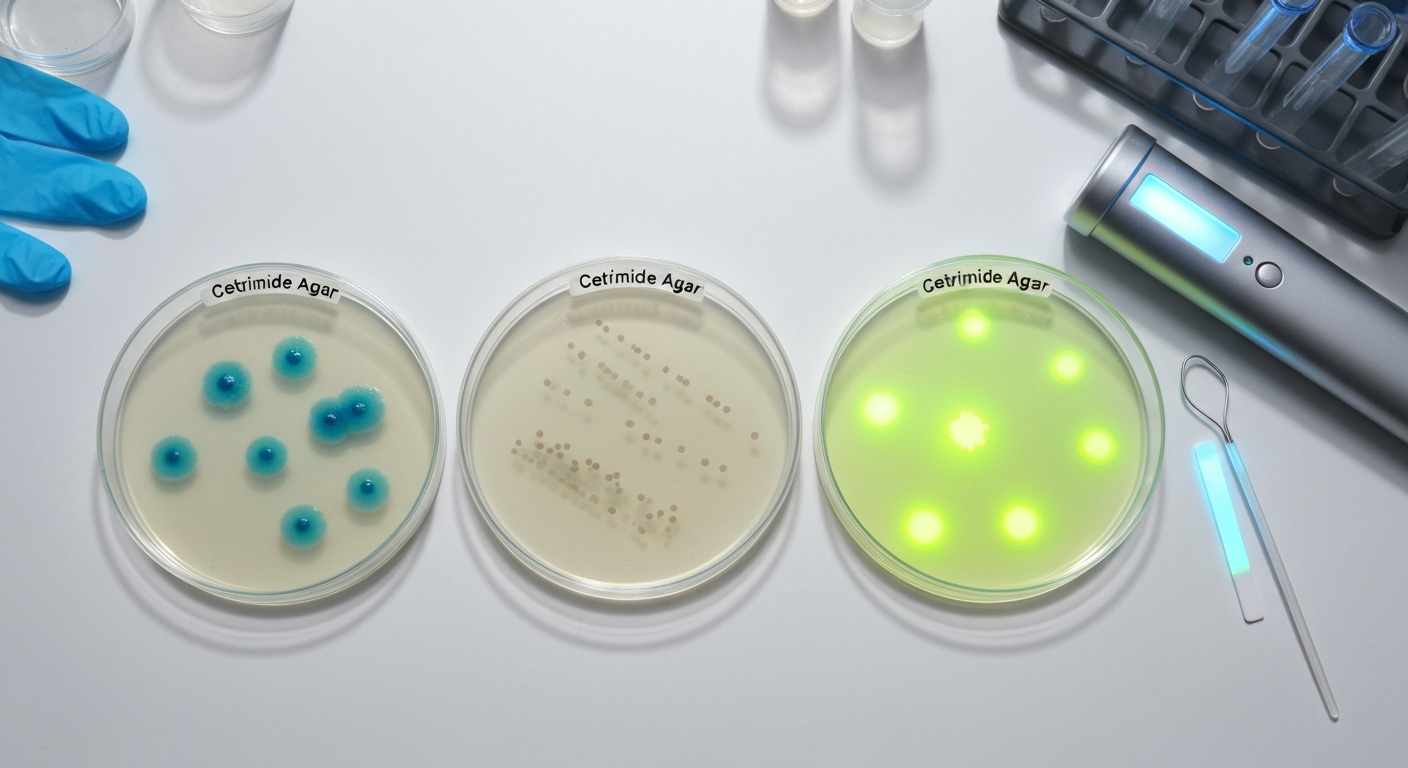
What cetrimide agar is and what's in it
Cetrimide agar is a selective solid medium formulated primarily to recover P. aeruginosa from clinical specimens, environmental samples, cosmetics, and food products. The selective power comes from cetrimide, the common name for cetyltrimethylammonium bromide (CTAB) or related tetradecyltrimethylammonium bromide compounds. Standard commercial formulations, including those from BD Difco and Oxoid (CM0579), contain cetrimide at approximately 0.3 g/L in the final reconstituted medium. Some manufacturers, notably Thermo Scientific (Remel, PO5076A), use a slightly lower concentration of 0.2 g/L and supplement the medium with nalidixic acid at 0.015 g/L and glycerol, both of which further shape the medium's selectivity and promote pigment production.
Glycerol in the formulation serves a specific purpose: it enhances the production of pyocyanin and pyoverdin, the characteristic blue-green and yellow-green pigments that P. aeruginosa secretes. These pigments diffuse into the agar around colonies and fluoresce under UV light, giving a visual cue that is used as presumptive evidence of P. aeruginosa in regulatory and clinical workflows. The FDA Bacteriological Analytical Manual (BAM) Media M37 recipe reflects the same basic framework, listing cetrimide at 0.3 g/L as the central inhibitory agent.
Why cetrimide targets Pseudomonas and inhibits almost everything else
Cetrimide is a cationic quaternary ammonium compound (QAC). Its mechanism is physical rather than enzymatic. The positively charged molecule binds to and disrupts the negatively charged bacterial cell envelope, destabilizing the outer membrane in Gram-negative bacteria, increasing membrane permeability, and ultimately causing leakage of cellular contents. At the 0.3 g/L concentration used in cetrimide agar, this is lethal or at minimum severely growth-inhibitory to most bacteria.
P. aeruginosa is selectively recovered not because cetrimide feeds it, but because it is inherently more tolerant of QACs than most other Gram-negative bacteria. Its outer membrane composition, particularly its lipopolysaccharide structure and efflux pump repertoire, gives it a higher minimum inhibitory concentration (MIC) for cetrimide compared to organisms like E. coli. Published broth MIC data report cetrimide inhibiting E. Lipophilic Arginine Esters: ... (contains comparative MIC data including cetrimide vs E. coli), PMC reports experimental MICs of cetrimide against E. coli ATCC 25922 at approximately 20 µg/mL Published broth MIC data report cetrimide inhibiting E. coli ATCC 25922 at around 20 µg/mL.. coli ATCC 25922 at around 20 µg/mL, which is well below the effective concentration in the agar. P. aeruginosa's tolerance can be substantially higher in comparative datasets, though exact values vary by strain and method. That gap in susceptibility is precisely what cetrimide agar exploits.
What typically happens when you plate E. coli on cetrimide agar
Standard compendial performance specifications describe the expected outcome clearly. The Oxoid CM0579 product specification requires that E. coli ATCC 8739 show no growth or produce only very small straw-colored colonies (2 to 8 mm) when challenged at defined inoculum levels, and it sets a pass criterion of at least a 3 log10 reduction in colony count compared to a non-selective control. In practice, if you streak a routine inoculum of E. coli on a freshly prepared cetrimide plate and incubate at 35 to 37°C for 24 to 48 hours, you will almost certainly see no colonies. If you do see growth, it will not produce the blue-green pyocyanin pigment or the fluorescence under UV that characterize P. aeruginosa, and it will look pale and unremarkable against the agar background.
When E. coli might still appear: exceptions and caveats
Several manufacturer IFUs, including Thermo Fisher/Fisher IFUs for cetrimide selective agar, explicitly note that some enteric Gram-negative bacilli may exhibit growth on the medium. This is not a manufacturing defect. It reflects genuine biological and procedural factors that can allow occasional breakthrough growth.
- High inoculum: Overloading a plate can overwhelm the cetrimide concentration and allow a small number of E. coli to survive. This is why compendial performance testing specifies challenge inocula carefully. At very high cell densities (well above routine diagnostic inocula), cetrimide's effective concentration relative to cell number drops, and the medium's selectivity is partially overcome.
- Resistant or adapted strains: E. coli harbors chromosomally encoded efflux systems, notably AcrAB-TolC and MdtM, that pump QACs out of the cell. Some strains also carry plasmid-associated qac genes (including qacEΔ1 found in integrons) that increase tolerance to cetrimide and related disinfectants. Strains previously exposed to sublethal concentrations of cetrimide or other QACs may show modestly elevated MICs, sometimes enough to permit visible growth on the agar.
- Formulation and concentration differences: Cetrimide content varies from 0.2 to 0.3 g/L depending on the manufacturer. A medium at the lower end of the range provides less inhibitory pressure. Formulations without nalidixic acid offer a narrower selective barrier against Gram-negative contaminants.
- Old or improperly stored media: Cetrimide can degrade over time, particularly in plates stored beyond the manufacturer's recommended shelf life or exposed to excess heat or light. Degraded cetrimide lowers the effective inhibitory concentration and reduces selectivity.
- Incubation conditions: Temperature deviations matter. Compendial testing for cetrimide agar often uses 32.5°C rather than 37°C. Running plates at a higher temperature may alter the medium's selectivity differently for P. aeruginosa versus Enterobacteriaceae.
How to interpret colonies that do appear on cetrimide agar
If colonies appear on cetrimide agar, the first step is visual assessment. P. aeruginosa produces flat, spreading, rough or metallic colonies that turn the surrounding agar blue-green from pyocyanin, or yellow-green under UV from pyoverdin. The colonies often have a characteristic fruity or grape-like odor from the volatile compound 2-aminoacetophenone. E. coli colonies, if they break through, will be pale, small, and non-pigmented. They will not fluoresce, and the surrounding agar will not change color.
The most decisive rapid test is the oxidase reaction. P. aeruginosa is oxidase-positive, a reflection of its cytochrome c oxidase activity. E. coli is oxidase-negative. A positive oxidase result strongly supports Pseudomonas and effectively rules out E. coli and most other Enterobacteriaceae, which are uniformly oxidase-negative. If a colony on cetrimide agar tests oxidase-negative, it is almost certainly not P. aeruginosa, and the isolate should be worked up separately using media and tests appropriate for Enterobacteriaceae.
Additional confirmatory features for P. aeruginosa include growth at 42°C (most Pseudomonas spp. The FDA's Bacteriological Analytical Manual (BAM) Chapter 23: Methods for Cosmetics contains confirmatory test guidance for Pseudomonas, listing oxidase reaction, pigment assessment, acetamide utilization, growth at 42°C, nitrate reduction and related biochemical tests before reporting P. aeruginosa Bacteriological Analytical Manual (BAM) Chapter 23: Methods for Cosmetics (contains confirmatory test guidance for Pseudomonas). tolerate this, while many other organisms and some non-aeruginosa Pseudomonas do not), positive nitrate reduction, acetamide utilization, and failure to ferment lactose. E. coli, in contrast, ferments lactose, is indole-positive, and grows at 37°C but not reliably at 42°C. These contrasting profiles make the two organisms easy to distinguish with a brief panel of confirmatory tests.
Confirmatory tests and the right media for finding E. coli
If your goal is isolating and identifying E. coli, cetrimide agar is the wrong starting point. Regulatory methods from the FDA BAM (Chapter 4), ISO 9308-1, and Standard Methods for water testing all direct analysts toward media designed for E. coli, not away from it. The following table summarizes the key options and what each one offers.
| Medium | Primary use | E. coli appearance | Key differentiator |
|---|---|---|---|
| MacConkey agar | Selective/differential for Gram-negatives | Pink to red, lactose-fermenting colonies with bile precipitation halo | Lactose fermentation; inhibits Gram-positives |
| Eosin Methylene Blue (EMB) | Selective/differential for Gram-negatives | Metallic green sheen | Classic visual marker for E. coli; high specificity of sheen |
| TBX (Tryptone Bile X-glucuronide) | Selective enumeration in water/food | Blue colonies (beta-glucuronidase activity) | Highly specific for E. coli via glucuronidase |
| CHROMagar ECC / Orientation | Chromogenic selective/differential | Blue/mauve colony color (species-specific chromogen) | Color coding reduces need for biochemical follow-up |
| Biochemical panels (API 20E, Vitek) | Confirmatory identification | Species-level profile | Indole+, VP-, lactose+, MR+, Citrate- |
| MALDI-TOF MS | Rapid species confirmation | N/A (protein fingerprint) | Definitive species ID from a single colony in minutes |
MALDI-TOF mass spectrometry has become the most efficient confirmatory tool in well-equipped labs. A single colony picked from any plating medium, processed in under 30 minutes, gives a protein fingerprint that reliably distinguishes E. coli from Pseudomonas spp. and from other Enterobacteriaceae. For labs without MALDI-TOF, a combination of MacConkey or EMB for primary isolation followed by a standard biochemical panel (or commercial strip test such as API 20E) is entirely adequate.
Practical notes on running cetrimide agar correctly
Incubation temperature is worth paying attention to. Compendial performance data from Oxoid and the USP/EP pharmacopeial methods commonly specify 32.5°C (plus or minus 2.5°C) with an observation window of 18 to 72 hours. This is somewhat lower than the 37°C used for many clinical and food safety workflows. Running cetrimide plates at 37°C is not wrong and is common in food and cosmetic testing, but it may modestly affect selectivity and pigment expression. If you are validating a method or running official compendial tests, match the temperature specified in the relevant standard.
Inoculum discipline is the single most practical variable within your control. Keep challenge inocula at the levels specified in your method. Using an excessive loop or swab inoculum when screening heavily contaminated samples can deposit enough cells to overwhelm the cetrimide and produce misleading breakthrough colonies. Diluting heavily contaminated samples before plating is standard practice and directly protects the medium's selectivity.
Plate age and storage conditions also affect outcomes. Use plates within the manufacturer's stated shelf life, store them at 2 to 8°C protected from light, and equilibrate to room temperature before inoculating. Old plates or those with visible moisture loss or color changes should be discarded. Because cetrimide itself can degrade, a plate that looks visually acceptable may have reduced inhibitory activity if it has been stored improperly.
Finally, bear in mind that no selective medium is perfectly selective. Even a well-prepared cetrimide plate with a controlled inoculum can occasionally yield non-Pseudomonas colonies, especially from samples with diverse microbial communities. Treating cetrimide agar as a screening step rather than a definitive identification is the right way to frame it. Any colony that raises doubt should go directly to oxidase testing, with full confirmatory work as needed.
Putting this in context: E. coli's broader environmental tolerances
Understanding how E. coli behaves on cetrimide agar connects naturally to its general tolerance profile. E. coli is not a particularly hardy organism against chemical stressors like QACs, which is why cetrimide at even 0.2 to 0.3 g/L is effective. Its vulnerabilities extend to other conditions too. E. coli growth slows dramatically at refrigeration temperature and is effectively arrested well below 10°C, which is why refrigeration at 4°C is a practical control. See further details on refrigeration effects and growth at 4°C (does E. coli grow at 4 degrees) for practical guidance and references (ID: 93ad27f6-bfcd-4593-8cc3-0d183b1feb0b) Does E. coli grow at 4°C?. Its optimal growth occurs close to 37°C, matching human body temperature, and that thermal optimum explains much of its clinical and food-safety relevance. For more on this thermal optimum and the mechanisms behind it, see why does e coli grow best at 37 degrees. Salt tolerance is modest, and E. coli does not compete well in high-sodium environments, though it can survive in lower-salinity water environments, which is relevant to contamination tracking in surface water and irrigation systems. See Can E. coli grow in water for details on how temperature, salinity, and nutrient levels affect E. coli survival and growth in water. For more detail, see can E. coli grow in salt. These tolerance parameters all feed into how labs and food safety professionals design detection workflows: the right medium for the right organism under the right conditions.
FAQ
Short answer: can Escherichia coli grow on cetrimide agar?
Generally no — cetrimide agar is formulated to be selective for Pseudomonas (especially P. aeruginosa) and contains a quaternary ammonium compound (cetrimide) that inhibits most enteric Gram‑negative bacilli including E. coli under normal conditions. However, occasional growth or small colonies of E. coli can occur depending on the medium formulation, inoculum, strain tolerance, and incubation conditions, so growth on cetrimide agar is not definitive proof of Pseudomonas.
What in cetrimide agar makes it selective and how does it inhibit non‑Pseudomonas organisms?
Cetrimide (cetyltrimethylammonium bromide, a quaternary ammonium compound) is the primary selective agent; it disrupts bacterial cell envelopes through cationic interactions with membranes, causing leakage and death. Some commercial formulas also include antibiotics (e.g., nalidixic acid) or glycerol to enhance selectivity and pigment production. Pseudomonas species (notably P. aeruginosa) tolerate or resist cetrimide better and produce characteristic pigments/fluorescence that aid identification.
What would I typically see for E. coli on cetrimide agar in routine testing?
Typically E. coli is inhibited and produces no growth. If E. coli grows it often appears as scanty growth, very small/poorly developed colonies, or colonies lacking Pseudomonas pigments/fluorescence. Manufacturer performance data commonly report inhibited growth or only tiny 'straw' colonies for E. coli ATCC challenge strains under defined inocula and incubation, but real‑world isolates with higher tolerance may behave differently.
Are there documented exceptions where E. coli grows on cetrimide agar?
Yes. Exceptions include: (1) strains with intrinsically higher QAC tolerance; (2) strains carrying qac efflux genes or upregulated chromosomal efflux pumps; (3) isolates previously exposed/adapted to sublethal QACs; (4) high inoculum loads that overwhelm the selective agent; and (5) variations in commercial media formulations (cetrimide concentration, presence/absence of nalidixic acid) or incubation conditions. In these cases E. coli can produce visible colonies on cetrimide plates.
How should laboratories interpret colonies on cetrimide agar that look like Pseudomonas?
Treat growth on cetrimide agar as presumptive only. Do not report Pseudomonas (or P. aeruginosa) solely on the basis of growth or pigment/fluorescence. Perform confirmatory testing: oxidase reaction, pigment/fluorescence checks, acetamide utilization, nitrate reduction, growth at 42°C, and/or biochemical or molecular identification (API, MALDI‑TOF, 16S PCR). Similarly, if E. coli is suspected, subculture onto E. coli‑selective/differential media and perform appropriate confirmation (indole, β‑glucuronidase, or standard confirmatory workflows).
Which alternative media should I use to isolate and confirm E. coli instead of (or after) cetrimide agar?
Use validated E. coli selective/differential media: MacConkey agar, EMB (e.g., Levine), TBX or Tryptone‑Bile X‑Glucuronide, CHROMagar ECC/Orientation, or ISO/FDA‑recommended media from BAM/ISO methods. For enumeration or regulatory testing follow the specific compendial method (FDA BAM, ISO 9308‑1, Standard Methods) and confirmation workflows described there.
Next Article
Can E. coli Grow in Water? Survival, Growth, and Controls
Can E. coli grow in water? Facts on survival vs growth, conditions, detection, biofilms, and prevention.