
No, E. coli does not grow at 4°C under normal food storage conditions. Predictive models and experimental storage studies consistently place the minimum growth temperature (Tmin) for common mesophilic E. coli strains somewhere between 6°C and 9.6°C, depending on the strain and matrix. That means a properly functioning refrigerator held at 4°C should prevent net multiplication for virtually all wild-type foodborne E. coli strains. What refrigeration does not do is kill them. E. coli can survive at 4°C for days or even weeks, which is a critical distinction for anyone making decisions about food safety, testing, or shelf life.
Does E. coli Grow at 4°C? Limits, Risks, and Food Safety

Marcus Reeves
18 Jul 2026
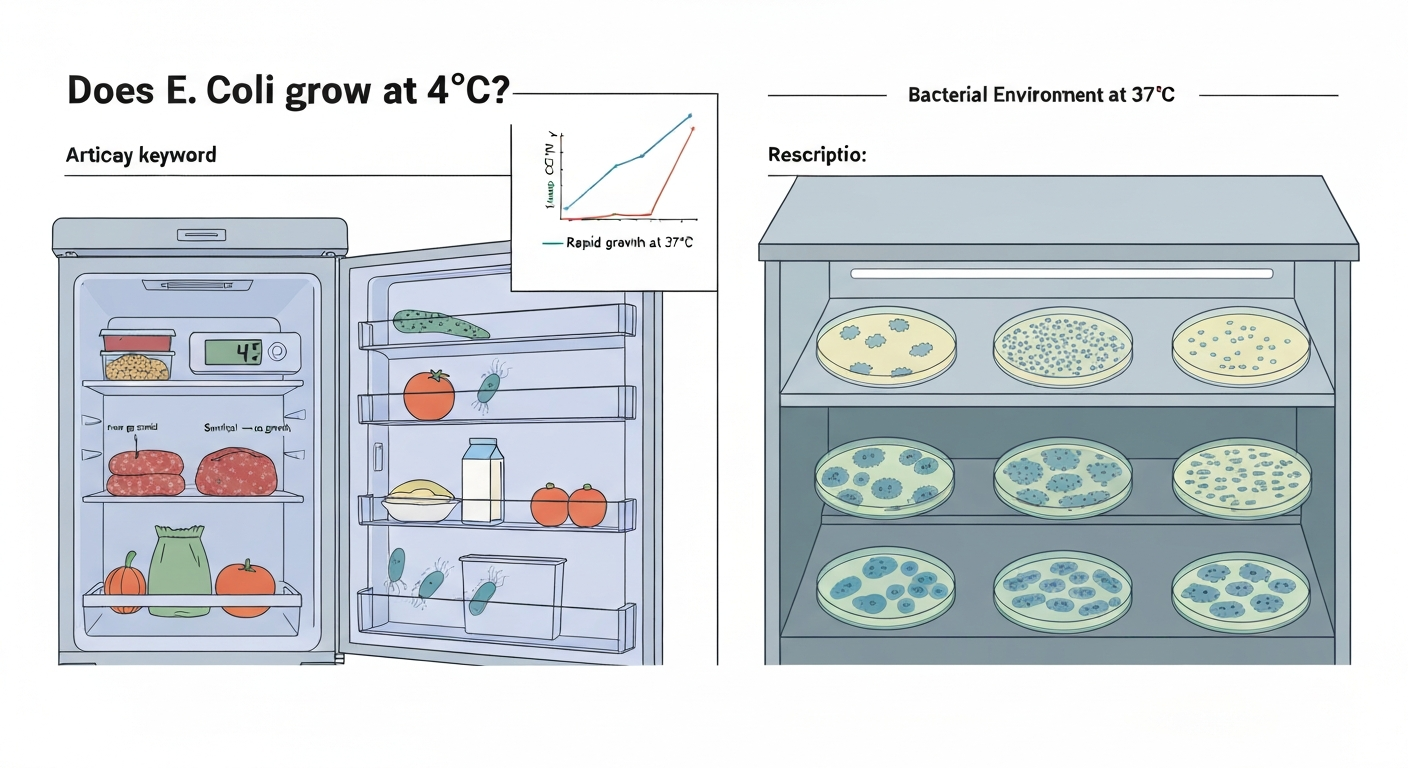
Growth versus survival: why the distinction matters at refrigeration temperatures
In predictive microbiology, 'growth' has a precise meaning: a statistically significant net increase in viable cell counts (CFU or MPN) over time in properly replicated experiments. Regulatory frameworks and shelf-life guidance commonly treat any increase below 0.5 log10 CFU as negligible and classify it as 'no growth' for practical purposes. Anything below that threshold is considered survival or persistence, not growth.
Survival at 4°C means viable E. coli cells are still present and potentially infectious, but their population is not expanding. This matters enormously for interpreting refrigerated food safety. A food that was heavily contaminated before refrigeration can still carry a dangerous dose even after several days in the fridge, even though the bacteria did not multiply. Refrigeration buys time by preventing amplification; it does not decontaminate.
Researchers also recognize a 'growth/no-growth interface,' a probabilistic boundary in temperature, pH, and water activity space where growth becomes increasingly unlikely. At 4°C, most E. coli strains fall clearly on the no-growth side of that interface under typical food conditions.
The typical temperature range for E. coli and why 37°C is optimal
E. coli is a classic mesophile, meaning it thrives at moderate temperatures that correspond to warm-blooded animal hosts. Its optimal growth temperature is approximately 37°C, which mirrors normal human and bovine body temperature. At that temperature, with adequate nutrients, E. coli achieves its shortest generation time and highest growth rate.
The practical growth range for mesophilic E. coli spans roughly 6–8°C on the low end up to about 46–49°C on the high end, with rapid growth occurring through the 20–42°C window. Below about 8°C, enzymatic activity, membrane fluidity, ribosome function, and protein folding all slow considerably, eventually preventing coordinated replication. This is the fundamental biochemical reason why refrigeration is effective. For a deeper look at why 37°C specifically represents the sweet spot, the strain-level biochemistry is covered in detail elsewhere in this reference.
What actually happens to E. coli at 4°C: dormancy, survival, and the growth ceiling
A well-cited secondary-modeling study of E. coli on hydroponic lettuce estimated the theoretical minimum growth temperature for the tested strain at 6.101°C, placing 4°C clearly below any expected growth threshold. Separate research on Shiga-toxin-producing E. coli (STEC) strains reported Tmin estimates of approximately 8.0°C for O104:H4, 8.4°C average for O157:H7, and 9.6°C for serogroup O26. A 2026 peer‑reviewed study, The Minimum Growth Temperatures of Shiga Toxin–Producing Escherichia coli (2026, Food Protection Trends/Food and Environmental Virology), measured Tmin values clustered above typical refrigeration (O104:H4 ≈ 8.0 °C, O157:H7 ≈ 8.4 °C, O26 ≈ 9.6 °C), indicating most STEC strains will not multiply at 4 °C. These are among the most dangerous E. coli strains in food safety, and none of them grow reliably at 4°C.
Storage experiments in ground beef showed that E. coli O157 and field isolates generally survived but did not reliably increase over 1 to 14 days at 4°C. Counts typically remained stable or declined slowly. Studies of raw cow's milk and dairy products found similar results: STEC and E. coli O157:H7 persisted for days to weeks at refrigeration temperature with little consistent change in counts. On leafy greens like lettuce and kale, inoculated E. coli O157:H7 typically declined gradually during refrigerated storage, yet viable cells remained detectable throughout the normal shelf-life period.
The practical takeaway: you can expect E. coli counts in refrigerated food to stay roughly stable or slowly decrease over a standard storage period, but you cannot expect refrigeration to eliminate the pathogen. If contamination entered at a high level, it will still be present at a high level several days later.
Psychrotrophic exceptions: rare strains and what the evidence actually says
True psychrotrophic E. coli strains capable of multiplying at or below 4°C in food matrices do exist but are genuinely rare in wild foodborne populations. The bacteria most commonly found growing at refrigeration temperatures in chilled foods are other genera entirely, particularly Pseudomonas, Listeria, and Hafnia. When you see spoilage in a refrigerated food, E. coli is almost never the organism driving that growth.
One laboratory demonstration of cold-adapted E. coli growth involved an engineered strain expressing psychrophilic chaperonins from cold-adapted organisms, which enabled replication down to approximately 4–10°C. This is scientifically interesting but not evidence that wild foodborne E. coli commonly exhibits the same behavior. Engineering a strain to express cold-adapted protein-folding machinery is a very different situation from what occurs naturally in food environments.
For practical food-safety purposes, the current evidence does not support treating cold-growing E. coli as a routine risk at 4°C. The precautionary principle still applies, which is why refrigeration temperature control and short storage times matter, but the primary concern at 4°C is survival of existing contamination, not new growth.
How the food matrix changes outcomes at 4°C
Temperature alone does not determine whether growth is possible. Intrinsic factors in the food itself interact with temperature to push the effective Tmin up or down. This is the hurdle-technology principle in practice: multiple suboptimal conditions combine to prevent growth more effectively than any single factor.
pH
Lower pH raises the minimum growth temperature for E. coli. A condition that might theoretically support slow growth at 8°C in a neutral, nutrient-rich medium may not support any growth at the same temperature if the food is mildly acidic (e.g., pH 4.5–5.5, as in many fermented foods). At 4°C, the combination of refrigeration and moderate acidity creates a strong barrier to growth.
Salt and water activity
Higher salt concentration reduces water activity (aw), and lower aw similarly raises the Tmin and reduces the maximum growth rate for E. coli. Experimental data show that conditions supporting E. coli growth at 8°C in rich broth may not support growth at the same temperature when NaCl is added. At 4°C, a food with meaningfully reduced aw due to salt content represents an even less hospitable environment for E. coli multiplication.
Packaging atmosphere
Modified atmosphere packaging (MAP) with elevated CO2 has been shown to suppress E. coli growth in meat and produce at refrigeration temperatures. Vacuum packaging achieves a similar effect by eliminating oxygen, though this mainly affects aerobic spoilage organisms. CO2-enriched MAP and vacuum packaging routinely delay or reduce E. coli outgrowth compared to air packaging at approximately 4°C. This is relevant when assessing risk in MAP-packaged deli meats, bagged salads, and vacuum-packed proteins.
Nutrient availability
Rich nutrient environments (high-protein raw meats, raw milk) provide E. coli with the substrates needed to sustain metabolic activity even in the absence of growth. Cells in nutrient-poor environments may enter a more profoundly dormant state and decline faster in viable counts. However, nutrient richness alone does not enable growth below the Tmin threshold.
Competing microflora: how other bacteria affect E. coli survival during cold storage
Refrigerated food is not a sterile environment. Psychrotrophic spoilage organisms such as Pseudomonas, Hafnia, and various lactic acid bacteria are adapted to cold conditions and outgrow E. coli readily at 4°C. This competition matters for two reasons. First, fast-growing psychrotrophs consume available nutrients and produce metabolic by-products (including organic acids and bacteriocins) that can inhibit E. coli. Second, the dense spoilage flora can physically and chemically alter the food environment in ways that reduce E. coli survival.
Research specifically examining E. coli O157:H7 in the presence of a competitive microflora found that background organisms measurably suppressed E. coli growth kinetics, even at temperatures approaching the Tmin. This means that a naturally contaminated food held at 4°C may actually see faster E. coli decline than a laboratory model with E. coli in isolation, because the natural flora is doing inhibitory work that clean lab media cannot replicate.
This is relevant for interpreting plate count data from naturally contaminated samples: low E. coli counts after refrigerated storage may partly reflect competitive suppression, not just the inhibitory effect of cold temperature alone.
E. coli in water and in salty environments: practical notes
In water at 4°C, E. coli follows the same survival-without-growth pattern seen in food. Clean, cold water is a hostile environment for E. coli growth because it lacks the nutrients needed to support replication and the temperature is below Tmin. However, E. coli can survive in cold water for extended periods, which is why refrigerated water samples and well water can harbor viable cells long after the initial contamination event. Growth in water at 4°C is not expected under normal circumstances. For practical guidance on whether E. coli can grow in water, see can e coli grow in water.
In salt-containing foods, the effect of NaCl on aw stacks on top of the temperature inhibition. Foods with moderate salt content (1–3% NaCl, as in many processed meats and brines) at 4°C present compounded hurdles to E. coli growth. At higher salt concentrations, E. coli survival itself begins to be compromised over time, though the organism tolerates moderate salinity better than many pathogens. The bottom line: refrigeration plus salt is a more effective combination than either alone, but it is still not a sterilization step.
Monitoring and testing E. coli at refrigeration temperatures
Testing for E. coli in or after refrigerated storage requires careful methodological choices. The key challenge is that refrigeration can push cells into a viable but non-culturable (VBNC) state, where they remain alive and potentially pathogenic but fail to form colonies on standard culture media. A negative plate count from a refrigerated sample does not always mean E. coli is absent.
Appropriate selective media
Standard selective and differential media for E. coli recovery include MacConkey agar (which selects for Gram-negative organisms and differentiates lactose fermenters), Eosin Methylene Blue (EMB) agar, CHROMagar ECC, and Tryptone Bile X-glucuronide (TBX) agar. All of these are incubated at 37°C (or 44°C for thermotolerant coliform confirmation) rather than at the storage temperature of 4°C, because incubating at 4°C would not allow E. coli to form detectable colonies even if cells are present and viable.
Why cetrimide agar is the wrong choice
Cetrimide agar is specifically designed as a selective medium for Pseudomonas aeruginosa. Cetrimide (a quaternary ammonium compound) inhibits most other organisms including E. coli, so using cetrimide agar will produce false negatives for E. coli. It is the wrong tool entirely for E. coli detection regardless of the storage temperature or matrix.
Enrichment strategies for low-count or stressed cells
Because refrigeration stress can injure or drive cells into VBNC states, direct plating of refrigerated samples may underestimate true E. coli populations. Pre-enrichment in non-selective broth (such as buffered peptone water) at 37°C before plating on selective media is the standard approach for recovering stressed or low-level E. coli from cold-stored samples. For STEC specifically, immunomagnetic separation (IMS) and PCR-based confirmation are now common in reference laboratory workflows.
| Medium | Primary use | Appropriate for E. coli? | Incubation temperature |
|---|---|---|---|
| MacConkey agar | Gram-negative selection, lactose differentiation | Yes | 37°C |
| EMB agar | Coliform/E. coli differentiation | Yes | 37°C |
| CHROMagar ECC | Chromogenic E. coli/coliform detection | Yes | 37°C |
| TBX agar | Thermotolerant E. coli (beta-glucuronidase) | Yes | 44°C |
| Cetrimide agar | Pseudomonas aeruginosa selection | No — inhibits E. coli | 37°C |
Practical refrigeration and storage guidance
The following guidance applies to food-safety professionals and informed consumers making decisions about storage, shelf life, and risk management for E. coli-relevant foods.
- Keep refrigerator temperature at or below 4°C (40°F). Temperatures between 4°C and 8°C create a marginal zone where slow or intermittent E. coli growth becomes increasingly plausible for some strains and matrices.
- Follow USDA-FSIS recommended storage times. Raw ground beef should be used within 1–2 days of refrigeration. Whole cuts of raw beef, pork, and lamb: 3–5 days. Raw poultry: 1–2 days. These limits exist because refrigeration prevents growth, not because it eliminates E. coli.
- Cool hot foods rapidly. Moving cooked food through the temperature danger zone (4–60°C) quickly prevents growth during cooling. Target moving food from 60°C to below 4°C within 2 hours using shallow containers, ice baths, or blast chilling.
- Never thaw at room temperature. Thawing on a countertop warms the food surface into the growth range long before the interior thaws. Use refrigerator thawing, cold running water, or a microwave followed by immediate cooking.
- Segregate raw and ready-to-eat (RTE) foods. Cross-contamination introduces E. coli to foods that will not receive a kill step. Use separate cutting boards, containers, and storage areas.
- Do not rely on appearance or smell. E. coli does not produce detectable odors or change food appearance during survival in cold storage. Sensory assessment is not a reliable indicator of E. coli contamination.
Risk-based decision checklist for food-safety professionals
When evaluating refrigerated products for E. coli risk, work through the following considerations before drawing conclusions from microbiological results.
- Was the product held consistently at ≤4°C throughout cold chain? Temperature excursions above 6–8°C, even brief ones, may have permitted growth before the sample was taken.
- What is the food matrix? High aw, near-neutral pH, and protein-rich raw foods (ground beef, raw milk, fresh produce) carry higher risk of E. coli survival and potential growth during any temperature excursions.
- Has enrichment been used before plating? A zero plate count from a direct-plated cold-stored sample does not rule out VBNC or injured cells. Pre-enrichment is required to rule out low-level contamination.
- Is the count result interpretable given cold storage? Counts from refrigerated samples will reflect survival kinetics, not growth kinetics. Declining counts over time are expected; zero counts do not equal absence without enrichment confirmation.
- If a low count is detected, does the product still represent a dose risk? For STEC O157:H7, the infectious dose is very low (estimated at fewer than 100 cells). A 'low count' is not automatically a safe count for high-risk groups.
- What downstream handling will occur? If the product will be consumed raw or minimally processed, even low surviving counts represent a hazard. If a validated kill step (thorough cooking) will follow, the risk profile changes significantly.
- Has competitive microflora been characterized? In naturally contaminated samples, dense spoilage flora may have masked or suppressed E. coli counts. Consider both possibilities when interpreting results near the detection limit.
Guidance for educators and communicators
When explaining refrigeration and E. coli to non-specialist audiences, precision in language prevents misunderstanding. The most common misconceptions are that refrigeration kills bacteria (it does not) and that bacteria cannot survive in the fridge (they can, for extended periods).
- Use 'prevents growth' rather than 'kills' when describing what refrigeration does to E. coli.
- Emphasize that E. coli can survive at 4°C for days to weeks, which is why storage time limits exist even for refrigerated food.
- Make clear that the fridge temperature itself matters: a unit running at 7–8°C provides meaningfully less protection than one running at 4°C.
- For consumer audiences, the actionable messages are simple: keep the fridge cold, use raw high-risk foods quickly, separate raw and ready-to-eat foods, and always cook ground beef thoroughly.
- Avoid framing refrigeration as a safety guarantee. It is a critical control point that limits growth, not a kill step.
Key takeaways and recommended actions
E. coli does not grow at 4°C under standard food storage conditions. The Tmin for common mesophilic and STEC strains consistently falls in the 6–9.6°C range, and experimental storage studies in ground beef, raw milk, and leafy greens confirm that counts remain stable or decline slowly during properly maintained refrigeration. True psychrotrophic E. coli capable of growing at 4°C exists but is rare in wild foodborne isolates and represents an edge case, not a routine planning concern.
Survival, however, is reliable. Viable E. coli can persist throughout a food's refrigerator shelf life, including highly pathogenic STEC strains. Food matrix factors (pH, aw, competing flora, packaging atmosphere) modify the survival and growth picture but do not override the fundamental temperature control at 4°C. The combination of tight refrigeration temperature, short storage times for high-risk foods, and appropriate downstream kill steps (cooking) remains the backbone of E. USDA‑FSIS recommends refrigerating ground beef at 40°F (4°C) or below and using raw ground beef within 1–2 days to reduce food‑safety risk USDA‑FSIS recommends refrigerating ground beef at 40°F (4°C) or below and using raw ground beef within 1–2 days to reduce food‑safety risk.. coli control.
For testing and monitoring: use appropriate selective media (MacConkey, EMB, CHROMagar ECC, TBX) with pre-enrichment for cold-stressed samples; incubate at 37°C or 44°C, not at storage temperature; and never use cetrimide agar, which is designed for Pseudomonas and actively inhibits E. coli. Interpret zero plate counts from refrigerated samples cautiously, especially for products destined for vulnerable populations or raw consumption.
FAQ
Does Escherichia coli (E. coli) grow at 4 °C (refrigeration temperature)?
Generally no — most typical (mesophilic) E. coli strains do not show net growth at 4 °C. Predictive models and experimental data place the practical minimum growth temperature (Tmin) for common E. coli and most Shiga‑toxin–producing E. coli (STEC) in the ≈6–9 °C range, so storage at ~4 °C prevents exponential multiplication for the large majority of strains and food matrices. However, cells can survive (remain viable) for days to weeks at 4 °C without increasing in number.
If E. coli doesn’t grow at 4 °C, does refrigeration make food safe from E. coli?
No — refrigeration at ~4 °C prevents or greatly slows net multiplication for most strains but does not reliably inactivate E. coli. Viable cells often persist through normal refrigerated shelf lives. Refrigeration reduces risk by preventing growth, but it does not replace safe handling, cooking, or short refrigerated storage times for high‑risk foods.
What do we mean by ‘growth’ versus ‘survival’ at low temperature?
Growth means a statistically significant net increase in viable counts (e.g., ≥0.5 log10 CFU is commonly treated as meaningful for shelf‑life decisions). Survival or persistence means viable cells remain detectable over time but counts do not increase (may decline slowly). Enrichment recovery with no increase in direct plate counts indicates survival/VBNC rather than growth.
Are there E. coli strains that can grow at 4 °C?
True psychrotrophic E. coli that multiply at 4 °C in foods are rare in natural/foodborne populations. Documented low‑temperature growth is mostly from laboratory‑adapted or genetically engineered strains. Most wild and pathogenic E. coli isolates (including common STEC serogroups) have Tmin values well above 4 °C and will not multiply under typical refrigeration.
How do food matrix and intrinsic factors affect whether E. coli can grow or survive at 4 °C?
Intrinsic factors alter Tmin and growth rates: lower pH, higher salt (lower water activity), preservatives, and low nutrient availability raise the Tmin and reduce growth rate. A strain that might grow near 8 °C in rich broth will often not grow at the same temperature in an acidic, salty, or low‑aw food. Thus matrix composition strongly affects whether any growth is possible near refrigeration temperatures.
How do extrinsic factors and competing microflora influence E. coli behavior at 4 °C?
Extrinsic controls such as modified‑atmosphere packaging (elevated CO2), vacuum packaging, and lower storage temperatures suppress or delay E. coli growth. Competitive psychrotrophic spoilage organisms (Pseudomonas, Hafnia, lactic acid bacteria) often dominate chilled foods and can outcompete or inhibit E. coli, further preventing its outgrowth during refrigerated storage.
Next Article
Can Bacteria Grow in Lemon Juice? Growth Risk Explained
Learn if bacteria can grow in lemon juice, how acidity affects survival vs multiplication, and safe storage steps.