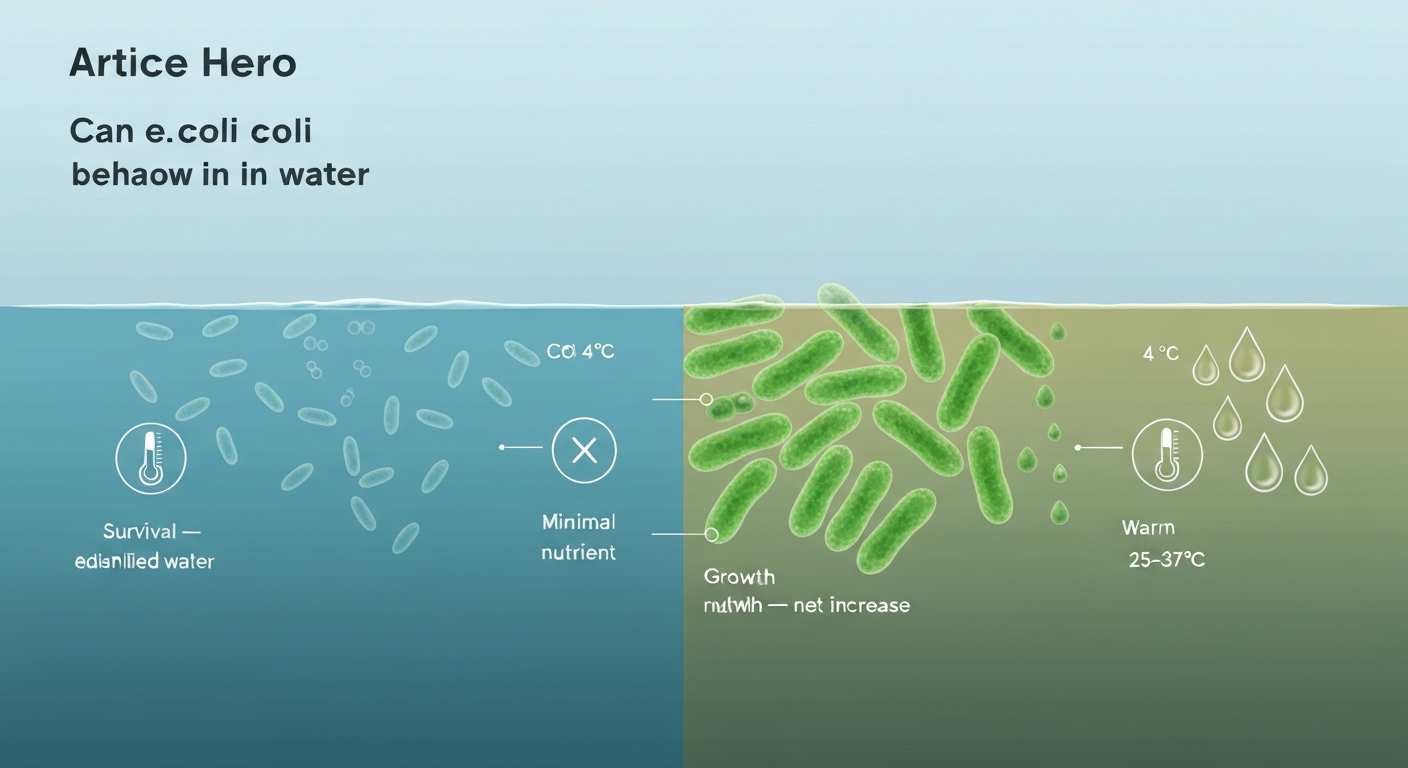
E. coli can survive in virtually any water, but active growth, meaning a measurable net increase in cell numbers, requires the right combination of temperature, nutrients, pH, and osmotic conditions. In clean, nutrient-poor drinking water at low temperatures, the bacteria typically persist for days to weeks without multiplying. In warmer, nutrient-rich water such as wastewater, agricultural runoff, or stagnant distribution-system sediments, net growth is genuinely possible. The short version: water type and environmental conditions determine whether E. coli is merely surviving or actually multiplying.
Can E. coli Grow in Water? Survival, Growth, and Controls

Marcus Reeves
28 Jul 2026
Why the words matter: growth, survival, persistence, and VBNC
These four terms are used interchangeably in casual conversation, but in water microbiology they mean very different things, and confusing them leads to serious errors in risk assessment.
- Growth: a net increase in viable cell numbers (CFU) or biomass over time. Demonstrated by watching counts rise in a controlled microcosm or culture. This is the most epidemiologically significant state because numbers amplify.
- Survival: maintenance of viability, measured as detectable CFU or positive viability indicators, without a net increase in numbers. The cells are metabolically active enough to stay alive but are not replicating.
- Persistence: long-term retention of detectable E. coli in an environment, often used when culturability remains measurable over weeks or months. Persistence can occur in biofilms, sediments, or under refrigeration even when bulk-water counts are declining.
- VBNC (viable but non-culturable): a stress-induced physiological state in which cells lose the ability to form colonies on standard media but retain metabolic activity and can regain culturability under appropriate resuscitation conditions. VBNC cells are easily missed by routine CFU-based tests, which means a negative culture result does not always equal a safe sample.
From a practical standpoint, a regulatory test that returns zero CFU is measuring culturability, not absolute absence. VBNC cells have been recovered from treated water and environmental samples, so understanding which state E. coli is in matters for both risk interpretation and disinfection validation.
E. coli growth potential by water type
Not all water presents the same risk. Here is how growth potential changes across the most common water categories.
Sterile or distilled water
This is the most predictable case. Sterile or distilled water contains no competing microorganisms and almost no dissolved organic carbon or nutrients. E. coli introduced into this environment can survive for an extended period, with published T90 values (the time required for a 1-log10 reduction) ranging from roughly 17 days to more than 100 days depending on temperature, strain, and starting inoculum. Sustained net growth is not expected because there is simply nothing to metabolize.
Treated drinking water
Properly chlorinated drinking water contains residual disinfectant and very low dissolved organic carbon, both of which suppress E. coli. However, in drinking-water microcosm studies run without residual chlorine, E. coli can persist for weeks at typical distribution temperatures. When biofilms form on pipe walls, or when sediment accumulates in dead-end sections, E. coli can find nutrient concentrations and redox conditions that support maintenance and even limited regrowth. This is one reason chlorine residuals in distribution systems are treated as a non-negotiable control rather than an optional safeguard.
Nutrient-rich water: wastewater and industrial water
Wastewater, agricultural drainage, food-processing effluent, and some industrial cooling waters can carry dissolved organic carbon, nitrogen, and phosphorus at concentrations that comfortably support E. coli replication. At temperatures above 20-25°C this combination creates genuine growth conditions. This is why untreated or partially treated wastewater returning to surface-water bodies represents a sustained source rather than a diluting-and-disappearing contaminant.
Brackish water
Brackish water presents a mixed picture. E. coli can tolerate moderate salinity through osmoregulatory mechanisms, and field data confirm that the organism survives longer in brackish estuaries than in full seawater. Growth is possible in brackish water if nutrients are available, but the salt load imposes an energetic cost that slows growth rate compared to freshwater at the same temperature and nutrient level.
Seawater
At full ocean salinity (approximately 3.5% NaCl), most E. coli strains cannot sustain growth and culturability declines sharply. The combination of high osmolarity, UV exposure in surface water, competition from marine microbiota, and nutrient form incompatibility all work against the organism. Survival after 48 hours in full-strength seawater falls markedly compared to brackish conditions. E. coli introduced via sewage outfalls or stormwater runoff is generally considered a declining population in open seawater rather than a growing one, though it can persist long enough to contaminate shellfish beds and recreational areas.
| Water type | Growth possible? | Typical survival | Key limiting factor |
|---|---|---|---|
| Sterile/distilled | No (no nutrients) | Days to >100 days (T90 data) | Nutrient limitation |
| Treated drinking water (with residual Cl) | No under normal conditions | Hours to days | Disinfectant residual |
| Treated drinking water (no residual Cl) | Limited (biofilm/sediment niches) | Days to weeks | Low DOC, temperature |
| Nutrient-rich wastewater | Yes, at >20°C | Indefinite with replication | Temperature, treatment |
| Brackish water | Possible if nutrients present | Days to weeks | Salinity + nutrient availability |
| Full seawater (~3.5% NaCl) | No for most strains | Hours to ~48 h declining rapidly | Osmotic stress, competition, UV |
Temperature: the single most controllable factor
Temperature governs E. coli's metabolic rate more directly than almost any other environmental variable. The commonly accepted minimum for sustained growth is around 7 to 8°C, with some strain-specific data putting it as low as 7°C. The optimum is close to human body temperature: at 37°C in nutrient-rich broth, exponential-phase doubling times are approximately 20 minutes. The upper limit for most strains is around 44 to 49°C, with pathogenic Shiga toxin-producing E. blank" rel="noopener noreferrer">Shelf‑life guidance (summary table citing E. coli temperature ranges) reports upper growth limits for many E. coli strains around 44–49 °C, with pathogenic STEC strains often cited at approximately 44–46 °C. coli (STEC) strains generally limited to around 44 to 46°C.
At 4°C, which is standard refrigeration temperature, active replication effectively stops for most strains. This is why refrigeration works as a preservation strategy. But 4°C does not kill E. coli. Studies consistently show that cells stored in sterile or mineral water at 4°C remain culturable for many weeks, sometimes months. The organism enters a maintenance state rather than dying, which is an important distinction when evaluating cold-stored samples or water held in chilled distribution systems. The relationship between E. coli survival at 4°C and whether that constitutes a risk depends entirely on what happens when that water warms up.
| Temperature range | E. coli status | Practical implication |
|---|---|---|
| Below ~7°C | No growth; survival only | Refrigeration prevents multiplication but not viability |
| 7–15°C | Minimal to slow growth | Slow but possible growth in nutrient-rich cold water |
| 20–37°C | Active growth | Highest risk window for amplification in water systems |
| 37°C (optimum) | Fastest growth (~20 min doubling) | Relevant to gut environment; lab reference condition |
| 44–49°C | Near maximum; growth ceases above | Pasteurization and hot-water systems work in this range |
| >49°C | Rapid killing for most strains | Thermal inactivation zone for practical disinfection |
pH: growth range and acid survival mechanisms
E. coli grows across a pH range of approximately 4.4 to 9.2, with optimal growth near neutral, around pH 6 to 7. Outside this range, growth slows significantly. The organism achieves this tolerance by maintaining its internal cytoplasmic pH close to neutral (approximately 7.3 to 7.8) even when external pH diverges substantially, a process called pH homeostasis.
At very low pH, E. coli activates specialized acid-resistance systems. The best characterized is the glutamate decarboxylase system (GadA/GadB with the GadC antiporter), which consumes intracellular protons during amino acid decarboxylation and effectively pumps excess hydrogen ions out of the cytoplasm. The arginine decarboxylase (AdiA) and lysine decarboxylase (Cad) systems operate on similar principles. These mechanisms allow E. coli to survive in environments well below its normal growth range, including acidic fruit juices and foods, which has significant food-safety implications even though the organism cannot actively replicate at those pH levels.
For water systems specifically, pH matters most in chemical disinfection contexts. Hypochlorous acid (HOCl), the active disinfectant form of chlorine, is more prevalent at lower pH values (below about 7.5), meaning the same total chlorine concentration provides more bactericidal activity at pH 6.5 than at pH 8. Monitoring pH alongside chlorine residual is therefore part of sound distribution-system management.
Oxygen: E. coli's flexibility as a facultative anaerobe
E. coli is a facultative anaerobe, which means it can shift between aerobic and anaerobic metabolism depending on oxygen availability. Under aerobic conditions it uses oxygen as its terminal electron acceptor and grows efficiently. When oxygen becomes limiting, regulatory systems (primarily FNR and Arc) redirect metabolism toward anaerobic respiration using alternative electron acceptors such as nitrate, nitrite, fumarate, DMSO, or TMAO, or toward fermentation.
This flexibility is directly relevant to water environments. Aerobic surface water and well-oxygenated drinking water favor aerobic metabolism. But sediments, biofilm interiors, and stagnant water pockets often have low or zero dissolved oxygen. E. coli can maintain itself in these anaerobic microenvironments, and under sufficient nutrient concentrations, can grow anaerobically, though more slowly than under aerobic conditions. Sediments in rivers, reservoirs, and water distribution pipelines are therefore genuine persistence reservoirs, not just contaminated inert material.
Biofilms are particularly important here. A biofilm on a pipe wall creates oxygen gradients: aerobic conditions near the bulk water interface, anaerobic conditions deeper in the matrix. E. coli embedded in biofilm not only survives better than planktonic cells (protected from shear stress, chlorine penetration, and predation) but can also sustain metabolism through multiple respiratory modes simultaneously across different layers of the same biofilm.
Organic nutrients: what actually fuels E. coli growth in water
Clean natural water is generally oligotrophic, meaning it has very low dissolved organic carbon (DOC) and limited nitrogen and phosphorus. E. coli is not well adapted to true oligotrophic competition and is typically outcompeted by native aquatic bacteria when nutrients are limiting. In controlled chemostat experiments, half-saturation constants (Ks) for single sugars have been measured in the 100 micrograms-per-liter range, indicating that E. coli can technically grow at very low substrate concentrations under optimized single-substrate conditions, but natural water presents a far more complex and competitive situation.
Classic and more recent studies consistently show that adding labile organic carbon (glucose, amino acids, organic matter from feces or plant material) to lake or river water microcosms causes measurable net increases in E. coli counts. Nutrient addition experiments that include nitrogen and phosphorus alongside carbon amplify this effect further. The practical implication is that agricultural runoff, sewage contamination, and organic sediment resuspension do not just introduce more E. coli to a water body, they also provide the substrates that allow those cells to multiply in place.
For drinking-water systems, total organic carbon (TOC) limits in treated water serve a dual purpose: they reduce disinfection byproduct formation and limit the nutrient base that could support microbial regrowth in distribution systems. Keeping TOC low after treatment is therefore a direct biocontrol measure, not just a chemistry concern.
Osmotic and salt tolerance: from brackish water to seawater
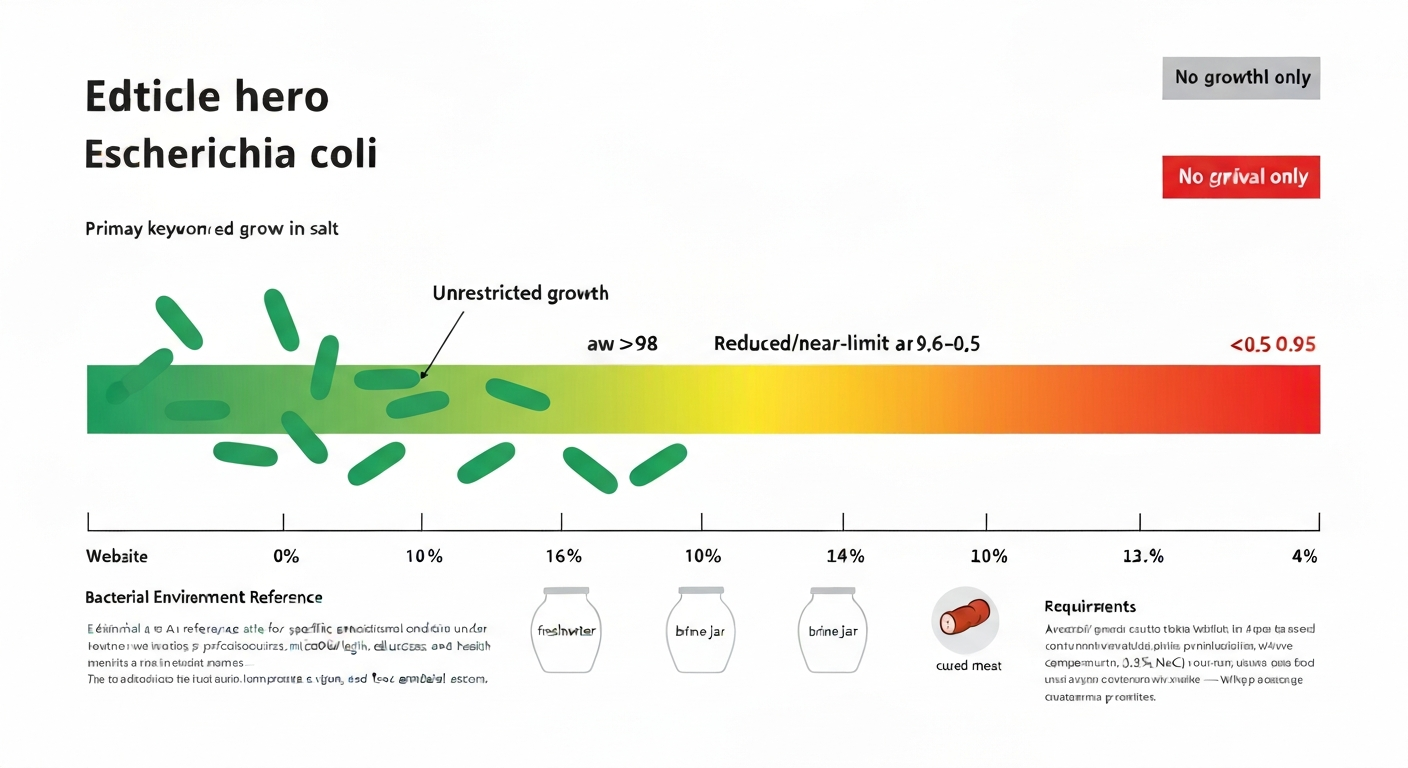
E. coli has meaningful but not unlimited salt tolerance. Laboratory growth assays across a range of NaCl concentrations show that many strains can grow at several percent NaCl, with growth rate declining as salinity rises. Evidence for Coexistence of Distinct Escherichia coli Populations in Various Aquatic Environments and Their Survival in Estuary Water (Applied and Environmental Microbiology) reports laboratory and environmental data showing E. coli growth across ~1%–8% NaCl, with growth rate declining at higher salinities blank" rel="noopener noreferrer">Evidence for Coexistence of Distinct Escherichia coli Populations in Various Aquatic Environments and Their Survival in Estuary Water (Applied and Environmental Microbiology) reports laboratory and environmental data showing E. coli growth across ~1%–8% NaCl, with growth rate declining at higher salinities.. This places E. coli comfortably within the range tolerated in typical brackish water environments (0.5 to 3% NaCl), though not full-strength seawater (approximately 3.5% NaCl total dissolved salts).
The organism manages osmotic stress through several mechanisms: accumulation of compatible solutes including glycine betaine, proline, and trehalose, and activation of the ProU and ProP transport systems that import these osmoprotectants from the environment. When external compatible solutes are absent, E. coli synthesizes trehalose internally as a substitute. These responses have energetic costs, which is why growth slows in saline conditions even when the organism is technically viable.
The transition from brackish to full seawater is critical. Studies tracking survival percentages after 48 hours show a sharp decline as salinity approaches full ocean strength. At full seawater concentrations, culturability drops markedly, and net growth is not supported for most strains. This is consistent with E. coli's evolutionary ecology as an intestinal commensal: it is selected for performance in mammalian gut osmolarity (equivalent to roughly 0.9% NaCl), not marine environments. For monitoring purposes, E. coli found in estuarine and coastal samples represents recent freshwater input, typically fecal contamination from land-based sources, rather than marine-adapted replication.
It is worth noting that salt tolerance in E. coli connects to the broader question of growth conditions in saline foods and water: the same osmoregulatory mechanisms that allow short-term brackish-water survival also determine how E. coli behaves in moderately salted food products.
Biofilm formation and regrowth in water systems
One of the most practically significant aspects of E. coli in water systems is its ability to form or integrate into biofilms on surfaces. Biofilm-associated cells are protected from chlorine penetration, mechanical removal, and predation by protozoa. Even in a well-maintained distribution system, pipe surfaces, joints, and dead-end sections can harbor biofilm communities where E. coli may persist far longer than planktonic cells in the bulk water.
Regrowth events, where E. coli counts in distribution water rise after an initial treatment, are often traced back to biofilm detachment events or sediment resuspension caused by pressure changes, flushing, or temperature increases. This is why a single point-of-entry treatment is insufficient: residual disinfectant must be maintained throughout the distribution network to address biofilm-derived regrowth, not just incoming contamination.
Detection and laboratory considerations
Standard E. coli detection in water uses selective and differential media: membrane filtration with Membrane Lauryl Sulfate Broth, Colilert (IDEXX) enzyme-substrate methods, and mFC agar incubated at 44.5°C are common approaches in regulatory frameworks. These methods are designed to culture E. coli selectively from mixed environmental samples.
Cetrimide agar is a selective medium used specifically for Pseudomonas aeruginosa, not E. coli. E. coli generally does not grow on cetrimide agar because the quaternary ammonium compound cetrimide inhibits most Gram-negative enteric bacteria, and E. coli lacks the cetrimide resistance mechanisms that Pseudomonas possesses. This is a point of confusion in laboratory settings where multiple selective media are in use, and it is worth being explicit: a negative result on cetrimide agar tells you nothing about E. coli presence.
VBNC cells add another layer of complexity. Standard CFU-based methods will miss VBNC E. coli entirely. Molecular methods (qPCR targeting uidA or other E. coli-specific genes), flow cytometry with viability stains (SYBR Green combined with propidium iodide), and direct viable count methods provide detection of cells that culture-based tests miss. For risk-sensitive applications, combining culture-based and molecular methods is best practice.
Public health implications
Most waterborne E. coli detections reflect fecal contamination events rather than environmental growth, but the distinction between survival and growth has direct consequences for outbreak dynamics. A water body or system where E. coli is merely surviving following a contamination event poses a diminishing hazard over time. One where growth conditions exist (warm temperatures, available nutrients, biofilm protection) can sustain or increase infective doses long after the contamination source has been removed.
Pathogenic strains, particularly STEC O157:H7 and other Shiga toxin-producing serotypes, have low infectious doses (as few as 10 to 100 cells for susceptible individuals). Even survival without growth in a contaminated water source can represent a public health risk if numbers are high enough at the time of exposure. This is why water standards typically set E. coli limits at zero detectable CFU per 100 mL for drinking water, not at some tolerable low level.
Practical controls: limiting growth and reducing persistence
Understanding what conditions favor E. coli growth directly informs control strategies. The goal is to deny the organism the conditions it needs: adequate temperature, nutrients, appropriate pH, and protective microenvironments.
- Maintain chlorine residuals throughout distribution systems: a minimum free chlorine residual of 0.2 mg/L at point of delivery is the baseline for most regulatory frameworks, but residuals should be validated at distribution extremities, not just at the treatment plant.
- Control water temperature: storage at or below 4°C prevents replication in water intended for food use or drinking. In distribution systems, addressing warm dead-end sections and insulating cold-water lines reduces the growth window.
- Minimize dissolved organic carbon: treatment processes targeting TOC reduction (coagulation, filtration, activated carbon) directly limit the nutrient substrate available for regrowth.
- Manage biofilm accumulation: regular pipe flushing, pipe replacement programs targeting tuberculated or corroded sections, and periodic disinfection boosting address biofilm reservoirs.
- Monitor sediment accumulation: sediments in reservoirs, storage tanks, and pipelines are the primary sites of anaerobic E. coli persistence. Tank cleaning programs and reservoir management that minimize settled solids reduce this reservoir.
- Use pH-appropriate disinfection: chlorination is more effective at slightly acidic to neutral pH. Where water is alkaline, consider UV disinfection or chloramine as adjuncts, noting their different efficacy profiles.
- Apply multiple-barrier approaches: no single treatment step is fail-safe. Source protection, treatment, distribution management, and monitoring at point of use together provide the layered protection that compensates for the limitations of each individual step.
Putting it all together
E. coli's behavior in water is not a simple yes-or-no question. It is a gradient determined by temperature (with the minimum for growth around 7-8°C and the optimum near 37°C), nutrient availability, pH (optimal near neutral, growth possible from roughly pH 4.4 to 9.2), oxygen conditions (facultative anaerobiosis allowing it to function in both aerobic and anoxic zones), and salinity (tolerable in brackish water, inhibitory in full seawater). In nutrient-poor, cold, treated water, E. coli survives but does not multiply. Add warmth, organic matter, and a biofilm surface to colonize, and you move from survival toward persistence and potentially growth. Recognizing which state applies to a specific water system or sample is the core competency that separates effective contamination management from reactive, event-driven responses.
FAQ
What is the difference between 'growth' and 'survival' of E. coli in water?
Growth means a net increase in viable cells or biomass over time under the tested conditions (e.g., rising CFU, ATP, or incorporation of labeled substrates). Survival means maintenance of viability without net increase — CFU may remain stable or slowly decline but cells stay detectable and potentially viable.
Can E. coli grow in water?
Yes — under the right conditions E. coli can actively grow in water. Whether growth occurs depends on temperature, available nutrients (C, N, P and labile organic carbon), salinity/osmotic stress, pH, oxygen or alternative electron acceptors, and ecological interactions (competition, predation). In oligotrophic natural waters growth is often limited; in nutrient‑enriched or biofilm microenvironments, net increases are commonly observed.
Which types of water support E. coli growth vs only survival?
Sterile, nutrient‑rich waters (lab broths, contaminated wastewater, or waters with added labile DOC) readily support growth. Typical drinking water and oligotrophic surface waters often permit only survival unless enriched. Brackish water can permit limited growth for some strains; full‑strength seawater usually inhibits sustained growth for most E. coli strains, though survival can occur. Distribution system biofilms, sediments, and particle‑associated niches frequently support persistence and localized growth.
What temperature ranges permit survival and growth of E. coli in water?
Survival: E. coli can remain culturable for days to many weeks at low temperatures (e.g., 4 °C), with much slower decay than at higher temperatures. Growth: many strains have a minimum sustained growth temperature near ≈7–8 °C; optimum growth is around 37 °C (doubling times ≈20 min in rich media); upper growth limits are strain‑ and medium‑dependent, often ≈44–49 °C. At intermediate temperatures growth rate slows progressively.
How does pH affect E. coli growth in water?
E. coli grows best near neutral pH (≈6–7). The typical growth range for many strains is roughly pH 4.4–9.2, but practical growth usually occurs between ~pH 5 and 9. Acid‑resistance systems enable survival (and sometimes limited activity) at lower pH values, but very acidic waters limit replication.
Does oxygen availability matter? Can E. coli grow anaerobically in water?
E. coli is a facultative anaerobe: it grows aerobically and can also grow anaerobically by fermentation or using alternative electron acceptors (e.g., nitrate, fumarate, DMSO, TMAO). In low‑oxygen microenvironments such as sediments or within biofilms, E. coli can maintain metabolism and sometimes multiply if nutrients and electron acceptors are available.
Next Article
Can E. coli Grow in Salt? NaCl Limits, Mechanisms, Controls
Can E. coli grow in salt: yes, tolerates ~6–8% NaCl (aw limits); mechanisms, temp/pH effects, and food-control tips.