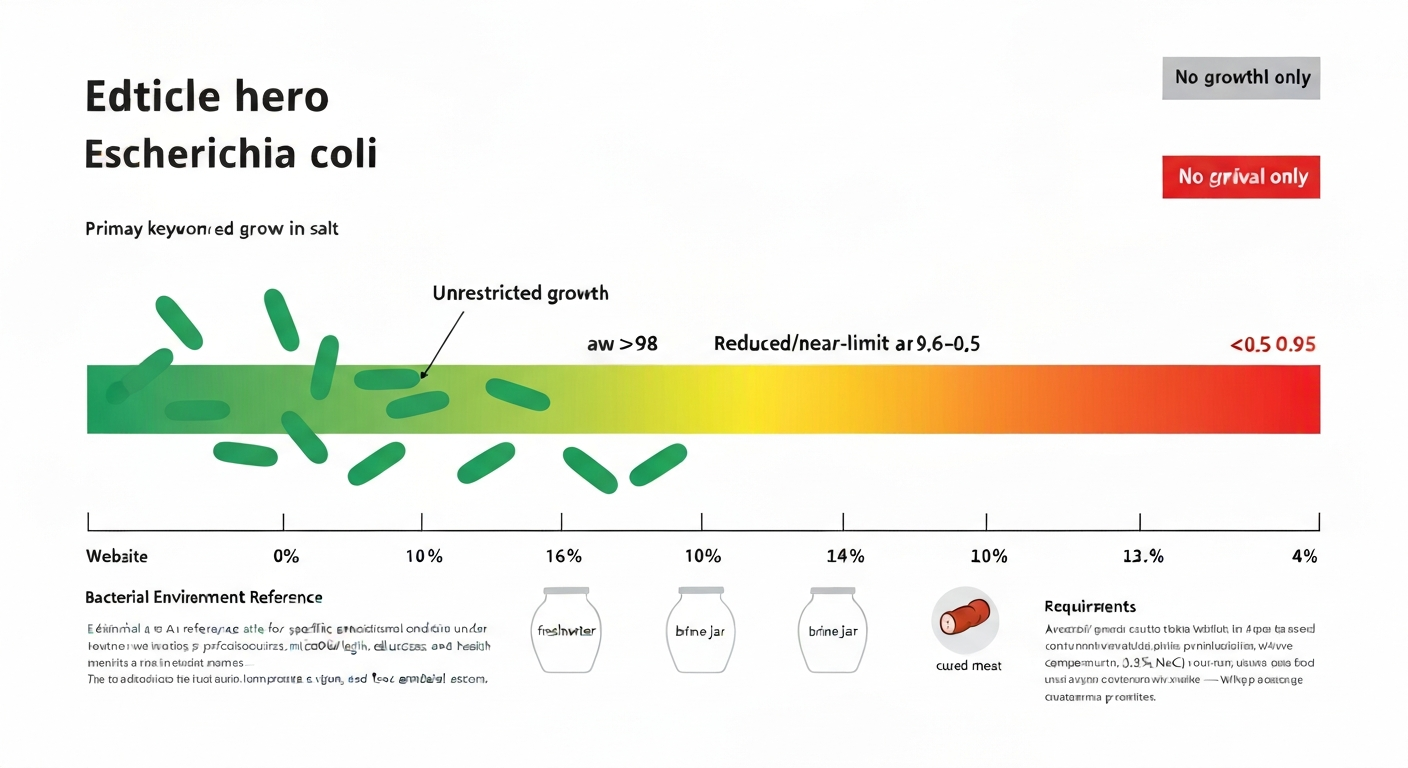
Yes, E. coli can grow in salt, but only up to a point. Most strains tolerate moderate NaCl concentrations and will grow readily in brines below about 7% NaCl (roughly equivalent to a water activity above 0.96). Once you push NaCl above approximately 8–10% (water activity at or below 0.95), growth becomes unlikely for typical strains, though the organism can survive for extended periods and resume growth if conditions improve. Salt is a useful preservation tool, but it rarely works alone.
Can E. coli Grow in Salt? NaCl Limits, Mechanisms, Controls

Marcus Reeves
26 Jul 2026
Numeric thresholds at a glance
The most practical way to think about salt and E. coli is through water activity (aw), the measure of free water available to microorganisms. Salt lowers aw by binding water molecules, and E. coli's minimum aw for growth is approximately 0.95. Below that threshold, growth stops; above it, growth is possible given adequate temperature, pH, and nutrients. The table below maps approximate NaCl concentrations to aw values and indicates what that means for E. coli growth potential.
| NaCl (% wt/wt) | Approximate aw | E. coli growth potential |
|---|---|---|
| 0.9% | 0.995 | Unrestricted — near physiological saline |
| 1.7% | 0.990 | Unrestricted — typical of lightly salted foods |
| 3.5% | 0.980 | Unrestricted — growth proceeds normally |
| 7% | 0.960 | Reduced but possible — near the lower boundary |
| 8–10% | ~0.95 | Growth at or approaching inhibitory limit |
| 10% | 0.940 | Growth generally inhibited for most strains |
| 13% | 0.920 | No growth; survival only |
| 16%+ | ≤0.900 | No growth; long-term survival possible |
These figures come from established NaCl-to-aw conversion data and align with FDA, ICMSF, and EFSA regulatory guidance. Keep in mind that the aw of a real food is not determined by salt alone. Sugars, proteins, and other solutes all contribute, so a 7% NaCl brine in a complex food matrix may yield a slightly different aw than the same brine in distilled water.
How E. coli responds to salt stress inside the cell
When E. coli encounters a sudden rise in external NaCl, the osmotic imbalance pulls water out of the cell, causing rapid shrinkage (plasmolysis) and a spike in internal solute concentration. The cell responds in two phases to counteract this stress.
The first phase is fast: the cell rapidly imports potassium ions (K+) and accumulates glutamate to partially restore turgor pressure within minutes. This is a holding strategy that buys time while the second phase gets underway.
The second phase involves accumulating compatible solutes, small organic molecules that raise internal osmolarity without disrupting enzyme function. In E. coli, the primary compatible solutes are glycine betaine, proline, and trehalose. The ProP and ProU transport systems import glycine betaine from the environment whenever it is available. If glycine betaine is absent, E. coli can synthesize trehalose through the OtsA/OtsB pathway, which is induced specifically by osmotic stress. The global stress sigma factor RpoS coordinates the longer-term regulatory response.
These mechanisms are effective across a range of salt concentrations, which is why E. coli tolerates moderate NaCl. However, they have a ceiling. At high NaCl (above roughly 8–10%), the osmotic gradient exceeds what compatible-solute accumulation can compensate for, especially under food conditions where exogenous betaine sources may be absent. Strain-to-strain variability is real: some adapted or experimentally evolved strains show extended tolerance, but this is not typical of clinical or food-associated isolates under normal circumstances.
Temperature and salt do not act independently
E. coli is a mesophile. It grows across roughly 7–45°C, with optimal growth near 37°C where metabolic enzymes and osmoadaptation systems function most efficiently. Near that optimum, E. coli tolerates salt stress better and recovers from osmotic shock more quickly because the full complement of stress-response machinery operates at peak capacity.
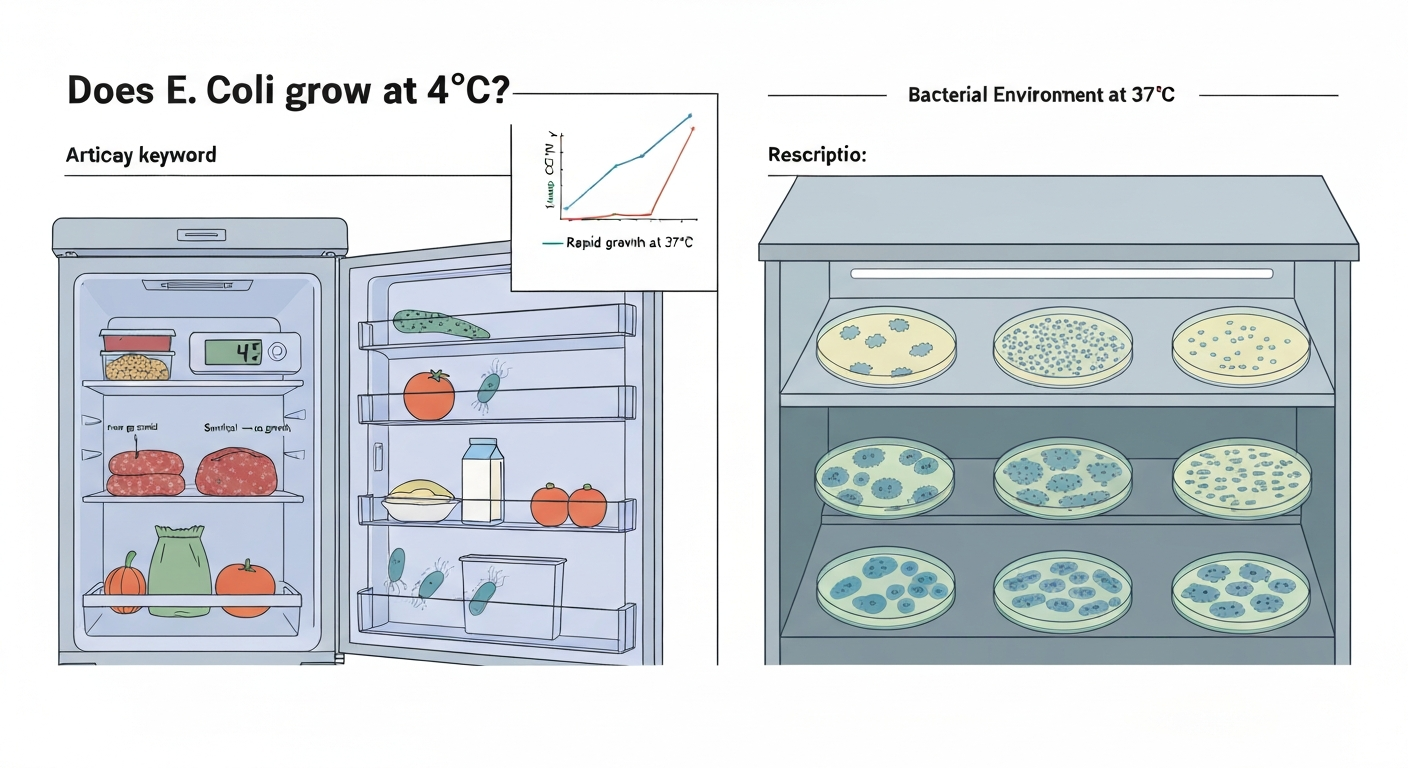
At lower temperatures the picture changes considerably. Most E. coli strains have a minimum growth temperature around 7–8°C. At 4°C (standard refrigerator temperature) growth typically halts, but the cells remain viable and stress-responsive. For more detail on growth behavior at refrigeration temperatures, see does e coli grow at 4 degrees. What makes this relevant to salt is that low temperature and high salt interact multiplicatively: a product at 4°C that is marginally above the aw inhibitory limit at room temperature may still support no growth, because cold alone is already suppressing growth. Predictive models such as ComBase and the USDA Pathogen Modeling Program (PMP) capture this interaction by showing that the no-growth region expands substantially as temperature drops. Predictive growth/no‑growth mapping studies demonstrate a combined temperature × salt (aw) boundary for E. coli and generate isothermal “no‑growth” maps showing higher NaCl (lower aw) raises the minimum permissive temperature (Modelling the Growth Limits (Growth/No Growth Interface) of Escherichia coli as a Function of Temperature, pH, Lactic Acid Concentration, and Water Activity, Applied and Environmental Microbiology (1998)) blank" rel="noopener noreferrer">Modelling the Growth Limits (Growth/No Growth Interface) of Escherichia coli as a Function of Temperature, pH, Lactic Acid Concentration, and Water Activity — Applied and Environmental Microbiology (1998). Conversely, a product stored at ambient temperature (20–25°C) provides no cold-temperature cushion, making the aw threshold the sole chemical barrier. The question of whether E. coli grows at 4°C specifically, and why 37°C is the optimum, are worth understanding in depth if you are designing products across a range of storage temperatures.
How pH, oxygen, and nutrients shift the salt tolerance picture
Salt does not operate in isolation. Three other variables routinely modify whether E. coli can grow at a given NaCl concentration.
pH is the most powerful co-variable. E. coli grows between about pH 4.4 and 9.0, with an optimum near pH 7. As pH drops toward 4.4–5.0, the minimum aw for growth rises, meaning a lower salt concentration becomes sufficient to prevent growth. Fermented vegetable products exploit this directly: lactic acid bacteria lower the brine pH rapidly, and the combined low-pH plus moderate-salt environment pushes conditions outside E. coli's growth window faster than either factor alone. USDA/FSIS guidance for shelf-stable fermented meats formalizes this with criteria such as final pH ≤5.3 combined with aw ≤0.90, or pH ≤4.6 regardless of aw.
Oxygen availability matters less to E. coli than to obligate aerobes because E. coli is a facultative anaerobe. It grows under both aerobic and anaerobic conditions, though typically more slowly anaerobically. Reduced-oxygen packaging or anaerobic fermentation alone will not stop E. coli growth in a well-salted product; however, anaerobic conditions do support lactic acid fermentation and therefore indirect inhibition through pH.
Nutrient richness affects how well E. coli tolerates stress. In nutrient-rich laboratory media, strains often tolerate higher NaCl than in nutrient-limited food matrices. This means laboratory-derived tolerance data may slightly overestimate what E. coli can do in a real food system. It also means that products with more available nutrients (proteins, free amino acids, sugars) may provide a more permissive environment for growth at marginal NaCl levels.
E. coli in water and saline environments
Fresh water (aw essentially 1.0) imposes no osmotic barrier on E. For more on E. coli survival and growth in aquatic environments, see the linked discussion on whether can E. coli grow in water. coli, and the organism grows readily in warm, nutrient-containing freshwater. Brackish water with moderate salt content (roughly 0.5–3% NaCl) is still well within the growth range for E. coli, which is why contaminated irrigation water or brackish estuarine water represents a genuine food-safety risk for fresh produce.
True seawater contains roughly 3.5% NaCl (aw approximately 0.98), which still permits E. coli growth at warm temperatures. E. coli does not thrive ecologically in marine environments because of competition, UV exposure, and nutrient limitation, but it can survive for days to weeks in seawater and can grow in controlled conditions at that salinity. Survival versus growth is an important distinction: cells that are not growing in a saline environment can still contaminate food contact surfaces, irrigation water, or raw materials and then grow once transferred to a more permissive environment. The behavior of E. coli in water environments connects directly to understanding how contamination moves from environmental sources into food systems.
What this means for brining, curing, and salting foods
The practical food-preservation question is not whether salt inhibits E. coli in principle, but what concentration is actually needed in a specific product under realistic storage conditions.
For vegetable fermentations, a cover brine of 2–3% NaCl (used in traditional sauerkraut production) sits well above the aw threshold for E. coli growth (aw approximately 0.98–0.99). At this salt level, salt alone does not prevent E. coli growth; the process depends on rapid acidification by lactic acid bacteria to drop pH below 4.4. If fermentation stalls or is delayed, E. coli growth is a real risk in low-salt brine at warm temperatures. Commercial cucumber fermentations typically use approximately 6% NaCl brine (aw near 0. Frontiers in Microbiology (2023) reports that commercial cucumber fermentations are commonly brined with ≈6% NaCl Frontiers in Microbiology (2023) reports that commercial cucumber fermentations are commonly brined with ≈6% NaCl.. 96), which reduces but does not eliminate E. coli growth on its own; experimental studies comparing 2% and 6% NaCl brines confirm that higher salt significantly slows STEC growth but does not guarantee inactivation without accompanying acidification.
For cured meats and dried products, achieving aw ≤0.95 through combined NaCl, drying, and other humectants is considered a functional hurdle for E. coli control. However, reaching aw ≤0.95 from NaCl alone in a whole muscle or comminuted meat product requires approximately 8–10% NaCl in the water phase, a level that makes most products unpalatable. In practice, partial drying (reducing total water content) is used alongside moderate NaCl to achieve target aw.
One important technical note: different humectants produce different growth responses at the same aw. E. coli may respond differently to sucrose-reduced aw versus NaCl-reduced aw of the same numeric value because the ionic environment differs. Predictive growth models and challenge studies recommend using the actual humectant present in the product rather than substituting equivalent aw values derived from a different solute.
Using combined hurdles to go further than salt alone
Hurdle technology refers to using multiple preservation factors together, each below the level needed for inhibition on its own, so that their combined effect crosses the threshold. Salt is one of the most important hurdles but works best when designed alongside others.
- Salt + low temperature: Even moderate NaCl (4–6%) combined with refrigeration at 4–7°C creates a no-growth environment, because cold raises the effective minimum aw required for growth. Products that will be stored cold can rely on lower salt levels than ambient-stable products.
- Salt + low pH: Fermentation or acidification to pH 4.6–5.3 combined with aw ≤0.95 is the basis of most validated shelf-stable fermented meat criteria. Each factor expands the no-growth boundary.
- Salt + nitrite (curing): In traditional cured meats, sodium nitrite (typically 100–200 ppm) acts on multiple cellular targets. Combined with NaCl and low aw, it provides an additional margin against both E. coli and Clostridium botulinum.
- Salt + drying: Reducing total moisture content lowers aw directly. When NaCl contributes to water binding and drying reduces total water, the combined aw target of ≤0.95 is achieved at lower, more palatable NaCl concentrations.
- Salt + thermal processing: A validated heat step (cook) after brining or before packaging eliminates E. coli and then relies on post-process aw and pH to prevent regrowth. This is the most reliable approach for high-risk products.
- Monitoring: All hurdle-based systems require regular aw and pH verification at the product level, not just brine concentration checks. Brine dilution by product moisture is common and can push aw higher than target.
Designing combined-hurdle systems requires knowing the starting pathogen load, the product matrix, the storage temperature, and the target shelf life. Predictive tools such as ComBase and the USDA PMP allow you to model the combined effect of temperature, aw, and pH on E. coli growth rates and lag times before committing to a physical challenge study. These tools should be treated as screening and planning aids, not as replacements for product-specific validation.
Laboratory testing and media considerations for salted foods
When testing salted or brined foods for E. coli, media selection and enrichment strategy matter more than they might for a simple aqueous food.
Cells in high-salt environments are frequently stressed and injured. Injured E. coli cells may not form colonies on selective media as reliably as healthy cells, so direct plating on selective agar can underestimate contamination levels. A non-selective pre-enrichment step (typically in buffered peptone water or tryptic soy broth for 6–8 hours at 37°C) allows stressed cells to repair before exposure to selective agents. This is standard practice in FDA Bacteriological Analytical Manual (BAM) and ISO methods for E. coli and STEC detection.
For E. coli enumeration and isolation, commonly used media include MacConkey agar, Eosin Methylene Blue (EMB) agar, and chromogenic media such as CHROMagar ECC. For STEC specifically, Sorbitol MacConkey agar (SMAC) with or without selective supplements is widely used, followed by confirmation with immunological or molecular methods.
Cetrimide agar is sometimes mentioned in the context of general microbiology testing, but it is important to understand that cetrimide agar is a selective medium for Pseudomonas aeruginosa, not for E. coli. Cetrimide (a quaternary ammonium compound) inhibits most Enterobacteriaceae including E. coli. Using cetrimide agar to test for E. coli in a salted food would produce false-negative or severely suppressed results and is not appropriate. If you are trying to understand the specificity of cetrimide agar and why it selects against E. coli, this is a useful reference point when evaluating mixed-culture results in food microbiology.
For quantitative risk assessment work, the recommendation is to pair enrichment-based qualitative detection (for regulatory compliance screening) with quantitative PCR or MPN-based methods when actual load estimates are needed, particularly in high-salt matrices where recovery efficiency varies by method.
Actionable controls and monitoring checklist
The points below summarize the critical control parameters for preventing E. coli growth in salted or brined food products. They are intended as a starting framework, not a substitute for product-specific HACCP analysis or regulatory validation.
- Set a target aw of ≤0.95 (equivalent to approximately 8–10% NaCl in the water phase) for any product where salt is the primary preservation hurdle and no other hurdles are consistently applied.
- Verify aw directly with a calibrated water activity meter on the finished product, not by back-calculating from brine concentration — product dilution of brine is common and often raises aw above the target.
- Apply at least one additional hurdle (pH ≤5.3, storage at ≤4°C, or validated thermal processing) if the product aw is between 0.95 and 0.98, as salt alone in this range does not reliably inhibit E. coli.
- For fermented vegetable products, confirm that pH reaches ≤4.4 within a defined time window (typically 3–7 days at 18–22°C for sauerkraut-style fermentations) and that brine NaCl is maintained at ≥2% throughout. Use ≥6% NaCl if relying more heavily on salt and less on fermentation rate.
- Store all products not protected by thermal processing or aw ≤0.95 at ≤4°C and monitor temperature continuously during distribution.
- Use pre-enrichment before selective plating when testing stressed or salt-exposed E. coli in finished products to avoid false negatives caused by sublethally injured cells.
- Do not rely on cetrimide agar for E. coli detection — it selects for Pseudomonas and suppresses E. coli.
- Apply validated predictive models (ComBase, USDA PMP) during product development to identify combinations of aw, pH, and temperature that fall within the no-growth region for E. coli, and follow up with challenge studies for novel product formulations.
- Account for strain variability: use conservative (worst-case) growth parameters in predictive models, and include STEC strains in challenge studies for high-risk products such as raw fermented meats and minimally processed vegetables.
- Re-verify critical parameters (aw, pH, salt percentage) whenever formulation ingredients, salt suppliers, or processing conditions change, as small shifts can move a product from the no-growth to the growth zone.
FAQ
Can Escherichia coli grow in the presence of NaCl (table salt)?
Yes — E. coli can grow in the presence of NaCl, but growth is progressively inhibited as salt concentration increases because NaCl reduces water activity (a_w) and imposes osmotic stress. Typical non‑adapted strains generally stop growing near an a_w of ≈0.95 (see next question for NaCl equivalents), although survival (no growth) is possible at much higher salinities. Strain variability and prior adaptation can shift these limits.
What NaCl concentrations and water‑activity (a_w) ranges permit or inhibit growth of E. coli in foods?
Approximate guidance (matrix‑dependent, temperature dependent): - E. coli growth generally requires a_w ≈0.95 or higher. - Using typical NaCl → a_w conversions (food matrix and temperature affect exact values), a_w ≈0.95 corresponds roughly to 7–10% NaCl (wt/wt) in simple aqueous solutions; lower NaCl (e.g., 0.9–3.5%) corresponds to a_w >0.98 and readily permits growth at permissive temperatures. - At ≈10% NaCl (a_w ≈0.94) growth is unlikely for most strains; at ≈7% NaCl (a_w ≈0.96) growth probability is reduced but not reliably prevented. - These are approximate; exact a_w should be measured in the actual food and models (ComBase/PMP) used for product‑specific predictions.
How do temperature, pH, oxygen and nutrients interact with NaCl to affect E. coli growth?
All factors interact (combined‑hurdle): - Temperature: E. coli is mesophilic with optimum ≈37°C. Minimum growth temperature for typical strains is ≈7–8°C; at refrigeration (4–5°C) growth is usually negligible though cells can survive. Lower temperatures lengthen lag times and raise the salt (or lower a_w) required for growth. - pH: Acidic conditions (lower pH) inhibit growth; for many products, pH ≤4.6 prevents growth regardless of a_w, and lower pH synergizes with salt to inhibit growth at higher a_w. - Oxygen: E. coli is a facultative anaerobe; oxygen availability alters competition and metabolic pathways but does not itself prevent growth under permissive a_w/temperature/pH. - Nutrient availability: Rich nutrient environments increase the likelihood of growth at borderline a_w/NaCl. Predictive models incorporate temperature, pH and a_w together because the boundary for growth shifts depending on the combination.
What physiological mechanisms allow E. coli to tolerate osmotic stress from NaCl?
E. coli uses a two‑phase osmoadaptation strategy: (1) immediate response — rapid K+ uptake and glutamate accumulation to counteract water efflux, and (2) longer‑term response — accumulation or synthesis of compatible solutes (osmoprotectants) such as glycine betaine, proline and trehalose. Key transport and biosynthetic systems include ProP and ProU uptake systems, BetT/BetAB for choline→glycine‑betaine, and OtsAB for trehalose synthesis. Stress regulators (e.g., RpoS) coordinate broader stress responses. These systems raise tolerance but have physiological limits; very high NaCl or rapid osmotic upshifts can still inhibit growth or cause cell damage.
Does E. coli grow at refrigeration temperature (4°C) in salted foods?
Generally no — at 4°C most E. coli strains show little to no net growth regardless of typical food NaCl levels, but they can remain viable (survive) for prolonged periods. Refrigeration strongly increases lag time and reduces growth rate; consequently, low temperature is an effective control to prevent growth but not necessarily to inactivate organisms already present. If foods are later warmed to permissive temperatures and have sufficient a_w/nutrients/pH, surviving cells can resume growth.
How does salt (NaCl) compare with other humectants — is the effect just due to a_w?
Salt's primary inhibitory effect is via lowering a_w, but ionic effects are not identical to non‑ionic humectants. At the same a_w, NaCl can have additional ionic stresses (specific ion effects) that differ from sugar or glycerol. Predictive models therefore recommend using the actual humectant present in the food when estimating growth/no‑growth boundaries rather than assuming identical behavior at the same a_w.
Next Article
Does E. coli Grow at 4°C? Limits, Risks, and Food Safety
Does E. coli grow at 4°C? Mostly survives, rarely grows; guidance on refrigeration, testing and risk factors.