Botulism cannot grow in dry granulated sugar. The bacterium responsible, Clostridium botulinum, needs liquid water to germinate and produce toxin, and dry sugar has a water activity (aw) so low, well below 0.93, that no meaningful bacterial growth is possible. Spores can survive dormant in sugar, but surviving is not the same as growing. The real risk emerges when sugar is dissolved into water-rich systems: diluted syrups, improperly processed jams, or honey fed to infants. Understanding exactly where that line sits is what this article is about.
Can Botulism Grow in Sugar? Water-Activity, pH, Controls

Marcus Reeves
29 Jul 2026
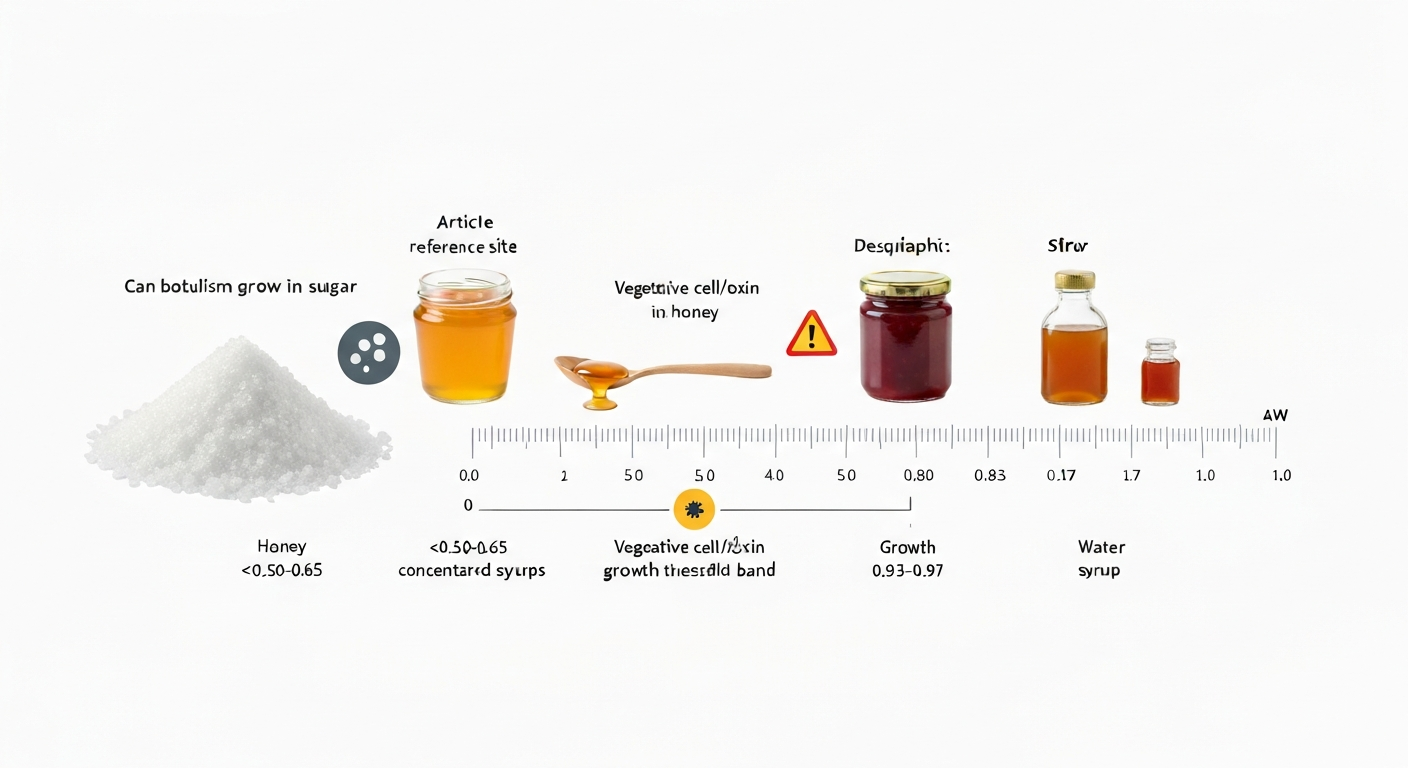
Quick reference: key thresholds and risk levels
| Sugar-containing product | Typical aw range | C. botulinum growth possible? | Spore survival possible? |
|---|---|---|---|
| Dry granulated sugar | 0.10–0.25 | No | Yes (dormant) |
| Commercial honey | 0.50–0.65 | No | Yes — infant risk via ingestion |
| Concentrated maple/corn syrup (high-Brix) | 0.80–0.87 | No | Yes |
| Standard jam/jelly (correct recipe) | 0.75–0.85, pH ≤3.5 | No (dual barrier) | Yes |
| Light or diluted syrup (>0.94 aw) | 0.94–0.99 | Possible if other barriers absent | Yes |
| Water-phase of improperly canned sweet spread | Variable, can exceed 0.94 | Possible | Yes |
C. botulinum biology: spores vs vegetative cells
C. botulinum exists in two very different states, and conflating them is the source of a lot of food-safety confusion. The vegetative cell is the active, metabolizing form that produces the botulinum neurotoxin. It is relatively fragile: it needs permissive temperature, sufficient water, the right pH, and low oxygen to thrive. Destroy or suppress the vegetative cell and you stop toxin production.
The spore is a different matter entirely. Spores are dormant survival structures that C. botulinum forms when conditions become unfavorable. They are extraordinarily heat-resistant and can persist in dry foods, soil, raw agricultural materials, and processing environments for years without causing any harm. The problem arises when a spore encounters the right conditions: it germinates into a vegetative cell, which then multiplies and produces toxin. This two-step process, dormancy, then germination, is the key to understanding why sugar creates a complicated picture rather than a simple safe-or-dangerous one.
C. botulinum is also not a single organism in terms of behavior. Group I (proteolytic) strains, types A, B, and F, are mesophilic, meaning they grow best at temperatures around 35°C and cannot grow below about 10°C. Group II (non-proteolytic) strains, many type E strains and some B and F, are psychrotrophic, capable of slow growth at refrigerator temperatures as low as 3°C. This distinction matters enormously when you consider chilled sugar-containing products.
The five environmental factors that control C. botulinum growth
No single factor operates in isolation. C. botulinum growth is controlled by a combination of conditions, and food processors exploit this with a concept called hurdle technology: stack enough inhibitory factors and growth becomes impossible even if no single hurdle alone would be sufficient.
Water activity (aw)
Water activity is the most directly relevant factor for sugar-containing foods. It measures available water on a scale of 0 to 1.0 (pure water = 1.0). Proteolytic Group I strains require a minimum aw of approximately 0.94 for growth and toxin production. Non-proteolytic Group II strains have a higher minimum, around 0.97, meaning they actually need more available water than Group I strains to grow. FDA guidance confirms the minimum aw for C. botulinum growth sits at roughly 0.93–0.94. Anything below 0.93 is reliably inhibitory to active growth.
pH
Acidity is the second major hurdle. Proteolytic strains cannot grow or produce toxin at pH 4.6 or below, this is why pH 4.6 is the regulatory dividing line between high-acid and low-acid foods in canning. Non-proteolytic strains are even more acid-sensitive, with a minimum growth pH of approximately 5.0. The interaction between pH and aw matters: when aw is already low, a slightly higher pH may still be acceptable because both barriers are operating simultaneously.
Temperature
Group I strains grow optimally near 35°C with a minimum of about 10°C. Group II strains have an optimum around 25°C and can grow, slowly, at 3°C. For more on low-temperature growth behavior, see can clostridium botulinum grow in cold temperatures. Refrigeration reliably inhibits Group I strains but is not a complete control for Group II in chilled, water-rich products. Freezing stops all growth but does not kill spores.
Oxygen
C. botulinum is an obligate anaerobe: it requires the absence of oxygen to grow. This is why the risk is highest in sealed, oxygen-depleted environments, vacuum-packed products, hermetically sealed cans and jars, oil-infused foods, and the interior of dense baked goods. For more detail on the environments in which Clostridium botulinum spores grow well, consult the section on anaerobic, low‑water‑activity, and low‑acid conditions. A syrup or jam sitting open to air is less immediately dangerous than the same product sealed in an airtight container. It is also why storage context, not just sugar content, is part of any realistic risk assessment.
Nutrients
C. botulinum, especially proteolytic strains, needs amino acids and other growth factors beyond simple sugars. Highly purified sugar solutions can be nutritionally poor substrates. Raw or less-refined sugars, honey, and syrups derived from plant materials provide a richer nutritional environment. That said, when aw and pH are already inhibitory, nutrient availability is largely a moot point.
How sugar changes the risk picture: water activity and osmotic effects
Dissolved sugars reduce water activity by binding free water molecules through osmotic and hydrogen-bonding interactions. The more sugar dissolved in a given volume of water, the lower the aw. This relationship is predictable and well-modelled for sucrose, glucose, and fructose solutions. High-Brix syrups and concentrated products exploit this principle directly.
Honey is the extreme example. Its aw commonly falls between 0.50 and 0.65, far below the 0.93 minimum for C. botulinum growth. Yet documented surveys show honey frequently contains C. botulinum spores. The honey itself does not permit germination or toxin production. The danger exists only when honey is consumed by an infant under 12 months old, whose immature gut microbiome cannot competitively suppress spore germination in the intestine. Infant botulism occurs when ingested C. botulinum spores germinate and produce toxin in the infant intestine; a healthy adult gut microbiota is generally protective against intestinal spore germination and disease Infant botulism occurs when ingested C. botulinum spores germinate and produce toxin in the infant intestine; a healthy adult gut microbiota is generally protective against intestinal spore germination and disease.. Adults with a healthy gut flora are protected by colonization resistance; infants are not.
Dry granulated sugar sits at even lower aw than honey. Refined white sugar typically sits around aw 0.10–0.25. Industrial challenge studies have confirmed that spore-forming bacteria including clostridia can persist dormant in fine granulated sugar, but the aw is so far below any growth threshold that germination simply does not occur. The risk only reactivates if the sugar is dissolved in water, raising the aw of the resulting solution into permissive territory.
The critical question for any sugar-containing food product is therefore not the sugar percentage in the formula, but the aw of the finished product as a whole. A jam with 65% sugar could still have a higher-than-expected aw if it contains substantial fruit juice or is undercooked. The water phase of the food must be assessed, not just the total sugar load.
Evidence-based control thresholds and operational targets
These are the numbers that food safety programs are built around. They come from regulatory guidance, peer-reviewed challenge studies, and expert committee reports.
| Control parameter | Group I (proteolytic) | Group II (non-proteolytic) |
|---|---|---|
| Minimum aw for growth | ~0.94 | ~0.97 |
| Minimum pH for growth | ~4.6 | ~5.0 |
| Minimum temperature for growth | ~10°C | ~3.0–3.3°C |
| Optimum growth temperature | ~35°C | ~25°C |
| Toxin inactivated by heat? | Yes — >85°C for several minutes | Yes — similar heat sensitivity |
| Spores inactivated by boiling? | No — pressure treatment needed | No — pressure treatment needed |
A critical operational point: the aw threshold is not a hard cliff but a boundary that interacts with other factors. Research published in Applied and Environmental Microbiology showed that the minimum pH for toxin production can shift depending on aw. When aw is already reduced to 0.95–0.96, a slightly higher pH may still prevent growth because both factors are operating together. This is why regulatory frameworks treat these as interacting controls, not independent absolutes, and why food safety plans should define combined limits rather than single-factor cutoffs.
For refrigeration: cooling to standard refrigerator temperatures (below 4°C) is a reliable control for Group I strains but provides only partial protection against psychrotrophic Group II strains. If a product's aw is above 0.97 and pH is above 5.0, refrigeration alone is not a complete control strategy for type E strains. This is an important consideration for chilled syrups and ready-to-use dessert sauces.
When heat treatment or pressure canning is required
The practical rule for home and commercial processing is this: if a food has a final pH above 4.6 and a water activity that supports growth, it must be pressure canned to achieve the thermal destruction of C. botulinum spores. Boiling-water bath canning does not reach the temperatures needed to destroy spores (typically 121°C for a specified time is the standard target in commercial processing). The WHO fact sheet 'Botulism, WHO fact sheet' notes that C. botulinum spores are highly heat‑resistant while the neurotoxin is heat‑labile and can be inactivated by boiling (for example, heating to >85°C for several minutes) Botulism — WHO fact sheet.
High-acid foods with pH at or below 4.6 can safely use boiling-water bath canning because the acidity itself prevents germination and toxin production from any surviving spores. Standard jams and jellies made with correct sugar-to-fruit ratios and natural fruit acidity typically fall into this safe zone, combining low pH and reduced aw as dual barriers.
The dangerous gap is low-acid, sugar-containing home-canned products: vegetable-based sweet pickles with insufficient vinegar, garlic-in-oil infusions sweetened with honey, or novelty syrups with added herbs where the pH has not been verified. In these cases, sugar alone does not provide adequate protection if the aw is above 0.93 and the pH is above 4.6. Heat treatment, specifically pressure canning at 116–121°C, is required.
- Verify the final aw of the product. If aw is at or below 0.93, C. botulinum growth is inhibited regardless of pH.
- Verify final equilibrium pH. If pH is at or below 4.6, proteolytic strains are inhibited even if aw is permissive.
- If neither threshold is met, a validated heat treatment (pressure canning or equivalent) is required.
- Do not rely on recipe-level sugar percentages alone — measure or calculate the aw of the finished product.
- For chilled products with aw above 0.97 and pH above 5.0, cold storage must be supplemented with another barrier — acid, reduced aw, or heat treatment — to address Group II strains.
- The neurotoxin itself can be inactivated by heating to above 85°C for several minutes, but this does not address spores; it only deactivates pre-formed toxin in food.
Food-by-food risk assessment
Granulated sugar
Dry granulated sugar, both refined white and raw, poses no growth risk for C. botulinum. The aw is far too low for germination or toxin production. Refined white sugar rarely yields detectable spores; raw sugar and molasses can harbor clostridial spores from soil-contaminated cane, but these are dormant. The risk does not emerge from dry sugar itself, it emerges when that sugar is incorporated into a food product whose final aw exceeds 0.93.
Honey
Honey is the most important case study for sugar and botulism. Its aw (0.50–0.65) categorically prevents C. botulinum growth. However, honey is a documented reservoir for C. botulinum spores, and the CDC explicitly advises against feeding honey to infants under 12 months for this reason. In an infant's gut, spores can germinate and produce toxin, a condition called infant botulism. Adults are not at risk through honey consumption under normal circumstances, because a healthy adult gut microbiome prevents spore colonization.
Syrups
Fully concentrated commercial syrups, high-Brix corn syrup, invert sugar syrup, commercial maple syrup, have aw values typically in the 0.80–0.87 range, well below the growth threshold. These products do not support C. botulinum growth. The risk increases with dilution. 'Light' syrups, table syrups blended with water, and diluted pancake syrups can have aw values approaching or exceeding 0.94, particularly if they lack added preservatives or acid. If such a product is then sealed in an anaerobic container, the conditions for potential growth may be present.
Jams and conserves
Standard high-sugar jams and jellies made with adequate sugar and naturally acidic fruit operate with two effective barriers: low pH (often 3.0–3.5) and reduced aw (commonly 0.75–0.85). Either barrier alone would be sufficient; together they provide a substantial safety margin. These products are not generally considered a C. botulinum risk when prepared to standard recipes. Problems arise with low-sugar or no-sugar-added jams that rely on alternative gelling agents, these may have substantially higher aw and, if the fruit or additives are also low-acid, could present a risk in sealed anaerobic jars.
Peanut butter
Peanut butter is a sugar-containing product in many commercial formulations and deserves a specific mention. Like dry sugar, peanut butter has a low aw (typically 0.70 or below) because of its low moisture and high fat content. C. botulinum does not grow in properly formulated peanut butter for the same aw-based reason. Spore survival is possible in theory, but growth and toxin production are not. This mirrors the dry-sugar situation: it is a dormancy context, not a growth context. For more detail on this point, see a focused discussion on whether can botulism grow in peanut butter.
Storage and packaging contexts that change risk
The same product stored in different packaging can carry different risk profiles. C. botulinum requires anaerobic conditions to grow, so the seal integrity and oxygen permeability of packaging are directly relevant, especially for products whose aw sits closer to the permissive threshold.
Glass jars and hermetic seals
Properly sealed glass jars with vacuum lids are the classic home-canning container and the one most associated with botulism risk in improperly processed products. The hermetic seal creates exactly the anaerobic environment C. botulinum prefers. A jar of correctly acidified, high-sugar jam with a proper vacuum seal is safe. A jar of low-acid, dilute sweet sauce with a compromised or false seal may not be, and the false vacuum created during cooling can mimic a correct seal without providing equivalent safety.
Plastic containers
Plastic containers vary enormously in oxygen permeability. Rigid HDPE or LDPE containers used for home storage of sugar products are typically not hermetically sealed and allow some oxygen exchange, which can inhibit C. botulinum. Vacuum-sealed plastic pouches and flexible retort pouches, however, create the same anaerobic conditions as glass jars and carry equivalent risks if the product inside has not been adequately processed. For more detail, see the article can botulism grow in plastic containers which discusses how oxygen permeability and sealing determine risk in plastic packaging. The container material is less important than the sealing and oxygen barrier properties.
Salt brines and comparison with sugar
Salt and sugar act similarly on water activity, both reduce aw by binding free water, but their molecular weights differ, so equal percentage concentrations of salt and sugar do not produce equal aw reductions. Saturated salt brines (about 26% NaCl) reduce aw to approximately 0.75, which is inhibitory to C. botulinum. For more detail on whether C. botulinum can grow in salt brine, see Can botulism grow in salt brine. High-sugar syrups can achieve similar or lower aw values. Traditional fermented and brined products rely on acid development as a supplementary hurdle, just as jam relies on fruit acid alongside sugar. The underlying mechanism of control, aw reduction and pH, is the same.
Plain water systems
At the opposite extreme from concentrated sugar, plain water at aw 1.0 presents no aw barrier at all. C. botulinum spores can survive in water, and if a contaminated water source is incorporated into a food product or used to dilute a concentrated syrup, the spore load carries forward. For more on the organism's behavior in aqueous environments, see can botulism grow in water. The dissolved sugar does not contribute to safety until the final product aw is verified. This is relevant to beverage manufacturers, craft syrup producers, and anyone incorporating water into a sugar-based formula: the starting spore burden from the water phase must be managed through heat treatment or other validated controls.
Practical risk summary and prevention framework
The core finding is simple: dry, concentrated sugar is not a growth environment for C. botulinum. The complexity enters when sugar is diluted, combined with low-acid ingredients, or sealed in anaerobic packaging without adequate processing. A useful mental model is to evaluate any sugar-containing product against three questions: Is the final aw below 0.93? Is the final pH at or below 4.6? If neither condition is met, has the product received a validated heat treatment sufficient to destroy spores?
- Never feed honey to infants under 12 months, regardless of source or claimed processing.
- Measure or calculate the final aw of finished sugar-containing products — recipe percentages are an estimate, not a measurement.
- Apply pressure canning to any low-acid, hermetically sealed product with aw above 0.93 and pH above 4.6.
- Treat diluted syrups and light sugar sauces as potentially permissive environments if they will be sealed and stored without refrigeration.
- Refrigeration alone is not a complete control for products with aw above 0.97 and pH above 5.0, because psychrotrophic Group II strains can grow at 3°C.
- Remember that spore survival in dry sugar does not equal growth risk — the aw must reach permissive levels before germination can occur.
- When combining multiple barriers (sugar, acid, refrigeration, preservatives), validate the combined effect rather than assuming each barrier independently meets its threshold.
FAQ
Can botulism grow in dry granulated sugar?
No — dry granulated sugar has very low water activity (aw) and does not support germination or vegetative growth of Clostridium botulinum. Spores can survive in dry sugar but remain dormant; risk of toxin production appears only if the sugar is dissolved or rehydrated to a permissive aw and other growth conditions are met.
What is the difference between C. botulinum spores and vegetative cells for sugar-related risk?
Spores are dormant, highly resistant forms that can survive drying, heat and long storage; they can be present in sugar supply chains. Vegetative cells are the active, growing, toxin‑producing form that require permissive conditions (sufficient water activity, appropriate pH, temperature, low oxygen in some contexts and nutrients). High sugar alone prevents spores from germinating into vegetative cells because aw is too low.
What water‑activity (aw) values prevent C. botulinum growth?
General evidence and regulatory guidance place the minimum aw for proteolytic (Group I) C. botulinum growth around 0.93–0.94. Non‑proteolytic (Group II) strains typically require higher aw (~0.97). Therefore foods with aw below these thresholds are not permissive for growth and toxin formation under otherwise favorable conditions.
How does acidity (pH) interact with sugar to control botulism risk?
pH is an independent hurdle. Proteolytic Group I strains are generally inhibited at pH ≤4.6 (commonly used canning safety cutoff). Non‑proteolytic strains require a slightly higher pH (≈5.0) for growth. In high‑sugar products (jams, jellies) the combination of low aw and low pH together prevents growth; if either hurdle is marginal, the other must be sufficient.
Are honey and syrups a botulism risk?
Honey frequently contains C. botulinum spores but has low aw (~0.50–0.65) that prevents growth in the product. The main risk is infant botulism if honey is fed to infants under 12 months. Fully concentrated syrups and high‑Brix syrups typically have low aw and are not permissive; diluted or ‘light’ syrups with higher aw can permit growth unless other controls (acid, preservatives, refrigeration) are present.
What about jams, jellies and preserves — do they require pressure canning to prevent botulism?
Most traditional high‑sugar jams and jellies are safe without pressure canning because their combination of high sugar (low aw) and added acid (pH often ≤4.6) prevents growth of C. botulinum. However, low‑acid fruit products, improperly acidified recipes, or products with added liquid (raising aw) may require validated thermal processing (pressure canning) to inactivate spores. Use tested recipes and follow regulatory/home‑canning guidance.
Next Article
Can Clostridium botulinum Grow in Cold Temperatures?
Learn when C. botulinum survives or grows in cold, plus food safety factors and practical risk steps for refrigerated fo