Psychrophiles do not grow best in warm temperatures. That statement is the opposite of what the science says. Psychrophiles are cold-adapted microorganisms that grow best at around 15 °C (59 °F) or lower, stop growing entirely above about 20 °C (68 °F), and have a lower growth boundary at or just below 0 °C. A halophile would grow best in highly salty environments where conditions are too saline for most other microbes. If you searched for 'psychrophiles grow best in warm temperatures' and found that claim somewhere, it is simply wrong. This guide will correct the record and then give you something more useful: a practical understanding of how cold-adapted microorganisms behave in real refrigerators, freezers, and during thawing.
Psychrophiles Grow Best in Cold Temperatures: Facts

Marcus Reeves
21 Apr 2026
What psychrophiles actually are (and what they are not)
A psychrophile is an organism that has evolved specifically to thrive in cold environments. Britannica defines them as having an optimal growth temperature at or below 15 °C, a maximum tolerable temperature of around 20 °C, and a minimum growth temperature at or near 0 °C. These organisms are found in polar soils, deep ocean sediments, and glacial ice. They are not well-adapted to warm conditions at all. Heat is essentially lethal to true psychrophiles at temperatures that humans consider mild.
What psychrophiles are not: they are not the same as cold-tolerant bacteria that happen to survive in a refrigerator. That distinction matters enormously in food safety, and most of the confusion in this area comes from mixing up psychrophiles with a related but different group called psychrotrophs. More on that distinction in a moment.
Where psychrophiles actually grow best: the real temperature numbers
Every microorganism has three key temperature thresholds: a minimum (the coldest temperature at which it can still divide), an optimum (where growth is fastest), and a maximum (above which it stops growing or dies). For psychrophiles, those numbers are tightly clustered in the cold zone.
| Temperature Threshold | Psychrophile | Psychrotroph | Mesophile |
|---|---|---|---|
| Minimum growth | At or below 0 °C | 0–7 °C | ~10–15 °C |
| Optimum growth | ≤15 °C (~59 °F) | 20–30 °C (~68–86 °F) | 25–40 °C (~77–104 °F) |
| Maximum growth | ~20 °C (~68 °F) | ~30–35 °C | ~45–50 °C |
Notice that a psychrophile's optimum is well below your refrigerator temperature target of 40 °F (4 °C). That means true psychrophiles grow, but not at their fastest, inside a typical refrigerator. They grow fastest closer to 10–15 °C, which is more like a wine cooler or a poorly controlled cold room. At typical refrigerator setpoints (2–4 °C), their growth rate slows considerably compared to that optimum, though it does not stop entirely.
Psychrophiles vs psychrotrophs vs mesophiles: why these categories matter
In food microbiology, the category you actually care most about is psychrotrophs, not true psychrophiles. Psychrotrophs are organisms whose optimum growth temperature is between 20 and 30 °C (more like room temperature) but that can still actively multiply at refrigeration temperatures as low as 0–7 °C. Psychrotrophs are the main bacteria that can still grow even in cold storage conditions. That combination makes them the real concern in cold storage. They grow slowly in a fridge, but they do grow.
Listeria monocytogenes is the textbook example. Its optimum growth temperature is 30–37 °C, and its maximum is around 45 °C, so by definition it is not a true psychrophile. But its minimum growth temperature is around −1.5 °C, which means it will multiply slowly even in a well-maintained refrigerator set at 40 °F (4 °C). That is why Listeria is treated as such a serious refrigerated-food risk. Similarly, Yersinia enterocolitica has a minimum growth temperature of about −1.3 °C and grows well at refrigerator temperatures.
Another example is Brochothrix thermosphacta, a psychrotrophic spoilage organism common in meat. Its growth range is 0–30 °C with an optimum around 20–25 °C. It rarely causes human illness, but it does cause spoilage in refrigerated meat, which is why meat storage times are limited even in cold conditions.
Mesophiles, by contrast, have an optimum around 25–40 °C and do not grow well at refrigerator temperatures at all. Mesophiles, by contrast, have an optimum around 25, 40 °C and do not grow well at refrigerator temperatures at all, since mesophiles grow best at warmer temperatures.
Mesophiles, on the other hand, generally have growth ranges that start at warmer minimums and can support growth across a broad temperature range compared with what fridges provide most mesophilic organisms can grow in a temperature range of. Most common foodborne pathogens like Salmonella and E. coli O157 are mesophiles. Refrigeration largely stops their growth, though it does not necessarily kill them.
The temperature danger zone defined by the FDA (41 °F to 135 °F, or 5 °C to 57 °C) is primarily designed around mesophilic pathogens, though cold-tolerant psychrotrophs like Listeria complicate the lower boundary.
How cold storage actually affects microbial growth in real foods
A refrigerator set at 40 °F (4 °C) or below does not create a sterile environment. What it does is slow growth rates dramatically for most organisms and stops growth entirely for mesophiles. For psychrotrophs like Listeria, however, it just slows them down. This is why time still matters in the fridge, not just temperature.
The USDA and FDA both recommend keeping refrigerators at 40 °F (4 °C) or below throughout the unit, not just near the thermostat. Warm spots, overpacking, or a door left ajar can push local temperatures into the 5–10 °C range, which accelerates psychrotrophic growth noticeably. At 8 °C instead of 4 °C, organisms like Listeria and Yersinia can grow at measurably faster rates, and EFSA research confirms that even an additional 7 days of storage at 4 °C after defrosting can lead to meaningful additional bacterial growth depending on conditions and pre-freezing history.
Thawing in the refrigerator is the safest method, but it is not zero-risk over long timeframes. USDA estimates roughly 24 hours of refrigerator thawing per 4–5 pounds of food. During that entire period, any psychrotrophic organisms present are slowly but actively multiplying, which is why the FDA Food Code caps the safe holding window for ready-to-eat refrigerated foods at 7 days after opening or preparation.
Cross-contamination during thawing is an additional concern. Drips from thawing raw meat can transfer psychrotrophic and mesophilic pathogens to other foods in the refrigerator. The FDA specifically flags drips from thawing meats as a contamination risk, which is why raw meat should always be stored on the lowest shelf, sealed, or in a container.
Food-safety steps that actually limit psychrophile and psychrotroph growth
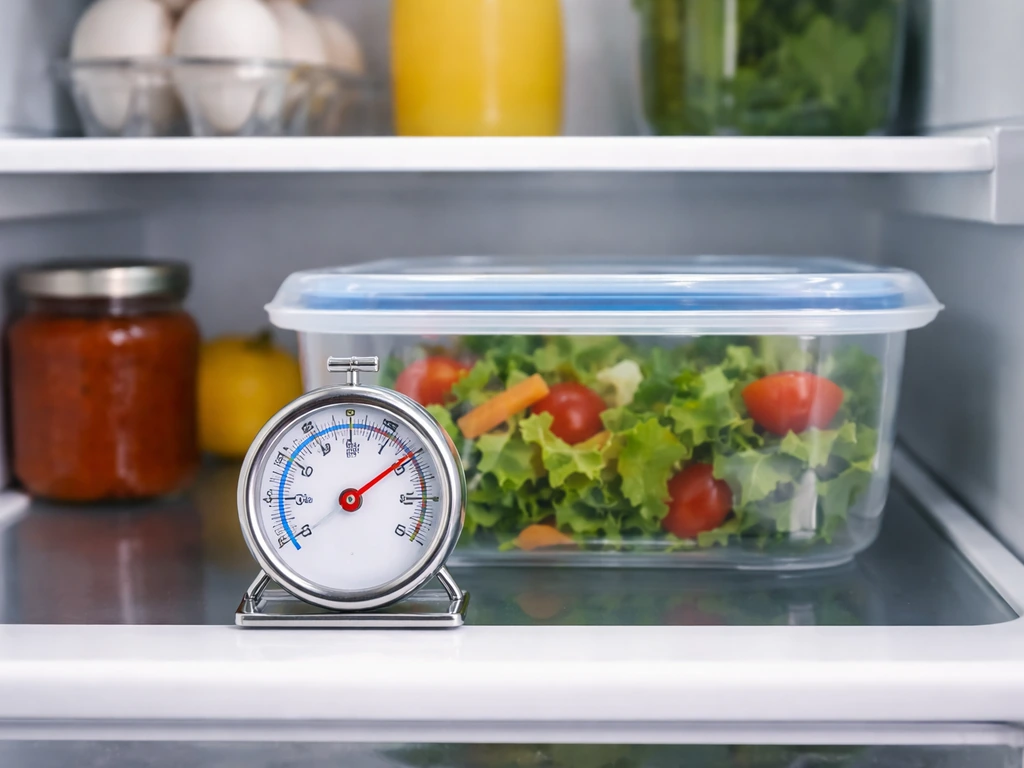
Knowing the biology translates directly into better storage habits. Here is what the evidence supports:
- Keep your refrigerator at 40 °F (4 °C) or below, measured at the warmest spot in the unit. Use a standalone appliance thermometer to verify this, because built-in displays are often inaccurate.
- Do not just set the dial and forget it. Check the thermometer periodically, especially after power outages or heavy use.
- Follow the 7-day rule for opened or prepared refrigerated foods. Even at proper temperatures, psychrotrophs like Listeria will accumulate over time. The FDA Food Code uses a 7-day discard window for most ready-to-eat foods held at 41 °F (5 °C) or below.
- Thaw in the refrigerator whenever possible, but account for thawing time and plan to use thawed food promptly. Food thawed in the refrigerator can be safely refrozen without cooking, according to USDA, though quality may decline.
- Never thaw at room temperature for extended periods. Time spent between 41 °F and 135 °F (5–57 °C) is time in the danger zone. The FDA cap is 4 hours cumulative in that range before food becomes a safety risk.
- Store raw meat on the lowest shelf in a sealed container or on a plate to catch drips. This prevents psychrotrophic and mesophilic organisms from contaminating ready-to-eat foods.
- Cool hot leftovers quickly before refrigerating. Rapid cooling to below 40 °F limits the time organisms spend in their optimal growth range. USDA recommends getting food into the safe refrigerator temperature zone as fast as possible.
How to actually verify growth vs survival at cold temperatures
If you are a microbiologist or educator trying to demonstrate or confirm whether an organism is growing (not just surviving) at a given cold temperature, the approach is straightforward. Growth means an increase in cell numbers over time. Survival means cell numbers stay roughly stable or decline slowly. The two look very different on a growth curve.
A basic temperature comparison experiment works like this: inoculate identical broth tubes or plate count agar with your organism of interest at a standardized cell concentration, then incubate replicate sets at a range of temperatures (for example: 0 °C, 4 °C, 10 °C, 15 °C, 20 °C, 25 °C, and 37 °C). Sample each set at regular intervals (e.g., every 24 hours for slow-growing cold cultures, every 4–8 hours for warmer incubations) and count viable cells by standard plate count or turbidity measurement. Plotting log CFU per mL against time at each temperature will show you the actual growth curve, not just viability.
What you are looking for: at temperatures below the organism's minimum, you will see flat or declining counts (survival, not growth). At the optimum, you will see the steepest slope in the log phase. For a true psychrophile, that peak will appear near 10–15 °C and will flatten or decline by the time you reach 20–25 °C. For a psychrotroph like Listeria, the peak will be around 30–37 °C, but you will still see a positive (growing) slope at 4 °C, just a very gentle one.
This distinction matters practically. If your 4 °C tubes show no increase in cell count over 7 days, the organism is not a cold-growth concern. If counts double or triple, even slowly, you have confirmed active growth at refrigeration temperature and that has direct implications for shelf-life and safety decisions. For food safety professionals, this kind of challenge study data is exactly what regulators expect when validating shelf-life claims for refrigerated ready-to-eat products.
Putting it all together: cold is not the same as safe
True psychrophiles grow best at cold temperatures, not warm ones. That also connects to why a related question like will a thermotropic organism grow in the direction of heat is different from psychrophile growth grow best at. That corrects the core misconception.
But the more important takeaway for food safety is that the organisms that cause real problems in refrigerated foods are mostly psychrotrophs: organisms like Listeria and Yersinia whose optimum is warmer but whose minimum is near or below freezing.
They exploit the refrigerator not because it is their ideal environment, but because it is cold enough to give them a growth advantage over competing organisms that have been slowed or stopped, while still allowing them to multiply over days and weeks.
Temperature alone is not enough. Time at temperature, proper thermometer placement, cross-contamination prevention, and respecting use-by windows are all part of a complete cold-storage strategy. The numbers here (40 °F max fridge temperature, 7-day discard window, 4-hour danger zone limit) are not arbitrary. FDA guidance on cooling and time/temperature control uses a “danger zone” approach that includes cooling from 135 °F to 70 °F and then a 4-hour cool-down window from 70 °F down to 41 °F (5 °C) or less for TCS foods 4-hour danger zone limit. They are based on the actual growth kinetics of cold-tolerant organisms, and understanding the science behind them makes them much easier to follow consistently.
FAQ
If a microbe does not grow well at 4 °C, does that mean it is harmless in the fridge?
Not necessarily. Even if an organism cannot grow at your fridge temperature, it may survive there and regrow once food warms. Also, some cells may increase slowly without obvious “turbidity” or odor change, so you cannot rely on appearance alone.
How can I tell whether “cold tolerant” microbes are the growth problem or just survival survivors?
Yes. “Psychrophile vs psychrotroph” can be misleading, because “cold-tolerant” in the news or on packaging often refers to any organism that survives cold, not one that is actively multiplying. In practice, ask whether growth is positive at your actual storage temperature, not whether it merely persists.
Why do some foods spoil faster even when my fridge is set to 4 °C?
Focus on your real operating temperatures. A true psychrophile may grow best near 10 to 15 °C, but most food risk in refrigeration comes from psychrotrophs that can still multiply at 0 to 7 °C. So the fridge setpoint matters less than avoiding warm spots that push local temperatures into the 5 to 10 °C range.
What is the best way to verify my refrigerator temperature is truly safe for cold-stored foods?
Use a calibrated probe thermometer and place it where food actually sits, not in the door or near the vent. Re-check after the fridge has been closed for a few hours (and again after loading) because warm-up during door openings and uneven air circulation can create pockets that drive faster psychrotroph growth.
If I freeze food, do I still need to worry about psychrotrophs after thawing?
Do not assume “freezing” ends the problem. Freezing typically stops growth but does not reliably kill cold-tolerant organisms. Once thawed, especially during long refrigerator thawing, psychrotrophs can resume growth, which is why thawing time windows and subsequent use-by timing still matter.
Is thawing in the refrigerator really safer if cross-contamination still happens?
Yes. Even if you thaw in the fridge, keep raw meat sealed and prevent drips. Transfer to a tray or container on the lowest shelf to reduce contamination of ready-to-eat items, because thawing liquids can carry both mesophilic and psychrotrophic pathogens to other foods.
When should the “7-day” rule start, and does it apply to every refrigerated food?
It depends on the product. Ready-to-eat refrigerated foods often have shorter holding limits than whole raw items because you are starting with lower competing flora and less heating kill. If you are tracking a 7-day “discard window,” count from the relevant event (opening or preparation), not from purchase date.
In a lab or teaching setting, what’s the simplest way to prove active growth at refrigeration temperatures?
Measuring “growth” requires viable counts over time, not just one time-point. If your only test is a single swab and culture at the end, you may miss slow-but-real multiplication. Time-series sampling (for example, multiple intervals over several days) is the practical way to distinguish survival from growth.
Does initial contamination level change how risky a “safe temperature” fridge is?
Because cold growth can be slow, the initial cell load matters a lot. Two samples at the same temperature can behave differently if one starts with much higher contamination. This is one reason regulators emphasize controlling time at temperature and preventing cross-contamination, not just chilling.
Why does thawing time and pre-freezing history sometimes seem to change the “safe” outcome?
Yes, if you are using thawed food inconsistently with temperature history. Pre-freezing conditions and thaw duration can change how many cells resume growth and how quickly. For longer thawing and for foods that warm slowly over time, growth during the refrigerator phase can be meaningfully higher than expected.
Next Article
Microorganisms That Grow Best in Warm, Moist Places
Learn which microbes thrive in warm, moist conditions and how to stop growth in kitchens, bathrooms, and food storage.