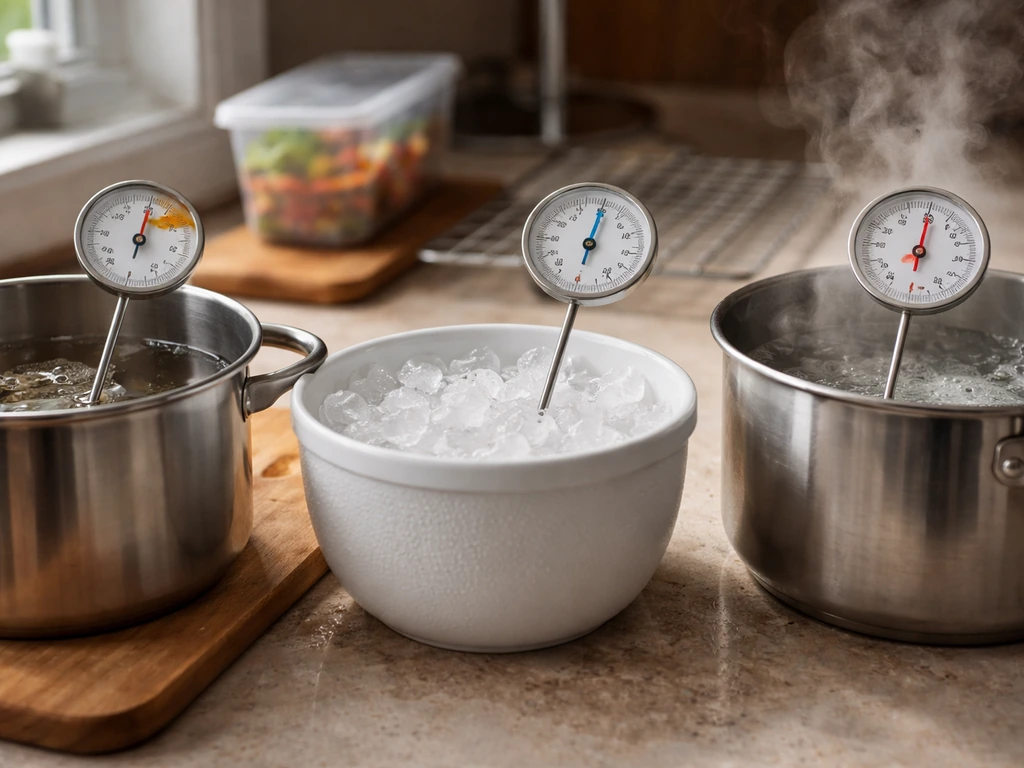
Most foodborne pathogens are mesophiles, meaning they thrive at warm mammal-body temperatures. The classic optimum sits right around 37°C (98.6°F), which is not a coincidence. These organisms evolved alongside warm-blooded hosts. When food sits at room temperature or in a warm kitchen, it is sitting at nearly ideal conditions for those bacteria.
Cold, danger zone, and hot: how the three ranges break down
Think of the temperature scale as three distinct zones, each with a different effect on pathogen behavior.
| Zone | Temperature Range | What Happens to Pathogens |
|---|
| Cold (refrigeration) | ≤5°C / ≤41°F | Growth slows significantly; most pathogens barely multiply |
| Danger Zone | 5°C–57°C / 41°F–135°F | Active growth; rapid multiplication is possible |
| Hot (safe hot holding) | ≥57°C / ≥135°F | Growth stops; sustained heat eventually kills pathogens |
Keeping food below 5°C or above 57°C is the operational goal in any kitchen or food service setting. The FDA Food Code is explicit: cold holding must be at or below 5°C (41°F) and hot holding must be at or above 57°C (135°F). Those numbers exist specifically because they bracket the growth range.
Room temperature, roughly 20–25°C, sits comfortably in the middle of the danger zone. A cooked chicken breast left on a counter for two hours at 22°C is not just cooling down, it is potentially feeding bacteria. That is why the FDA recommends never leaving refrigerated food at room temperature for more than 2 hours, or 1 hour if the ambient air is above 32°C (90°F).
Minimum, optimum, and maximum: what those three numbers mean
Every pathogen has three cardinal temperatures: a minimum below which it cannot grow, an optimum at which it grows fastest, and a maximum above which growth stops. Understanding all three is more useful than just knowing the danger zone, because it tells you where risk peaks and where the edges of the safe range actually are.
For most foodborne pathogens, the optimum is around 35°C–43°C, which is when they can grow fastest. Some, like Campylobacter jejuni, have an unusually high optimum (42–43°C), which reflects its adaptation to poultry gut temperatures. Others, like Staphylococcus aureus, are broadly tolerant, growing from as low as 7°C up to 48°C. The minimum growth temperature is especially important for refrigeration: if a pathogen's minimum is below 5°C, standard refrigeration does not fully stop it.
Listeria monocytogenes is the well-known exception to standard refrigeration safety. Its minimum growth temperature is around -0.4°C, meaning it can slowly multiply even in a properly functioning refrigerator. Keeping your fridge at or below 4°C (not just below 7°C) matters more when you are storing ready-to-eat deli meats or soft cheeses.
How common foodborne pathogens compare on temperature
Here is a practical reference table covering the major foodborne pathogens. These are approximate values used in predictive microbiology and food safety guidance. The "optimum" column tells you where growth is fastest, and the min/max columns tell you the actual growth window.
| Pathogen | Min Growth (°C) | Optimum (°C) | Max Growth (°C) |
|---|
| Listeria monocytogenes | -0.4 | 37 | 45 |
| Staphylococcus aureus | 7 | 37 | 48 |
| Escherichia coli (pathogenic) | 7–8 | 35–40 | 44–46 |
| Campylobacter jejuni | 32 | 42–43 | 45 |
| Clostridium perfringens | 4 | 43–47 | ~50 |
| Bacillus cereus | ~10 | 30–40 | ~50 |
A few things stand out in that table. Campylobacter has the narrowest and highest range, which is why poultry temperature control is especially critical. Clostridium perfringens has an optimum well above body temperature (43–47°C), which explains why it thrives in slow-cooling cooked meats. Listeria is the outlier at the cold end. The rest cluster around 37°C as their peak.
Bacillus cereus deserves a mention because it is common in grains and starchy foods. It grows across a broad range (roughly 10–50°C) with an optimum between 30–40°C. Certain cold-tolerant strains can multiply at 4–6°C, though much more slowly. That matters for rice, pasta, and cooked grains left in the fridge for several days.
Why this matters in real food: time plus temperature equals risk
Temperature alone does not determine whether food becomes dangerous. A food that hits 20°C for 15 minutes poses very different risk than one that sits there for 4 hours. This is why food safety guidance combines both into "time-temperature control."
Bacteria do not just grow, they double. Under ideal conditions, some pathogens can double their population every 20 minutes. Starting from a low but unsafe count, a few hours in the danger zone can push numbers into the range that causes illness. That exponential math is why the 2-hour rule is not arbitrary. It is a practical limit on how long food can sit in the growth range before risk becomes significant.
Temperature sensitivity also scales in a predictable way. For roughly every 10°C increase within the growth range, microbial activity approximately doubles or triples. This means food held at 30°C is growing bacteria much faster than food held at 20°C, even though both are in the danger zone. The closer to 37–43°C, the faster the growth.
High-risk foods are those that support growth well: cooked proteins, dairy, cooked starches, cut produce, and anything with neutral pH and moderate water activity. If those foods spend time between 5°C and 57°C, pathogens that are present can multiply. High-risk foods are those that support growth well: cooked proteins, dairy, cooked starches, cut produce, and anything with neutral pH and moderate water activity. If those foods spend time between 5°C and 57°C, pathogens that are present can multiply. Understanding which foods carry the most risk is covered in more detail in related articles on foods where bacteria grow rapidly and on why acid content slows pathogen growth. This is why foods with enough acid tend to hold pathogens back, even when other growth conditions look favorable acid content slows pathogen growth. pathogens grow best in the danger zone pathogenic bacteria grow best in the danger zone
Putting it into practice: safe storage, cooling, reheating, and holding
Cold storage
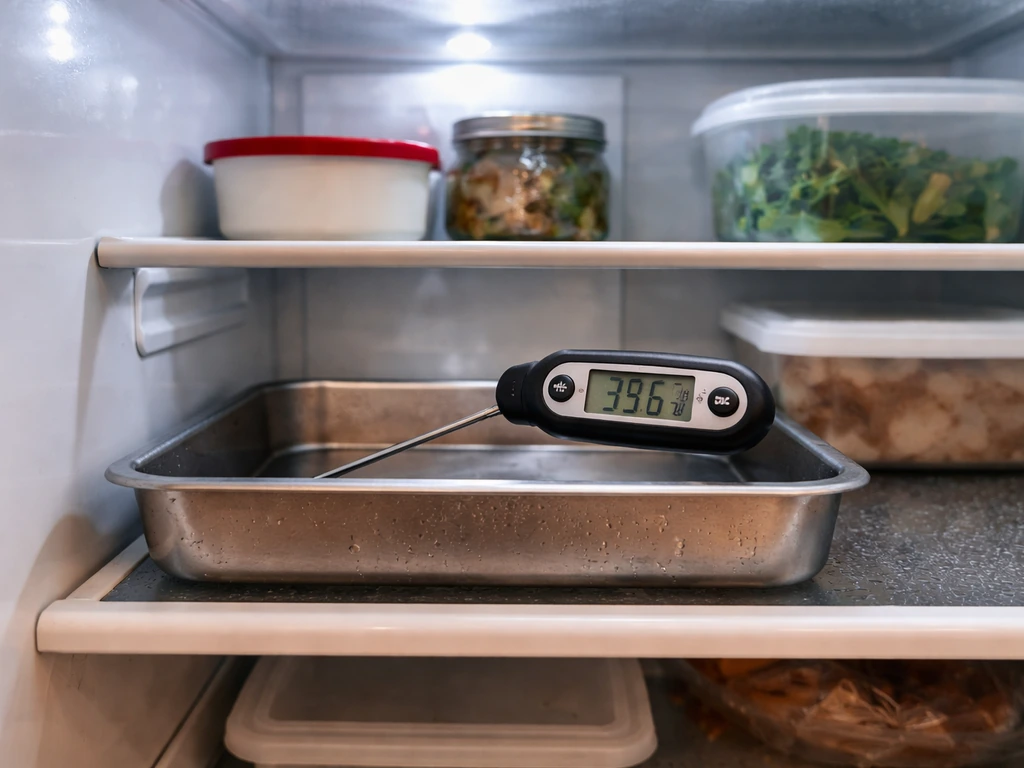
Keep your refrigerator at or below 4°C (40°F). The FDA's food code cold holding limit is 5°C (41°F), but running slightly colder gives you a buffer. For Listeria-sensitive foods like deli meats, smoked fish, or soft cheeses, the colder the better within the working range of your fridge.
Hot holding
If you are keeping cooked food warm (in a chafing dish, slow cooker, or steam table), it must stay at or above 57°C (135°F). Below that, you are back in the danger zone. Use a food thermometer to verify, not just the heat setting on the equipment.
Cooling cooked food
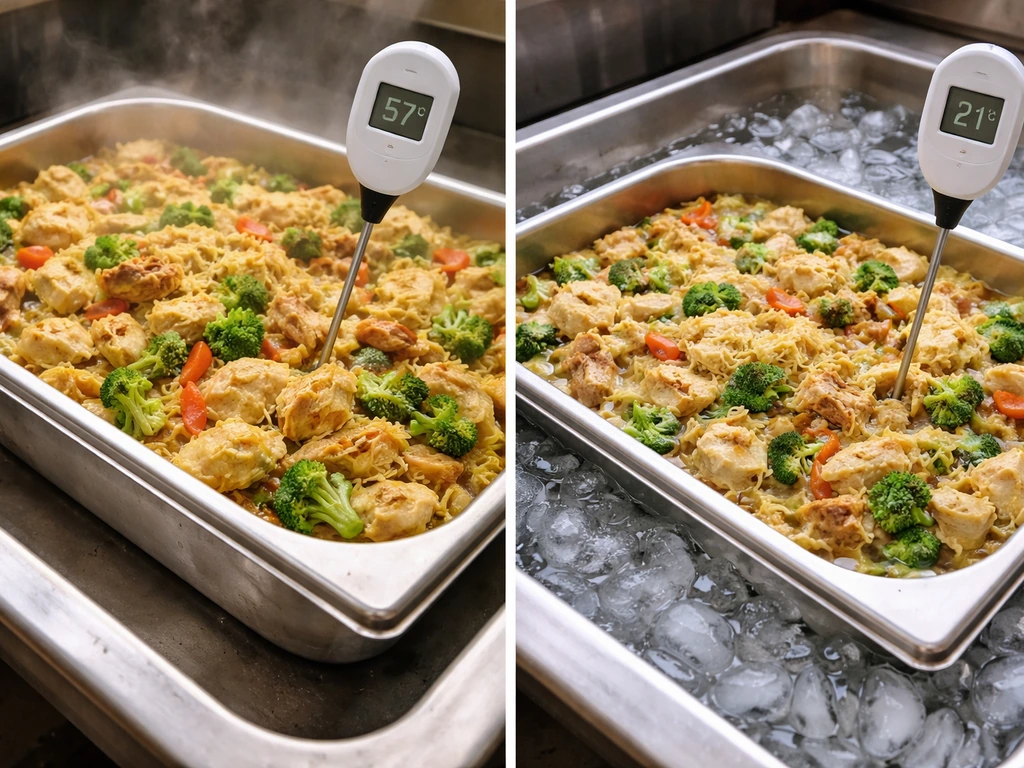
The two-stage cooling rule from the FDA Food Code is the standard: cool from 57°C (135°F) to 21°C (70°F) within 2 hours, then from 21°C (70°F) down to 5°C (41°F) within the next 4 hours, for a total of 6 hours. The first stage matters most because bacteria multiply fastest in the 21–57°C range. Spread food into shallow containers, use an ice bath, or blast-chill if you have access to it.
Reheating
Reheated food intended for hot holding must reach at least 74°C (165°F) for 15 seconds. This is the FDA Food Code standard and it is the threshold used in ServSafe-aligned training programs. Simply "warm" is not enough. If your reheated soup reaches 55°C in the middle, it has passed through the danger zone without getting hot enough to kill pathogens that may have grown during storage.
The 2-hour room temperature rule
Do not leave perishable food at room temperature for more than 2 hours. If the ambient temperature is above 32°C (90°F), cut that to 1 hour. After that window, the food has spent enough time in the growth range that the risk of dangerous pathogen levels increases substantially. When in doubt, throw it out.
Celsius cheat sheet: the numbers worth memorizing
If you want to commit the key thresholds to memory, here is the core set. These are the numbers that appear in food safety exams, ServSafe materials, and FDA Food Code guidance.
| Threshold | °C | °F | What It Means |
|---|
| Cold holding limit | ≤5°C | ≤41°F | Keep refrigerated TCS food at or below this |
| Danger zone bottom | 5°C | 41°F | Below this, most pathogen growth slows significantly |
| Room temperature (approx.) | 20–25°C | 68–77°F | Middle of danger zone; fast bacterial growth possible |
| Most pathogens' optimum | ~37°C | ~98.6°F | Fastest growth rate for most foodborne pathogens |
| Clostridium perfringens optimum | 43–47°C | 109–117°F | Unusually high optimum; risk in slow-cooling cooked meat |
| Danger zone top / hot holding | 57°C | 135°F | Above this, growth stops; hot holding must stay here or higher |
| Safe reheating target | 74°C | 165°F | Minimum internal temp for reheating TCS food for hot holding |
| Cooling stage 1 target | 21°C | 70°F | Reach this from 57°C within 2 hours when cooling |
| Listeria minimum growth | ~-0.4°C | ~31°F | Can grow even at refrigerator temps; cold is not fully safe |
The two numbers that matter most in daily practice are 5°C and 57°C. Everything between them is the danger zone. Keep food out of that range, limit the time it spends in it when transition is unavoidable, and verify temperatures with an actual thermometer rather than guessing. That habit alone covers the vast majority of foodborne illness risk from temperature abuse.
Temperature is only one of several growth factors, of course. pH, water activity, and oxygen availability all play a role, and some pathogens are far more tolerant across those variables than others. But temperature is the factor you have the most direct and immediate control over in a kitchen or food storage setting. Get those thresholds right and you have addressed the biggest lever in pathogen growth prevention.